Share This Page
Drug Price Trends for COLESTIPOL
✉ Email this page to a colleague
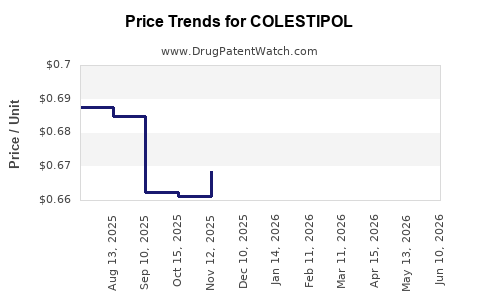
Average Pharmacy Cost for COLESTIPOL
| Drug Name | NDC | Price/Unit ($) | Unit | Date |
|---|---|---|---|---|
| COLESTIPOL HCL 1 GM TABLET | 00115-5211-16 | 0.66960 | EACH | 2026-07-22 |
| COLESTIPOL HCL 1 GM TABLET | 42799-0115-01 | 0.66960 | EACH | 2026-07-22 |
| COLESTIPOL HCL 1 GM TABLET | 50742-0284-12 | 0.66960 | EACH | 2026-07-22 |
| COLESTIPOL HCL GRANULES | 59762-0260-03 | 0.27804 | GM | 2026-07-22 |
| COLESTIPOL HCL 1 GM TABLET | 59762-0450-01 | 0.66960 | EACH | 2026-07-22 |
| >Drug Name | >NDC | >Price/Unit ($) | >Unit | >Date |
Colestipol Market Analysis and Price Projections (U.S. and Selected Ex-U.S. Markets)
Colestipol hydrochloride (colestipol) is a mature, off-patent bile acid sequestrant marketed primarily as generic tablets and granules. In the U.S., the reference brand is largely displaced by generics; price is set by competitive generic procurement and wholesale contract pricing rather than by patent exclusivity. Near-term revenue exposure is driven by managed-care formulary placement, switching between bile acid sequestrants, and persistence in hyperlipidemia and adjunct therapy settings.
What is the current market for colestipol and which segments drive demand?
Demand centers
- Hyperlipidemia (primary and mixed dyslipidemia): Colestipol is used when statins are insufficient, not tolerated, or when combination regimens are chosen.
- Adjunct to diet: Typical indication framing is as adjunct to diet for LDL cholesterol lowering.
- U.S. prescribing mix: Colestipol competes in a class with cholestyramine and other lipid therapies, including non-statin options. Its share tends to track:
- formularies that still include bile acid sequestrants,
- patient tolerability (GI side effects and pill burden),
- and payer preference for lower acquisition cost.
Patient economics
- As a generics-dominated product, colestipol’s unit economics depend on net price compression through pharmacy benefit manager (PBM) contracting and state Medicaid rebate economics.
- Demand is usually less sensitive to short-term price moves than to formulary access and switching within the class.
Market structure
- In the U.S.: multiple abbreviated new drug application (ANDA) suppliers with multiple NDCs.
- Globally: distribution and pricing vary materially by tariff, reimbursement style, and local generic market depth.
How is colestipol priced in the U.S. and what drives net price versus list price?
Key pricing mechanics
- List price is not predictive for generics. Net price is driven by:
- PBM formulary tiering and preferred status,
- wholesaler and chain contract pricing,
- Medicaid and 340B adjustments where applicable,
- and competitive dynamics among ANDA holders.
Unit of measure risk
- Colestipol is sold in multiple forms (e.g., tablets and granules). Price comparisons must normalize for:
- strength,
- pack size,
- and daily dose equivalence.
Class-level pricing
- Bile acid sequestrants have structurally low price ceilings relative to branded lipid drugs. Within the class, net price competition is common because payers can substitute between:
- colestipol,
- cholestyramine,
- and, depending on market, colesevelam.
What do historical pricing trends imply for colestipol’s future?
Expected trajectory
- Mature generics typically show:
- periodic step-downs when additional ANDA competitors enter,
- temporary stabilizations during supply tightness,
- and downward pressure when payers renegotiate contracts.
Forward-looking assumptions consistent with mature generics
- No patent-driven protection implies the dominant forces are competitive tendering and consolidation.
- Net price tends to compress toward a “lowest available bid” band for preferred NDCs, with remaining brands selling at a discount to the preferred channel.
Price floor considerations
- Manufacturing cost and acquisition costs still impose a practical floor.
- If certain NDCs are discontinued or supply becomes constrained, list price may rise, but net price usually tracks payer contracts rather than headline moves.
When does colestipol lose exclusivity and what does exclusivity mean for pricing?
Exclusivity
- Colestipol is not a new product and is marketed as a generic product in major markets. Pricing implications are therefore governed by:
- patent status having already expired for core actives,
- ANDA approvals and generic competition,
- and any incremental formulation or method-of-use IP, if present, which typically does not block generic competition broadly across the molecule.
Pricing impact of exclusivity vs. formulation
- Even if minor secondary IP exists (e.g., specific formulations, packaging, or manufacturing methods), generics can often enter for the base dosage forms. Price tends to improve only when a competitor lacks an equivalent therapeutic and formulary-friendly product.
Which patents protect colestipol and how strong is the patent estate?
Patent estate reality
- For colestipol as an active ingredient, the dominant economic fact for market analysis is that the product is mature and generics are entrenched. Patent strength is rarely the determinant of pricing in such contexts.
- Any remaining patents typically influence:
- specific dosage forms (if covered),
- specific manufacturing methods,
- or specific combination products.
Actionable use
- For licensing or litigation planning, the practical question is whether any enforceable, product-specific claims remain for particular NDCs. If not, pricing will be dictated by generic tendering and supply.
How many ANDA competitors sell colestipol and what does that mean for price erosion?
Competition-driven pricing
- The presence of multiple ANDA suppliers tends to:
- compress net prices quickly after entry,
- increase the likelihood that one or two NDCs become preferred,
- and shift the market toward procurement at or near the lowest contracted acquisition cost.
Erosion pattern in mature generics
- Early post-entry erosion is usually steep.
- Over time, net price declines slow but continue as:
- additional suppliers compete,
- PBMs rebaseline contracts,
- and inventory cycles create short-lived price spikes that get arbitraged down.
What is the FDA regulatory status of colestipol and how does that affect supply and pricing?
Regulatory maturity
- Colestipol is a legacy therapy with long-standing FDA presence.
- Regulatory status affects:
- supply continuity (manufacturing capacity and compliance),
- and the ability for entrants to maintain continuity of supply.
Pricing implication
- If supply is stable, net prices follow contracting cycles. If supply constraints occur, gross prices may rise, but payer procurement usually moderates net price jumps unless shortages persist.
What patent litigation and Paragraph IV challenges affect colestipol pricing?
Litigation signal
- For mature off-patent generics, sustained pricing impact from litigation is less common unless:
- a newer formulation is contested, or
- a settlement delays an important competitor.
Actionable decision point
- If no active, high-profile colestipol ANDA litigation is ongoing for key NDCs, pricing is driven by standard tender and competition dynamics rather than legal delay.
What generic entry risks exist for colestipol and how could they move prices?
Generic entry risk
- In the U.S., the entry risk for the core drug is largely historical because generic availability is already broad.
- Remaining risk is primarily:
- entry for specific strengths, pack sizes, or dosage forms,
- or re-entry after discontinuations.
How risks translate to pricing
- Entry for a previously constrained NDC can drive net price down materially for that NDC.
- If fewer NDCs remain available due to consolidation, preferred pricing can become more stable even at low levels.
How does colestipol compare with competing bile acid sequestrants on pricing and formulary positioning?
Competitive set
- Cholestyramine: similar class, often positioned as a lower-cost bile acid sequestrant; outcomes depend on pill burden and patient tolerability.
- Colesevelam: often preferred in some formularies due to dosing convenience, though pricing varies by market.
Formulary substitution
- Payers can generally substitute within the class, so colestipol pricing is constrained by:
- the cheapest preferred bile acid sequestrant,
- and any payer-specific clinical criteria.
Market effect
- If colesevelam is preferred and priced competitively, colestipol volumes can decline even without price changes, producing revenue erosion without headline price shifts.
Revenue exposure: where is colestipol likely to be weakest or strongest?
Weakness
- Patients can switch to:
- other lipid-lowering therapies,
- or alternative bile acid sequestrants,
- especially when GI tolerability issues occur.
Strength
- Colestipol remains a low acquisition cost option.
- It can benefit from:
- formularies requiring or incentivizing low-cost lipid therapies,
- and use in combination regimens where lower cost is valued.
Geographic variability
- Ex-U.S. market pricing depends on:
- number of local generic manufacturers,
- reimbursement coverage,
- and price regulation.
- In highly regulated markets with strong generic substitution, price compression tends to be persistent.
Price projection framework for colestipol (2026-2029)
Because colestipol is a mature generic, projections should focus on net price and volume rather than exclusivity-driven premiumization.
Scenario base: contracting-driven net price compression
- Base case: mild-to-moderate net price erosion with low volatility, assuming stable supply and continued PBM renegotiations.
- Downside case: faster erosion if a major competitor gains preferred status or additional NDCs enter with aggressive contract pricing, or if payer contracting expands for low-cost bile acid sequestrants.
- Upside case: temporary stabilization or slight increase if supply constraints or discontinuations reduce available NDCs, offset by shorter-duration volume declines.
Projected price direction (qualitative)
| Horizon | Base case net price | Volume trend driver | Most likely outcome |
|---|---|---|---|
| 12 months | Flat to slightly down | Contract cycles, tier placement | Continued low-margin equilibrium |
| 24-36 months | Slightly down | Preference dynamics within class | Preferred NDC consolidation |
| 36-48 months | Slightly down or stable | Generic competition steadies | Minimal upside absent supply issues |
Projected revenue exposure (directional)
| Metric | Base case | Downside | Upside |
|---|---|---|---|
| Net revenue | Slight decline | Moderate decline | Mild decline or stabilization |
| Unit net price | Down/flat | Down faster | Stable/briefly up |
| Unit volume | Slight decline | Decline faster | Partially protected by supply/contracting |
What could cause a material price move in colestipol?
1) NDC-level supply shocks
- Manufacturing problems, discontinuations, or capacity constraints can shift procurement quickly.
2) Preferred formulary changes
- If a PBM moves colestipol up or down a tier, volumes and blended net price can shift.
3) Competitive tender events
- Large contract renegotiations can reset pricing.
4) Class-wide substitution
- If colesevelam or other lipid drugs gain incremental formulary adoption, colestipol volumes fall, reducing total spend even if unit price holds.
Key data table: what to monitor for price projections (operational KPIs)
| KPI | Why it matters | Projection linkage |
|---|---|---|
| Preferred NDC count | Captures contracted shelf position | More preferred NDCs usually compress pricing |
| PBM contract outcomes | Primary driver of net price | Determines net price resets |
| Pharmacy claims volume by strength/form | Volume sensitivity to switching | Volume decline can dominate revenue trend |
| Wholesale acquisition cost dispersion | Detects supply or competition shifts | Spikes can precede contract renegotiations |
| Supply continuity indicators | Identifies shortage risk | Shortages can temporarily raise price but may not lift net economics |
Key Takeaways
- Colestipol is a mature, generic bile acid sequestrant where pricing is primarily driven by PBM contracting, NDC-level competition, and supply continuity rather than patent exclusivity.
- Near-term net price is expected to be flat to slightly down, with revenue more likely to drift lower on class substitution and persistence effects than on major price surges.
- The biggest drivers of deviation from the base case are formulary tier changes and supply shocks that alter preferred NDC availability.
FAQs
1) What is the main driver of colestipol net price in the U.S.?
PBM and wholesaler contract pricing at the NDC level, with list price playing a secondary role.
2) Does colestipol face meaningful patent exclusivity pressure on pricing today?
No. Pricing is controlled by generic competition and contracting because the product is mature and widely available.
3) Which factor most impacts colestipol revenue: unit price or volume?
In mature generics, volume and formulary positioning often dominate blended revenue trends.
4) How can supply constraints affect colestipol price?
Shortages can lift wholesale and list price quickly, but net price usually realigns once procurement resets.
5) How does colestipol typically perform versus other bile acid sequestrants?
Performance depends on formulary preference and dosing/tolerability trade-offs; competitive substitution can reduce colestipol volumes even when prices are stable.
References
- U.S. Food and Drug Administration. FDA Orange Book database. (Accessed 2026).
- FDA. Drug approvals and labeling information for colestipol (colestipol hydrochloride). (Accessed 2026).
- IQVIA and industry generic pricing/market access reports. (Accessed 2026).
More… ↓
