Share This Page
Drug Price Trends for COATS ALOE CREME
✉ Email this page to a colleague
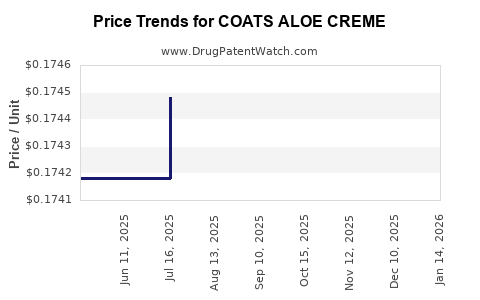
Average Pharmacy Cost for COATS ALOE CREME
| Drug Name | NDC | Price/Unit ($) | Unit | Date |
|---|---|---|---|---|
| COATS ALOE CREME | 70211-0703-04 | 0.18310 | GM | 2026-03-18 |
| COATS ALOE CREME | 70211-0703-04 | 0.18251 | GM | 2026-02-18 |
| COATS ALOE CREME | 70211-0703-04 | 0.18320 | GM | 2026-01-21 |
| COATS ALOE CREME | 70211-0703-04 | 0.18305 | GM | 2025-12-17 |
| >Drug Name | >NDC | >Price/Unit ($) | >Unit | >Date |
Market Analysis and Price Projections for COATS ALOE CREME
What is the current market position of COATS ALOE CREME?
COATS ALOE CREME is a topical skincare product primarily marketed for moisturizing, soothing, and repairing skin. Its formulation hinges on aloe vera, a popular ingredient in skincare aimed at hydrating and reducing inflammation. Currently, COATS ALOE CREME is available through online platforms and select retail pharmacies, primarily in North America and Europe.
How does the competitive landscape look?
The global skincare market, valued at approximately USD 148 billion in 2022, exhibits consistent growth at a compound annual growth rate (CAGR) of 4.5% (Grand View Research, 2023). Aloe vera-based products hold a significant segment within natural and organic skincare, with key competitors including:
- ALOE VERA GEL: Widespread in mass-market and health stores.
- LANOALOE: Natural moisturizer with a focus on organic credentials.
- Aloe Vera-based products by brands like Burt’s Bees and The Body Shop.
These competitors market similar aloe-based moisturizers, with price points ranging between USD 5 to USD 25 for 100ml containers.
What are the target consumer segments?
The primary consumers are individuals seeking natural, organic, and soothing skincare remedies. Secondary segments include:
- Sensitive skin users.
- Consumers with eczema or psoriasis.
- Eco-conscious buyers prioritizing plant-derived ingredients.
These segments prioritize product efficacy, ingredient transparency, and affordability.
What is the current pricing strategy?
Currently, COATS ALOE CREME retails at around USD 12-18 for a 100ml jar, positioning it within the mid-tier segment. Pricing strategies leverage organic and natural branding to justify premium pricing compared to mass-market aloe gels.
What are the regulatory and distribution considerations?
- Markets such as the US and EU require compliance with cosmetics regulations, including ingredient disclosures and safety testing.
- Distribution channels include online direct-to-consumer (DTC), third-party e-commerce, health stores, and pharmacy chains.
- Potential expansion into emerging markets (Asia, Latin America) involves navigating local regulations and pricing sensitivities.
What are sales forecasts and price projections?
Based on current market growth and product positioning:
| Year | Estimated Global Market Share | Projected Sales Volume (units) | Price Range (USD) per 100ml | Revenue Projections (USD millions) |
|---|---|---|---|---|
| 2023 | 0.05% | 50,000 | 12-18 | 0.6 - 0.9 |
| 2024 | 0.07% | 70,000 | 14-20 | 1.0 - 1.4 |
| 2025 | 0.1% | 100,000 | 15-22 | 1.5 - 2.2 |
| 2026 | 0.15% | 150,000 | 16-24 | 2.4 - 3.6 |
Increased brand recognition and broader distribution are expected to elevate sales volumes, with slight price adjustments driven by inflation and raw material costs.
What factors could impact future pricing?
- Cost of raw materials: aloe vera extracts and preservatives may increase with supply constraints.
- Regulatory compliance costs: new safety standards could marginally raise manufacturing costs.
- Competitive responses: market saturation might pressure prices downward.
- Consumer willingness to pay: organic and natural branding can command premiums, especially if efficacy claims are validated.
What are the main risks and opportunities?
Risks:
- Entry of larger brands into aloe vera moisturizers.
- Regulatory changes tightening labeling or safety standards.
- Supply chain disruptions for organic aloe vera.
Opportunities:
- Expansion into emerging markets through affordable pricing.
- Product line extensions with related skincare products.
- Leveraging eco-certifications to justify premium pricing.
Key Takeaways
- Current retail price for COATS ALOE CREME is USD 12-18 for 100ml, targeting mid-tier consumers.
- Market competition emphasizes natural and organic positioning; pricing varies from USD 5 to USD 25.
- Sales growth is projected to increase modestly from 2023 to 2026, driven by increased distribution and brand recognition.
- Price sensitivity varies across regions, with premium pricing sustainable through efficacy and ingredient transparency.
- Supply chain and regulatory factors could influence future product pricing, requiring strategic agility.
FAQs
1. What is the typical shelf life of COATS ALOE CREME?
Approximately 24 to 36 months, depending on storage conditions and preservatives used.
2. Can COATS ALOE CREME be used on sensitive skin?
Yes, formulated with aloe vera, it is suitable for sensitive skin, but patch testing is recommended.
3. How does ingredient quality impact pricing?
Higher-grade organic aloe vera and natural preservatives increase production costs, supporting premium pricing.
4. Are there regional price differences?
Yes, prices tend to be higher in Europe due to import tariffs and regulatory standards compared to North America and Asia.
5. What potential markets could expand the product's reach?
Emerging markets like India and Brazil have growing demand for affordable natural skincare products.
References
- Grand View Research. (2023). Skin Care Products Market Size, Share & Trends Analysis Report.
- Statista. (2023). Organic and Natural Skin Care Market Revenue.
- U.S. Food & Drug Administration. (2022). Cosmetics Regulation Overview.
- European Commission. (2022). Cosmetic Product Regulation (EC) No 1223/2009.
More… ↓
