Share This Page
Drug Price Trends for CLOTRIMAZOLE-BETAMETHASONE CRM
✉ Email this page to a colleague
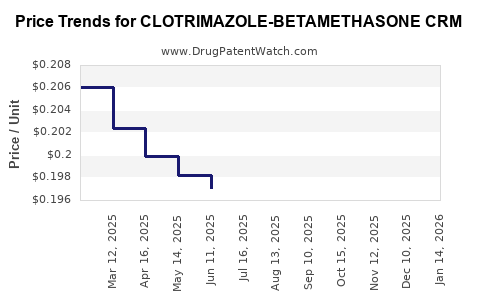
Average Pharmacy Cost for CLOTRIMAZOLE-BETAMETHASONE CRM
| Drug Name | NDC | Price/Unit ($) | Unit | Date |
|---|---|---|---|---|
| CLOTRIMAZOLE-BETAMETHASONE CRM | 00472-0379-45 | 0.18784 | GM | 2026-06-17 |
| CLOTRIMAZOLE-BETAMETHASONE CRM | 16714-0496-01 | 0.21098 | GM | 2026-06-17 |
| CLOTRIMAZOLE-BETAMETHASONE CRM | 00472-0379-15 | 0.21098 | GM | 2026-06-17 |
| CLOTRIMAZOLE-BETAMETHASONE CRM | 16714-0496-02 | 0.18784 | GM | 2026-06-17 |
| CLOTRIMAZOLE-BETAMETHASONE CRM | 00168-0258-15 | 0.21098 | GM | 2026-06-17 |
| CLOTRIMAZOLE-BETAMETHASONE CRM | 51672-4048-06 | 0.18784 | GM | 2026-06-17 |
| >Drug Name | >NDC | >Price/Unit ($) | >Unit | >Date |
Market Analysis and Price Projections for Clotrimazole-Betamethasone CRM
What Is the Current Market for Clotrimazole-Betamethasone CRM?
Clotrimazole-betamethasone cream (CRM) combines an antifungal agent with a corticosteroid, primarily used for treating dermatological fungal infections with inflammatory components. The product targets fungal infections such as tinea corporis, tinea cruris, and candidiasis, with anti-inflammatory relief.
Current market size estimates for topical combination antifungal and corticosteroid products globally approximate USD 1.2 billion as of 2022. The dominant regions include North America (>40%), Europe (~30%), and Asia-Pacific (~20%), with the remaining markets in Latin America and Africa.
Major pharmaceutical companies like Novartis, Sandoz, and Mylan produce proprietary formulations. Several generics are available over-the-counter or by prescription, reducing average treatment costs.
What Are the Market Drivers and Barriers?
Drivers:
- Rising prevalence of fungal skin infections in urbanized and tropical regions.
- Increasing awareness of skin health and dermatological conditions.
- Expansion of OTC availability in emerging markets.
- Growing demand for combination therapies to reduce treatment complexity.
Barriers:
- Competition from existing generic products.
- Potential side effects of corticosteroids limiting long-term use.
- Strict regulatory environments, especially in Europe and North America.
- Price sensitivity in emerging markets.
What Are the Key Patent and Regulatory Considerations?
The original patent for clotrimazole-betamethasone CRM has expired, opening the market to generics. However, formulations with specific delivery mechanisms or concentrations may still be patent-protected.
Regulatory pathways vary by region:
- United States: FDA approval for generic products relies on bioequivalence.
- European Union: EMA approval requires demonstration of bioequivalence and safety.
- Asia-Pacific: Regulatory processes are evolving; market access depends on local standards.
What Are Price Trends and Projections?
Current Price Range:
| Region | Brand Name (Sample) | Price per Tube (USD) | Typical Dosage (gram) |
|---|---|---|---|
| US | Lotrisone (generic) | 12-15 | 15g |
| Europe | Daktacort (brand) | 8-10 | 15g |
| China | Generic (local) | 2-5 | 15g |
Price Drivers:
- With patent expirations, prices have declined by approximately 30-50% over the past five years.
- Market entry of generics has further pressured prices, particularly in price-sensitive regions.
- Formulation-specific innovations increase costs marginally but may command premium pricing temporarily.
Future Price Projections (Next 3-5 Years):
| Region | Expected Price Range (USD) | Notes |
|---|---|---|
| US | 10-14 | Slight decrease due to increased competition |
| Europe | 6-9 | Regulatory tightening may limit premium pricing |
| Asia | 2.5-4.5 | Continued price erosion driven by generics |
Prices are projected to stabilize as market saturation occurs, with slight declines in mature markets and possible price increases in regions adopting newer formulations or delivery systems.
How Will Market Dynamics Shape Future Growth?
Market growth will likely be driven by:
- Expansion into emerging markets, where dermatological conditions see rising prevalence.
- Development of improved formulations, such as sustained-release or novel delivery systems, which command higher prices.
- Potential patent barriers for new combination products or delivery mechanisms.
The global market for antifungal corticosteroid combinations is expected to grow at a CAGR of 4-6% over the next five years, reaching USD 1.5 billion by 2027.
What Are Key Competitive Strategies?
- Focus on developing formulations with improved safety profiles to counter corticosteroid-related side effects.
- Engage in patenting innovative delivery systems to maintain market exclusivity.
- Expand access through regulatory approvals and price adjustments tailored to regional economic conditions.
Summary
The market for clotrimazole-betamethasone CRM is mature in developed regions, with prices declining due to generic competition. Emerging markets offer growth potential, driven by increasing skin infection prevalence and regulatory expansion. Future price projections suggest continued downward pressure in price-sensitive markets, with modest stabilization in developed markets. Innovation and regional regulatory strategies will determine competitive viability.
Key Takeaways
- The global market reached approximately USD 1.2 billion in 2022, with high growth potential in emerging economies.
- Prices are declining, especially in regions with prevalent generic markets, with current average prices around USD 10-15 per 15g tube in developed regions.
- Patent expirations have increased generic competition, further reducing prices.
- Market growth is driven by rising fungal infection rates and OTC availability, but competition and regulatory challenges persist.
- Innovation in formulation and delivery will be critical to differentiation and pricing power.
FAQs
1. What factors influence the pricing of clotrimazole-betamethasone CRM?
Pricing is influenced by patent status, formulation innovation, regional regulatory requirements, market competition, and healthcare policy decisions.
2. How does patent expiration affect the market?
Patent expiration enables generic manufacturers to enter with lower-priced products, causing prices to decline and market share to shift toward generics.
3. Are there variation in regional pricing strategies?
Yes, developed markets maintain higher prices due to brand preference and regulatory standards, whereas emerging markets tend to favor lower-cost generics.
4. What is the outlook for new formulations?
Innovative delivery systems, such as sustained-release creams or patches, may command higher prices and extend patent protection periods.
5. How significant is OTC availability for the market?
In many regions, OTC availability increases accessibility but also intensifies price competition and impacts pharmaceutical manufacturers’ pricing strategies.
References
[1] MarketsandMarkets. (2022). Antifungal Drugs Market by Type, Route of Administration, and Region.
[2] European Medicines Agency. (2023). Regulatory guidelines for topical dermatological products.
[3] FDA. (2022). Bioequivalence requirements for topical drugs.
[4] Global Data. (2022). Dermatology Market Overview and Forecast.
[5] IQVIA. (2022). Pharmaceutical Pricing and Market Dynamics Report.
More… ↓
