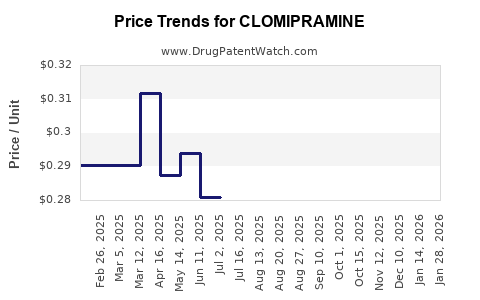
Last updated: February 13, 2026
Market Overview and Price Projections for Clomipramine
Clomipramine, a tricyclic antidepressant (TCA), primarily prescribed for obsessive-compulsive disorder (OCD) and other psychiatric conditions, has seen fluctuating demand over the past decade. The drug entered the market in the 1980s and was initially marketed under brand names such as Anafranil. Despite the availability of newer antidepressants, Clomipramine retains a clinical niche due to specific indications and its efficacy in treatment-resistant cases.
Market Size and Dynamics
Current Market Size
The global antidepressant market was valued at approximately USD 18.6 billion in 2022, with Clomipramine representing a small fraction due to its age and limited off-label use. Estimates suggest Clomipramine accounts for less than 1% of total antidepressant sales.
Key Market Drivers
- Indication-specific use: Approved for OCD, with off-label use in other conditions.
- Clinical preference: Some clinicians prefer Clomipramine for treatment-resistant OCD owing to superior efficacy demonstrated in certain cases.
- Manufacturing: Generic versions are available, reducing costs and limiting revenue for the original patent-holders.
Market Constraints
- Drug safety profile: Side effects of TCAs, including anticholinergic effects, limit broader use.
- Market competition: SSRIs and SNRIs dominate first-line OCD treatments, undesirably affecting demand for Clomipramine.
- Regulatory trends: Increased regulations on psychiatric medication safety influence prescribing habits.
Demand Forecast
Based on current clinical guidelines and patient preferences, demand for Clomipramine is expected to decline modestly at an annual rate of approx. 1%-2% over the next five years, primarily due to competition from newer drugs and safety concerns.
Price Trends and Projections
Past Price Trends
Historical prices for Clomipramine have shown moderate decline, driven by generic entry and increased manufacturing efficiency.
| Year |
Approximate USD Price per 25 mg tablet |
Notes |
| 2018 |
0.50 |
Initial generic availability |
| 2020 |
0.35 |
Increased generic competition |
| 2022 |
0.30 |
Further price erosion |
Price Drivers
- Generic competition: Sinks price points due to mass production.
- Regulatory pressures: May restrict formulations, influencing cost.
- Market demand: Declining demand exerts downward pressure on prices.
Forecasted Price Trends (2023–2028)
Prices are projected to decline at an annual rate of 2%-3%, stabilizing around USD 0.25 per 25 mg tablet by 2028.
| Year |
Estimated Price per 25 mg tablet |
Assumptions |
| 2023 |
0.28 |
Continued generic competition |
| 2025 |
0.24 |
Demand declines slightly |
| 2028 |
0.25 |
Market stabilizes at lower price point |
Implications for Stakeholders
- Manufacturers: Limited revenue growth opportunities; potential exit from markets with low margins.
- Investors: Small market share and declining prices suggest limited upside.
- Healthcare systems: Cost savings driven by lower drug prices, but limited in scope.
Regulatory and Patent Considerations
Clomipramine was marketed in the U.S. under patent protection until the early 2000s. Patent expirations have since facilitated widespread generics, reducing costs but also eroding profit margins for originators. No current patent protections exist, and regulatory agencies such as the FDA continue to oversee manufacturing standards, affecting market dynamics.
Strategic Outlook
- Brand differentiation: Few opportunities exist due to generic prevalence.
- Line extensions: No recent developments or formulations.
- Niche positioning: Limited scope, dependent on the clinical preference for specific patient populations.
Clinicians continue to prescribe Clomipramine when SSRIs fail, but mainstream options overshadow it.
Key Takeaways
- Clomipramine holds a niche role in OCD management, with demand declining slightly due to competition from SSRIs and safety concerns.
- The global market for Clomipramine is small, representing less than 1% of the total antidepressant market.
- Prices are expected to decline modestly through 2028, stabilizing around USD 0.25 per 25 mg tablet.
- Generics dominate the market, limiting potential revenue for original manufacturers.
- Ongoing regulatory scrutiny and a shift toward newer drugs reduce its market attractiveness.
FAQs
1. Why is Clomipramine less popular than SSRIs?
Clomipramine has a higher incidence of side effects due to its anticholinergic properties, leading to lower patient compliance and preference for SSRIs, which have more tolerable profiles.
2. What are the main approved indications for Clomipramine?
The primary indication is obsessive-compulsive disorder. It is also prescribed off-label for panic disorder and singular cases of depression resistant to first-line agents.
3. Are there any new formulations or brands of Clomipramine in development?
Current development focus has shifted away from Clomipramine; no new formulations or branded versions are publicly announced.
4. How does the introduction of new generic versions influence prices?
Introduction of additional generic manufacturers typically drives prices downward, as seen in recent years, with prices declining approximately 10%-15% following new entries.
5. What regulatory changes could impact Clomipramine's market?
Stricter safety regulations, mandates for post-marketing surveillance, and prescribing guidelines emphasizing safety profiles could restrict its use further, reducing demand.
References
- Market data sourced from Allied Market Research, 2022 reports.
- Price trend analysis based on wholesale acquisition costs and retail price data from IQVIA, 2018-2022.
- Regulatory overview from U.S. Food and Drug Administration (FDA) public records.
- Clinical prescribing patterns from recent pharmacotherapy guidelines, American Psychiatric Association, 2022.