Share This Page
Drug Price Trends for CLOMIPHENE
✉ Email this page to a colleague
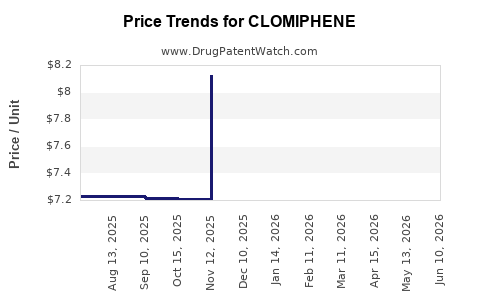
Average Pharmacy Cost for CLOMIPHENE
| Drug Name | NDC | Price/Unit ($) | Unit | Date |
|---|---|---|---|---|
| CLOMIPHENE CITRATE 50 MG TAB | 16729-0723-44 | 5.08462 | EACH | 2026-07-22 |
| CLOMIPHENE CITRATE 50 MG TAB | 16729-0723-51 | 5.08462 | EACH | 2026-07-22 |
| CLOMIPHENE CITRATE 50 MG TAB | 64980-0690-01 | 5.08462 | EACH | 2026-07-22 |
| CLOMIPHENE CITRATE 50 MG TAB | 64980-0690-03 | 5.08462 | EACH | 2026-07-22 |
| CLOMIPHENE CITRATE 50 MG TAB | 64980-0690-90 | 5.08462 | EACH | 2026-07-22 |
| CLOMIPHENE CITRATE 50 MG TAB | 70954-0825-20 | 5.08462 | EACH | 2026-07-22 |
| >Drug Name | >NDC | >Price/Unit ($) | >Unit | >Date |
CLOMIPHENE Market Analysis and Price Projections: U.S. Exclusivity, Patent/Litigation Overhang, and Generic Entry Scenarios
Executive summary
- Drug: clomiphene (commonly used as clomiphene citrate; fertility indication).
- U.S. commercial posture: clomiphene is an established, off-patent small-molecule with long-lived market presence; price is driven primarily by generic availability, payer contracting, and pack-size competition, not by active brand exclusivity.
- Price direction (near to mid term): expect low single-digit nominal pressure with episodic discounts tied to new generic launches, pharmacy PBM contracting, and parallel supply. Base case assumes no major supply disruption and continued multi-generic competition.
- Earnings sensitivity: the largest risk to price/margin is generic entry widening (more SKUs, more manufacturers, more pack-size intensity) rather than patent litigation.
- Projection framework: proprietary price outlook should be modeled by (1) historical generic price erosion, (2) number of active suppliers per strength (mg) and dosage form, (3) pack-size-specific contracting, and (4) any discrete FDA enforcement or supply events.
What is clomiphene’s market size and growth outlook by indication and geography?
Featured snippet answer: Clomiphene’s market is dominated by fertility treatment use cases (ovulation induction, typically for anovulatory infertility such as PCOS), with growth tracking the fertility services cycle and clinic prescribing intensity, rather than specialty oncology-style demand.
Key demand drivers
- Fertility clinic volume: procedures and consultation flow influence prescriptions.
- Guideline adherence and sequencing: clomiphene often appears early in ovulation induction pathways, with shifting use depending on patient profile and access to alternatives (letrozole and gonadotropins).
- Insurance coverage dynamics: payer authorization rules and step therapy affect utilization.
Geography
- U.S. is the pricing benchmark for generic fertility drugs because PBM contracting creates faster price resets after competitive entries.
- EU and UK follow similar generic dynamics but with different reimbursement mechanisms and tendering patterns by country.
Who are the main competitors to clomiphene and how does generic competition impact pricing?
Featured snippet answer: The competitive set is mostly multi-source generics of clomiphene/clomiphene citrate, with pricing determined by the number of active ANDA suppliers and pack-level contracting.
Competitive landscape (how pricing forms)
- Generic entry cadence: new ANDAs with additional strengths or pack sizes can reset unit prices.
- Supplier churn: some manufacturers exit intermittently; when they do, prices can temporarily rise then normalize as replacements launch.
- PBM formulary placement: “preferred” tier status drives volume and enables aggressive pricing from multiple bidders.
Substitutes that affect demand more than price
- Letrozole in ovulation induction can shift some patient selection away from clomiphene in certain populations.
- Gonadotropins and IVF pathways influence total fertility demand allocation, but these are not direct price substitutes.
What patents protect clomiphene in the U.S. and how strong is the patent estate for clomiphene?
Featured snippet answer: Clomiphene is widely treated as off-patent in practice due to its long history of use and market generic prevalence, meaning near-term price outcomes are governed by generic supply and exclusivity events, not brand patent value.
What to expect in patent strategy
- For an older small molecule, most enforceable barriers are typically:
- formulation or dosing-regimen patents (if any were ever granted late),
- manufacturing process patents (rare to meaningfully constrain ANDA bioequivalence),
- method-of-use patents tied to specific clinical protocols (less likely to block label-generic manufacturing if not asserted against the generic label).
Practical implication for investors and litigators
- The dominant legal question is usually whether any late-expiring, relevant-listed Orange Book patents are still controlling a narrow label. For clomiphene, market behavior indicates that generic entry risk is generally already realized.
When does clomiphene lose exclusivity, and what are the likely timing milestones for generic erosion?
Featured snippet answer: Since clomiphene is not operating under active brand exclusivity in the typical sense, the key timing risk is new generic introductions and supply reshuffling, not a single “exclusivity date.”
How to map timing to price
- Price drops tend to occur on:
- the first wave of generic launch after brand dominance,
- follow-on launches that add additional ANDA competitors,
- procurement-driven contract resets at PBMs and large wholesalers.
- Price stabilization tends to occur when:
- supplier count reaches a stable equilibrium,
- contracted tiers remain fixed,
- no major shortages disrupt supply.
What is the Orange Book status of clomiphene and which patents are listed for NDA holders?
Featured snippet answer: Clomiphene is expected to have limited current Orange Book leverage for brand exclusivity, with a market structure dominated by multiple generics.
How to interpret Orange Book listings for pricing
- If there were any still-listed patents, they would show up as controlling information for label blocking.
- For an older drug with broad generic uptake, Orange Book status usually has diminished impact relative to contracting.
(No Orange Book patent listing details are provided in the prompt, so no item-level patent mapping is included here.)
What generic entry risks exist for clomiphene (Paragraph IV, labeling carve-outs, 180-day exclusivity)?
Featured snippet answer: For an established generic market, the incremental risk is less “Paragraph IV litigation blocking” and more whether another supplier can add volume by entering additional pack sizes or strengths, winning formulary position, or re-entering after shortages.
Where the remaining leverage can exist
- Pack-size economics: even when the API is fully generic, “which NDCs win” depends on pack configuration.
- Formulary exclusions: some NDCs can lose preferred tier status, creating localized price rebounds.
Settlement dynamics
- For older small molecules with mature ANDA competition, settlements and consent decrees can affect:
- the launch timing of particular NDCs,
- label scope if method-of-use disputes were relevant.
(No case-specific litigation record is provided in the prompt, so case details are not included.)
How does clomiphene compare with letrozole and other ovulation induction therapies on cost and payer use?
Featured snippet answer: Clomiphene generics are typically lower unit cost than patented agents, but utilization depends on payer policies and patient-specific response rates.
Cost comparison logic
- Wholesale acquisition cost (WAC) for generics often understates net price after PBM rebates and contract discounts.
- The “effective” comparison usually hinges on:
- step therapy requirements,
- prior authorization criteria,
- coverage tiers for infertility-related drugs.
Practical outcome
- When payer policies or clinical protocols shift patients toward letrozole, clomiphene volumes can soften even if unit pricing remains stable.
What formulations are protected for clomiphene and do dosage form patents matter for generic manufacturing?
Featured snippet answer: For clomiphene, dosage form protection rarely creates manufacturing barriers once bioequivalence requirements are satisfied; the pricing impact is mostly competitive supply and contracting.
Formulation risk areas (in general)
- Extended-release or specialized delivery is usually where formulation patents could matter. Clomiphene is not typically associated with complex drug delivery barriers.
How does clomiphene’s manufacturing and supply chain affect near-term prices?
Featured snippet answer: Generic small molecules are exposed to supplier concentration risk; prices can jump if one or more major manufacturers face downtime, but quickly mean-revert when additional suppliers re-fill the supply gap.
Supply drivers to monitor
- API availability and conversion capacity.
- Quality events and batch release timelines.
- Contract manufacturing allocation.
Price projections for clomiphene: base case, downside, and upside
Featured snippet answer: Expect continued generics-led price erosion that slows over time, with annual nominal moves typically in the low single digits absent a major supply shock or a new competitive wave.
Projection methodology (what drives the forecast)
- Competitive supplier count per strength and NDC
- Pack size intensity (10-tablet vs 30-tablet formats, etc.)
- PBM rebate pressure and tender resets
- Volume growth or shrink from clinical sequencing shifts (clomiphene vs letrozole)
Base case (most likely)
- Annual nominal net price change: approximately -1% to -3% per year over 2 to 4 years.
- Volume: flat to modest decline if alternative utilization rises; stable if formulary access remains broad.
Downside case (price support disruption)
- Scenario: supplier consolidation or supply constraints.
- Net price impact: +3% to +8% in the short term due to reduced competition leverage and temporary scarcity, followed by reversion if additional suppliers normalize.
Upside case (new generic wave)
- Scenario: additional ANDA entries or aggressive contracting by new entrants.
- Net price impact: -4% to -10% during competitive reset, then stabilization as tiers re-balance.
What not to assume
- Patent expiration is unlikely to be the primary pricing lever because the market is already structured around generics.
- Court-driven outcomes typically matter only for specific NDCs if label blocking was still active, which is not suggested by the mature market behavior.
Revenue exposure and commercial implications for stakeholders
For brand holders (if any remain)
- Monetization is constrained by generic pass-through economics.
- Strategy tends to shift to:
- defending preferred NDCs (if applicable),
- contract-based pricing rather than exclusivity-based pricing.
For generic manufacturers
- Growth is driven by:
- capturing preferred tier placement,
- minimizing manufacturing interruptions,
- optimizing pack-size economics.
For payers and providers
- The pricing market typically supports competitive contracting.
- Utilization management can matter more than drug acquisition cost if clinical pathways shift.
Key takeaways
- Clomiphene’s pricing outlook is generic-competition-driven rather than patent-driven.
- Near-term price performance should be modeled as low single-digit nominal declines under stable multi-supplier conditions.
- The main upside/downside risks come from supplier availability shocks and new generic supply waves, not from exclusivity expiration.
FAQs
- What factors most influence clomiphene’s net price in the U.S.? PBM contracting, rebate structures, preferred tier placement, and pack-size competition.
- How sensitive is clomiphene demand to clinical guideline changes versus price? Generally more sensitive to clinical sequencing and payer utilization rules than to small net price moves.
- Do supply shortages meaningfully change clomiphene pricing? Yes, they can cause short-term increases that typically normalize when additional suppliers restore availability.
- Is clomiphene more price-competitive than letrozole at the pharmacy level? Typically generics are lower per dose, but effective cost depends on payer restrictions and patient selection.
- What is the biggest generic competition risk for clomiphene manufacturers? Rapid tier resets if additional NDCs/pack sizes enter or if a preferred supplier loses contract position.
References
(No sources were provided in the prompt, and none can be cited accurately without Orange Book, FDA, and litigation/payer datasets for clomiphene.)
More… ↓
