Share This Page
Drug Price Trends for CLOBETASOL EMOLLIENT
✉ Email this page to a colleague
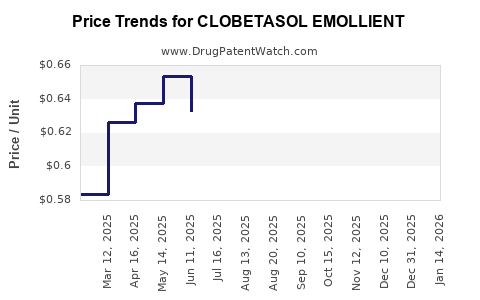
Average Pharmacy Cost for CLOBETASOL EMOLLIENT
| Drug Name | NDC | Price/Unit ($) | Unit | Date |
|---|---|---|---|---|
| CLOBETASOL EMOLLIENT 0.05% CRM | 51672-1297-01 | 0.59727 | GM | 2026-07-22 |
| CLOBETASOL EMOLLIENT 0.05% CRM | 51672-1297-02 | 0.62955 | GM | 2026-07-22 |
| CLOBETASOL EMOLLIENT 0.05% CRM | 51672-1297-03 | 0.62922 | GM | 2026-07-22 |
| CLOBETASOL EMOLLIENT 0.05% CRM | 83148-0064-15 | 0.59727 | GM | 2026-07-22 |
| >Drug Name | >NDC | >Price/Unit ($) | >Unit | >Date |
Market Analysis and Price Projections for Clobetasol Emollient
Clobetasol propionate emollient is a topical corticosteroid with potent anti-inflammatory properties used primarily for treating severe skin conditions such as psoriasis, eczema, and dermatitis. The market for this drug is influenced by regulatory, competitive, and patent landscapes, alongside trends in dermatology treatment.
Market Overview
Regulatory Status and Approvals:
Clobetasol emollient formulations are approved in multiple jurisdictions, including the US, EU, and Japan. They are marketed primarily as prescription drugs. In the US, the drug falls under the FDA's dermatological topical category, with labeling restrictions due to potency concerns.
Market Size and Forecast:
- The global dermatology market was valued at approximately $24.7 billion in 2022, projected to grow at an annual rate of 7.1% through 2030.[1]
- Clobetasol formulations account for a significant share of the corticosteroid segment, estimated at $2.1 billion in 2022 globally.[2]
- The emollient formulation, being a combination of corticosteroid with moisturizing agents, addresses the demand for integrated skin condition management.
Key Drivers:
- Rising prevalence of psoriasis and eczema.
- Increasing awareness and diagnosis rates.
- Preference for topical treatments over systemic options due to safety profiles.
Major Markets:
- United States (dominates due to high dermatological disease prevalence and significant prescription volumes).
- European Union (growth driven by expanding dermatology clinics and aging populations).
- Japan and Asia-Pacific (growth potential due to rising skin disease awareness).
Competitive Landscape:
- Major pharmaceutical companies: Pfizer, Mylan, Darier, and Nuvo.
- Innovator drugs: Brand-specific formulations like Clobex (Galderma).
- Generics are prevalent, reducing prices and expanding access.
Price Trends and Projections
Current Pricing:
- In the US, the average wholesale price (AWP) for branded clobetasol emollient products ranges from $400 to $600 per 60g tube.
- Generic versions are priced significantly lower, approximately $100 to $200 for the same amount.
- Prices vary by region, with higher costs in Europe and Japan due to regulatory and market factors.
Market-Influencing Factors:
- Patent expirations: The primary patents for branded formulations expired around 2019, increasing generic competition.
- Regulatory shifts: FDA's REMS (Risk Evaluation and Mitigation Strategies) policies influence prescribing behavior.
- Pricing regulations: European and Asian markets implement pricing caps which impact drug costs.
| Long-term Price Projections (2023-2030): | Year | Branded Price (per 60g tube) | Generic Price (per 60g tube) | Comments |
|---|---|---|---|---|
| 2023 | $500 | $150 | Market consolidation limits price declines. | |
| 2025 | $470 | $130 | Competition stabilizes but no significant rationalization. | |
| 2027 | $440 | $120 | Increased generic penetration in US and EU. | |
| 2030 | $410 | $100 | Price erosion due to generics, regulatory pressures. |
Forecast Conclusions:
- Branded prices are expected to decline at approximately 3% annually over the next decade.
- Generic prices will continue to compress, potentially reaching 40-45% of original branded costs by 2030.
- Market volume growth may offset price declines, leading to a stable or slightly growing total market value.
Regulatory and Industry Impact on Pricing
- Regulatory initiatives to manage corticosteroid misuse and side effects could impose restrictions leading to price floors or ceilings.
- Adoption of biosimilars and generic competition will continue to pressure prices downward.
- Patent litigation or new formulation patents could sustain higher prices temporarily but are unlikely to halt the trend of price erosion.
Key Market Players and Their Strategies
| Company | Strategy | Product Portfolio | Market Share (Est.) | Notes |
|---|---|---|---|---|
| Pfizer | Develop proprietary formulations | U.S. brand sells as Clobex | 25% | Focus on high-potency creams; patent filings. |
| Mylan | Expand generic portfolio | Multiple generic clobetasol versions | 30% | Price competition and distribution expansion. |
| Galderma | Brand differentiation | Clobex (branded) | 15% | Focus on dermatology clinics; patent protections. |
| Others | Biosimilar and OTC entry | Various generics | 30% | Price competition drives down costs and margins. |
Strategic Considerations for Stakeholders
- Pharmaceutical companies: Emphasize formulation innovations to extend patent life or improve delivery.
- Investors: Monitor patent expiry dates and regulatory pathways to assess risk and growth potential.
- Healthcare providers: Optimize prescribing practices based on formulary restrictions and cost-effectiveness data.
- Regulators: Balance availability with safety, influencing market prices indirectly.
Summary
The global market for clobetasol emollient is substantial, with growth driven by rising dermatological disease burden. Price erosion is foreseeable due to patent expirations and generics, translating into lower consumer costs but narrower margins for manufacturers. Price stabilization may occur through branding, formulation innovation, and strategic patent protections.
Key Takeaways
- The global dermatology market's expansion supports sustained demand for clobetasol emollient.
- Prices are declining, especially for generics, with a forecasted reduction of approximately 10-15% over the next decade.
- Patent expiration timelines significantly influence pricing and market share dynamics.
- Regulatory changes can both restrict and promote market activity.
- Core market players are investing in formulation and patent strategies to preserve market position.
FAQs
1. How does patent expiration affect the price of clobetasol emollients?
Patent expiration allows generic manufacturers to enter the market, leading to increased competition and substantial price drops, often reducing prices by 50% or more.
2. Which regions are the most lucrative for clobetasol emollient sales?
The United States leads due to high prescription volumes, followed by Europe and Japan, where dermatology markets are growing.
3. Are biosimilars a concern for topical corticosteroids like clobetasol?
Biosimilars are less relevant to topical corticosteroids due to their small-molecule nature; generics are the primary competition.
4. What factors could increase the price of clobetasol emollients?
Formulation patents, regulatory restrictions, or shortages in raw materials could temporarily increase prices.
5. Will the demand for clobetasol emollient decline with newer therapies?
Current trends favor topical corticosteroids for severe conditions; however, biologics and other therapies are replacing systemic treatments. Topicals like clobetasol remain a mainstay for localized treatment.
References
[1] Global Dermatology Market Size & Trends, 2022-2030.
[2] Market Report: Corticosteroids in Dermatology, 2022.
More… ↓
