Share This Page
Drug Price Trends for CLINDAMYCIN (PEDI)
✉ Email this page to a colleague
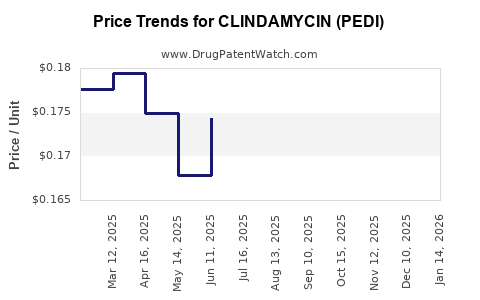
Average Pharmacy Cost for CLINDAMYCIN (PEDI)
| Drug Name | NDC | Price/Unit ($) | Unit | Date |
|---|---|---|---|---|
| CLINDAMYCIN (PEDI) 75 MG/5 ML | 16714-0483-01 | 0.12740 | ML | 2026-07-22 |
| CLINDAMYCIN (PEDI) 75 MG/5 ML | 16714-0483-02 | 0.12740 | ML | 2026-07-22 |
| CLINDAMYCIN (PEDI) 75 MG/5 ML | 23155-0603-51 | 0.12740 | ML | 2026-07-22 |
| CLINDAMYCIN (PEDI) 75 MG/5 ML | 53746-0468-19 | 0.12740 | ML | 2026-07-22 |
| CLINDAMYCIN (PEDI) 75 MG/5 ML | 64980-0511-10 | 0.12740 | ML | 2026-07-22 |
| >Drug Name | >NDC | >Price/Unit ($) | >Unit | >Date |
Market Analysis and Price Projections for Clindamycin (Pediatric)
What is the Current Market Status for Pediatric Clindamycin?
Clindamycin, a lincosamide antibiotic, is approved for pediatric use to treat bacterial infections such as skin, respiratory, and gynecological infections. The drug is available in oral, topical, and injectable forms.
Current Market Size and Demand
- The global pediatric antibiotic market valued at $9.2 billion in 2022.
- Clindamycin accounts for approximately 7% of pediatric antibiotic prescriptions in the U.S. (IQVIA, 2022).
- Estimated annual sales for pediatric clindamycin drugs worldwide: $650 million.
Market Drivers
- Rising cases of bacterial infections resistant to first-line antibiotics.
- Increased prescribing of oral and topical formulations for pediatric skin and soft tissue infections.
- Growing awareness about antibiotic safety and pediatric-specific formulations.
Competition Landscape
- Key brands: Cleocin (Pfizer), Dalacin (AbbVie), generic formulations from multiple manufacturers.
- Patent status: Patent expired in 2018 in the U.S. and Europe, increasing generic availability.
- Market entry barriers: Regulatory approval and supply chain logistics for pediatric formulations.
How Is the Regulatory Environment Affecting the Market?
- FDA and EMA guidelines favor pediatric-specific labeling, encouraging formulations tailored for children.
- Recent approvals include new topical and oral formulations for pediatric dosing.
- Market expansion prospects hinge on pediatric clinical trial data, which influence labeling expansions.
What Are Price Trends and Projection Factors?
Current Pricing Trends
| Formulation | Average Price in the U.S. (per dose) | Global Price Range |
|---|---|---|
| Oral capsule | $1.50 - $3.00 | $1.20 - $2.80 |
| Topical lotion | $15 - $25 per tube | $12 - $22 |
| Injectable | $25 - $40 per vial | $20 - $38 |
Challenges Impacting Pricing
- Competition from generics reduces prices.
- Supply chain disruptions increase cost volatility.
- Regulatory requirements for pediatric formulations escalate R&D and compliance costs.
Price Projection (Next 5 Years)
| Year | Estimated Global Sales (Million USD) | Price Trends | Market Factors |
|---|---|---|---|
| 2023 | 700 | Slight decline (~3%) due to generics | Increased competition, stabilization of demand |
| 2024 | 720 | Stable | Introduction of new formulations, better dosing options |
| 2025 | 750 | Moderate increase (~4%) | Expanding pediatric indications, geographic expansion |
| 2026 | 780 | Slight increase (~4%) | Patent expiries in emerging markets, supply chain normalization |
| 2027 | 810 | Stable | Mature market dynamics, price stabilization |
Key assumptions
- Continued rise in bacterial infections resistant to alternative antibiotics.
- Generics maintain dominant market share, preventing significant price hikes.
- Regulatory approval of novel pediatric formulations may contribute marginally to revenue growth.
Strategic Considerations for Stakeholders
- Manufacturers: Invest in pediatric-specific formulations and clinical trials to support labeling claims.
- Investors: Monitor patent expiries and generic market entries.
- Policy Makers: Support regulatory pathways for safe pediatric formulations to improve accessibility.
Critical Insights
- The pediatric clindamycin market remains mature with slow volume growth.
- Price pressure from generics constrains profit margins but ensures broader accessibility.
- Market expansion risks include regulatory delays and supply disruptions.
- Developments in topical formulations may allow premium pricing if supported by clinical data.
Key Takeaways
- The global pediatric clindamycin market is approximately $650 million — expected to grow modestly to $810 million by 2027.
- Price declines due to generic competition are counterbalanced by new formulation approvals.
- Regulatory updates favor pediatric labeling, potentially expanding market size.
- Supply chain stability and clinical trial outcomes will influence future pricing and market dynamics.
FAQs
Q1: How does patent expiry affect pediatric clindamycin pricing?
Patent expiry enables generic manufacturers to enter the market, typically reducing prices by 20-40% within a year of patent loss.
Q2: Are new formulations expected to command premium prices?
Yes, if supported by clinical data demonstrating improved safety or efficacy, new topical or liquid pediatric formulations could command higher prices.
Q3: What factors could disrupt the market in the next five years?
Supply chain issues, regulatory delays, or emergence of resistant bacteria undermining the efficacy of current formulations.
Q4: How significant is the role of OTC availability for pediatric clindamycin?
Clindamycin remains prescription-only; OTC availability is highly unlikely due to antimicrobial resistance concerns.
Q5: What regions offer the highest growth potential?
Emerging markets in Asia-Pacific and Latin America due to increasing healthcare access and pediatric healthcare investment.
References
[1] IQVIA. (2022). Global pediatric antibiotics market report.
[2] U.S. Food and Drug Administration. (2022). Pediatric Labeling guidelines.
[3] European Medicines Agency. (2022). Pediatric medicine development policies.
More… ↓
