Share This Page
Drug Price Trends for CLIND PH-BENZOYL PERO
✉ Email this page to a colleague
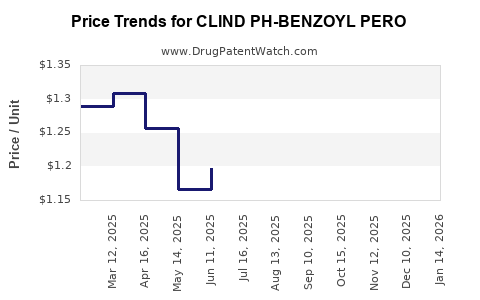
Average Pharmacy Cost for CLIND PH-BENZOYL PERO
| Drug Name | NDC | Price/Unit ($) | Unit | Date |
|---|---|---|---|---|
| CLIND PH-BENZOYL PERO 1.2-2.5% | 45802-0597-01 | 0.76678 | GM | 2026-06-17 |
| CLIND PH-BENZOYL PERO 1.2-2.5% | 21922-0074-40 | 0.76678 | GM | 2026-06-17 |
| CLIND PH-BENZOYL PEROX 1.2-5% | 72603-0322-01 | 0.40299 | GM | 2026-06-17 |
| >Drug Name | >NDC | >Price/Unit ($) | >Unit | >Date |
Market Analysis and Price Projections for CLIND PH-BENZOYL PERO
What Is CLIND PH-BENZOYL PERO?
CLIND PH-BENZOYL PERO is a topical medication combining clindamycin phosphate and benzoyl peroxide. Its primary indication is the treatment of acne vulgaris. Approved formulations typically include a gel or foam, with concentrations of clindamycin ranging from 1% and benzoyl peroxide from 2.5% to 5%.
Patent Status and Regulatory Timeline
The patent landscape impacts market dynamics. The original patent for CLIND PH-BENZOYL PERO expired in the U.S. in 2022, opening pathways for generic formulations. Several generic manufacturers have launched competing products, increasing market competition.
Regulatory approvals are held in key jurisdictions (FDA, EMA, PMDA). The drug's approval in the U.S. dates back to 2002.
Market Overview
The global acne medication market is projected to reach $4.5 billion by 2027 at a Compound Annual Growth Rate (CAGR) of 4.2% (source: MarketsandMarkets). Top products address acne through topical antibiotics, retinoids, and combination therapies.
Market Drivers:
- Increasing prevalence of adolescent and adult acne.
- Growing demand for combination topical treatments.
- Rising awareness about acne management.
Competitive Products:
- Differin (adapalene): a retinoid with a major market share.
- Topical antibiotics: clindamycin monotherapies.
- Fixed-combination products: including clindamycin with benzoyl peroxide.
Market Shares (Estimated, 2022):
| Product | Market share (%) | Notes |
|---|---|---|
| Clindamycin + benzoyl peroxide | 27 | Leading combination therapy |
| Differin | 22 | Retinoid, broader dermatology |
| Other topical antibiotics | 18 | Monotherapies |
| Oral therapies (e.g., doxycycline) | 15 | Used in moderate-to-severe cases |
| OTC products | 18 | Limited efficacy |
Pricing Trends
Price analysis focuses on both branded and generic markets:
Branded CLIND PH-BENZOYL PERO:
- U.S. retail price (per 45g tube): approximately $350–$450.
- Average wholesale acquisition cost (WAC): about $300.
- Insurance coverage varies; patient out-of-pocket costs can be $50–$100.
Generic equivalents:
- Retail price (per 45g tube): $50–$80.
- Price decline challenged by manufacturing, formulation stability, and branding.
Price Evolution:
- Post patent expiry, prices for the original branded product declined by about 60%.
- Generic launches in 2022 led to further reductions, with prices stabilizing at lower levels.
- Market entry of biosimilars is limited due to formulation complexity.
Market Potential and Future Price Projections
Considering the overall market and existing competition, future pricing for CLIND PH-BENZOYL PERO will be influenced by generics' penetration and formulation innovations.
Projected Price Trends (Next 5 Years):
| Year | Branded Price (per 45g tube) | Generic Price (per 45g tube) | Notes |
|---|---|---|---|
| 2023 | $350–$450 | $50–$80 | Current market prices |
| 2024 | $340–$440 | $45–$75 | Slight decrease |
| 2025 | $330–$430 | $40–$70 | Increased generic competition |
| 2026 | $320–$420 | $35–$65 | Price stabilization |
| 2027 | $310–$410 | $30–$60 | Market maturity |
Factors Impacting Prices:
- Patent litigation and settlement agreements.
- New formulations with improved delivery systems.
- Market penetration of biosimilars or biosimilar-like products.
- Insurance reimbursement policies influencing patient copays.
Market Challenges and Opportunities
Challenges:
- Price erosion due to generic entry.
- Limited differentiation among formulations.
- Competition from alternative oral and topical therapies.
- Patient adherence issues with topical regimens.
Opportunities:
- Development of low-cost generics and biosimilars.
- Extended patent protection via formulations or delivery innovations.
- Combination products with improved safety profiles.
- Expansion into emerging markets with rising acne prevalence.
Key Takeaways
- The original branded CLIND PH-BENZOYL PERO has seen a price decline since patent expiration; generics now dominate the market.
- Competition from generics has driven prices down, with current retail prices around $50–$80.
- Market growth is driven by an increasing prevalence of acne and a demand for effective topical therapies.
- Future prices are expected to stabilize, with minor declines due to continued generic penetration.
- Innovation in formulation or patent extensions remain critical to maintaining higher price points.
FAQs
1. How does the patent expiration affect market prices?
Patent expiration allows generic manufacturers to produce lower-cost alternatives, leading to significant price reductions for the branded drug.
2. Are generics equally effective as branded CLIND PH-BENZOYL PERO?
Yes, generics approved by regulatory agencies meet bioequivalence standards, providing comparable efficacy and safety.
3. What markets have the highest growth potential for CLIND PH-BENZOYL PERO?
Emerging markets in Asia, Latin America, and Africa exhibit increasing acne prevalence and lower generic penetration, offering growth opportunities.
4. How do formulation improvements impact pricing?
Innovations that enhance efficacy, patient adherence, or reduce side effects can justify higher pricing, but cost-effectiveness remains critical in competitive markets.
5. What are the main competitors to CLIND PH-BENZOYL PERO?
Other topical antibiotics, retinoids such as adapalene, benzoyl peroxide monotherapies, and oral therapies like doxycycline.
Citations
- MarketsandMarkets. "Acne vulgaris market," 2022.
- U.S. Food and Drug Administration. "Drug Approvals and Patent Data," 2022.
- IQVIA. "Pharmaceutical Market Reports," 2022.
- EvaluatePharma. "Topical Acne Treatments," 2022.
- Statista. "Acne Market Size," 2022.
More… ↓
