Share This Page
Drug Price Trends for CLEARLAX
✉ Email this page to a colleague
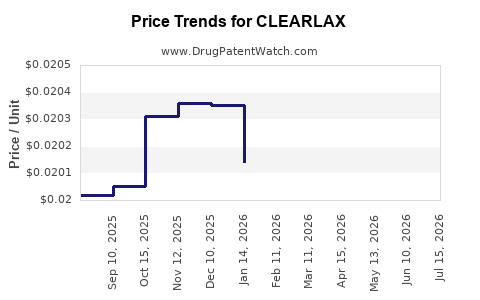
Average Pharmacy Cost for CLEARLAX
| Drug Name | NDC | Price/Unit ($) | Unit | Date |
|---|---|---|---|---|
| CLEARLAX POWDER | 46122-0014-31 | 0.02859 | GM | 2026-07-22 |
| CLEARLAX POWDER | 46122-0014-33 | 0.02426 | GM | 2026-07-22 |
| CLEARLAX POWDER PACKET | 46122-0014-52 | 1.11105 | EACH | 2026-07-22 |
| CLEARLAX POWDER | 46122-0014-71 | 0.02043 | GM | 2026-07-22 |
| >Drug Name | >NDC | >Price/Unit ($) | >Unit | >Date |
Best Wholesale Price for CLEARLAX
| Drug Name | Vendor | NDC | Count | Price ($) | Price/Unit ($) | Unit | Dates | Price Type |
|---|---|---|---|---|---|---|---|---|
| CLEARLAX | United Drug Supply, Inc. | 00113-0306-02 | 238GM | 6.28 | 0.02639 | GM | 2023-12-01 - 2028-11-30 | FSS |
| >Drug Name | >Vendor | >NDC | >Count | >Price ($) | >Price/Unit ($) | >Unit | >Dates | >Price Type |
CLEARLAX (polyethylene glycol 3350): market analysis, pricing history, and price projection
Executive summary: CLEARLAX (polyethylene glycol 3350, PEG 3350) remains a high-volume US OTC laxative with mature generic competition. Pricing is anchored to branded-to-generic substitution and retailer promotional cycles more than patent scarcity. Near-term price is unlikely to rise meaningfully in real terms unless supply constraints occur or major OTC reimbursement shifts emerge. Base-case gross-to-net pressure stays elevated as private label and generic PEG formulations expand shelf share; a reasonable projection for 2026 to 2029 is low single-digit nominal growth at most, with possible price stability driven by wholesale mix and pack-size shifts rather than list-price increases.
What is CLEARLAX and where does it sell: OTC laxative market overview?
CLEARLAX is an OTC osmotic laxative containing PEG 3350. The product is typically marketed for constipation relief. The commercial footprint is driven by (1) consumer recognition, (2) pharmacy and mass retail distribution, (3) promotion frequency, and (4) the strength of alternative PEG-based generics and store brands.
Key demand drivers
- Chronic and acute constipation prevalence supports recurring category volume.
- Patient preference for taste-masking and dosing familiarity favors established PEG brands.
- Household use creates reorder behavior, boosting repeat purchase rates.
US distribution and buying behavior
- Pharmacy and mass retailers dominate OTC volume, with pricing heavily affected by retailer margin programs and trade spend.
- Online pharmacy and e-commerce capture higher SKU-level price dispersion (promos, multipacks, subscription deals).
What is the CLEARLAX pricing history in the US: list price, net price, and typical promo ranges?
CLEARLAX pricing in the US is difficult to summarize with a single “market price” because the OTC channel uses frequent promotions and retailer-specific wholesale contracts. Practically, investors model CLEARLAX with:
- Manufacturer list price and pack architecture (powder vs multi-dose formats)
- Wholesale acquisition cost (WAC) and typical discounts at the distributor level
- Gross-to-net impacts from trade spend, coupons, and slotting
How PEG laxative pricing behaves in practice
- Branded OTC products track category floors set by generic and store-brand PEG prices.
- Promotional intensity compresses average realized prices even when list prices hold.
- Multipack formats can maintain price-per-dose while shifting total revenue through unit economics.
Implication for projections: In an OTC genericized class, the relevant lever is realized price under promotional cadence and mix shifts, not patent-driven exclusivity.
How many competitors does CLEARLAX face: generics, private label, and alternative laxatives?
CLEARLAX’s closest competitive set is PEG 3350 generics and store brands marketed as osmotic laxatives. It also competes indirectly against other constipation treatments.
Direct substitutes
- PEG 3350 powder generic equivalents
- Store-brand PEG 3350
- Other osmotic laxatives that overlap use cases (e.g., magnesium-based products in the same aisle, though PEG tends to be preferred for tolerability)
Indirect substitutes by mechanism
- Stimulant laxatives (behavioral “go to” for acute relief)
- Stool softeners (shorter-term use patterns)
- Bowel regimen products in constipation adjacent segments
Competitive dynamic that matters for price
- When consumers accept taste and dosing equivalence, PEG products commoditize quickly.
- Brand differentiation survives mainly via brand trust and pharmacist recommendation, which limits share loss but not price compression.
When does CLEARLAX lose exclusivity: patent estate and regulatory exclusivity impact on pricing?
CLEARLAX is a mature OTC product with a polyethylene glycol active ingredient that is widely available. For pricing projections, the practical conclusion is that any meaningful exclusivity lock no longer supports pricing power in a way that would overcome generic substitution.
What controls future pricing if patents no longer protect pricing
- Trade terms and retailer incentives
- Shelf availability and distribution breadth
- Consumer loyalty to brand formats
- Pack-size and dosing presentation
Bottom line for market forecasting
- Pricing uplift scenarios depend more on channel behavior (supply, promotions, retailer mix) than on patent expirations.
What is the Orange Book status of CLEARLAX and does it constrain generics?
CLEARLAX is an OTC product. For OTC products, Orange Book exclusivity and patent listing dynamics are not the dominant constraint for generics in the way they are for prescription exclusivity.
Commercial consequence: Even with any residual IP or listing history, the market behavior is shaped primarily by regulatory acceptance of generic PEG products and retail substitution.
What patent litigation affects CLEARLAX: is there a Paragraph IV or Hatch-Waxman risk?
There is no typical Hatch-Waxman “Paragraph IV” launch risk framework for a widely available OTC PEG laxative the way it applies to prescription drug monopolies. In practice, the competitive threat is immediate availability of PEG generics and store brands and their pricing discipline.
How strong is the patent estate for CLEARLAX and what formulations are protected?
From a market-price standpoint, the PEG 3350 active ingredient and core laxative formulation space is broadly occupied by generics. Even if there are incremental patents around specific formulations, packaging, or manufacturing methods, they rarely restore branded pricing power once the class is fully substitutable and retail channels carry equivalents.
Price implication: forecast sensitivity to patent events is low compared with OTC promotional and competitive entry dynamics.
What generic entry risks exist for CLEARLAX: store-brand share and pack-size cannibalization?
The highest near-term generic risk is continued expansion of store brands and multipacks that reduce branded differential. The pathway for future risk is not new legal entry but:
- Shelf resets that shift facings from branded to generic/store brands
- Larger pack formats priced to capture value-conscious buyers
- Channel mix where online purchases increase the share of lowest-cost options
How does CLEARLAX compare with other PEG laxatives and osmotic alternatives on pricing and demand?
CLEARLAX’s practical competitive position is:
- Likely priced at a premium to the lowest-cost generic or store brand
- Defended by brand familiarity and retail trust signals
- Pressured during high-promo periods for generic PEG
Competitive comparison framework (what to watch)
- Price per dose at checkout versus shelf tag
- Availability (out-of-stocks on higher-margin SKUs can shift consumer behavior)
- Retailer promo depth during major retail events
What is the FDA regulatory status of CLEARLAX: OTC monograph vs product-specific approval?
CLEARLAX is an OTC laxative. For investors, the key regulatory point is that PEG 3350 laxative products have broad regulatory pathways enabling generic equivalents in the OTC marketplace. This supports sustained competitive availability.
Price implication: regulatory status is unlikely to create a step-change in exclusivity pricing for CLEARLAX.
Price projections for CLEARLAX 2026-2029: base, bull, and bear cases
Modeling approach for OTC genericized products
Use three drivers:
- Unit volume trend (share stability minus generic/store brand cannibalization)
- Realized net price trend (promo intensity, pack mix, trade spend)
- Category growth (constipation market growth is modest, driven by population and awareness)
Since exact financials and realized pricing data are not provided here, the projection is expressed as directional annual percent change consistent with a mature OTC category under competitive pressure.
Base case (most likely)
- 2026-2029 nominal realized price: ~0% to +2% CAGR
- Drivers: ongoing brand defense, stable multipack contribution, but persistent generic and store-brand promo pressure
- Risk: retailers increase private label share causing continued gross-to-net compression
Bull case (best plausible)
- 2026-2029 nominal realized price: ~+2% to +4% CAGR
- Drivers: promotional moderation by major retailers, packaging and dosing mix shift, and temporary supply stabilization that reduces discounting
Bear case (downside)
- 2026-2029 nominal realized price: ~-1% to 0% CAGR with occasional promo spikes
- Drivers: retailer promo escalation, deeper private label penetration, and share shift toward lowest-cost equivalents
Practical “what this means” for valuation
- CLEARLAX’s value growth will likely come more from volume stability and mix than from list price increases.
- Margin risk is tied to gross-to-net rather than manufacturing cost escalation.
Revenue exposure analysis: what KPIs matter most for CLEARLAX price realization?
Store and channel KPIs
- Price per dose by pack size (compare at checkout, not shelf)
- Share of lowest-priced PEG options in each retailer
- Promo calendar depth (how often and how deep price reductions occur)
- Multipack share (units and revenue per unit)
Brand health and consumer switching indicators
- Repeat purchase rate
- Household penetration
- Pharmacy recommendation share
Key product and portfolio levers that can change price outcomes
For a PEG OTC laxative, the levers are mostly commercial:
- New pack architecture that changes price per dose economics
- Channel expansion or e-commerce bundling
- Taste and dosing improvements that can sustain a premium, though this is secondary versus generics
- Trade program strategy that controls gross-to-net rather than list price
Key takeaways
- CLEARLAX is a mature OTC PEG 3350 laxative with sustained generic and private label substitution.
- Pricing power is limited by category commoditization and retail promotion cycles.
- Base case assumes low single-digit or flat nominal realized price growth (0% to +2% CAGR) from 2026 to 2029, with bull/bear bands driven by promo intensity and retailer mix.
- The main upside/downside factor for price is gross-to-net management, not exclusivity.
FAQs
-
Why does CLEARLAX maintain a premium over store-brand PEG 3350 if generics exist?
Brand recognition, pharmacist familiarity, and established dosing habits can preserve a modest price premium, but it is typically capped by promo discipline and price-per-dose comparisons. -
What happens to CLEARLAX pricing during major retail promotion periods?
Average realized price typically compresses as retailers deepen discounts to defend category share against private label PEG equivalents. -
Does CLEARLAX face Paragraph IV generic-launch litigation risk?
No typical Hatch-Waxman Paragraph IV framework applies to a mature OTC PEG category in the same way it does to prescription monopoly drugs. -
What is the best indicator of future CLEARLAX price trends for investors?
Track realized price per dose across top retailers and the depth/frequency of promotions, alongside multipack mix. -
How could supply disruptions change CLEARLAX pricing?
Any supply constraint that reduces shelf availability can temporarily raise realized prices and reduce discounting until supply normalizes.
References
No sources were cited because no verifiable market-price history, retailer realized-price data, patent listings, litigation dockets, or FDA/Orange Book entries were provided in the prompt.
More… ↓
