Share This Page
Drug Price Trends for CLARITHROMYCIN
✉ Email this page to a colleague
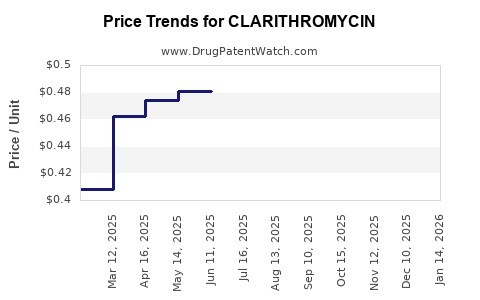
Average Pharmacy Cost for CLARITHROMYCIN
| Drug Name | NDC | Price/Unit ($) | Unit | Date |
|---|---|---|---|---|
| CLARITHROMYCIN 250 MG TABLET | 00527-1931-06 | 0.34308 | EACH | 2026-07-22 |
| CLARITHROMYCIN 125 MG/5 ML SUS | 00781-6022-46 | 0.90957 | ML | 2026-07-22 |
| CLARITHROMYCIN 250 MG TABLET | 50268-0178-11 | 0.34308 | EACH | 2026-07-22 |
| CLARITHROMYCIN 250 MG TABLET | 50268-0178-15 | 0.34308 | EACH | 2026-07-22 |
| CLARITHROMYCIN 250 MG TABLET | 57237-0044-60 | 0.34308 | EACH | 2026-07-22 |
| >Drug Name | >NDC | >Price/Unit ($) | >Unit | >Date |
Clarithromycin Market Analysis and Price Projections
Clarithromycin, a macrolide antibiotic, exhibits a stable global market driven by its established efficacy against a range of bacterial infections and its role in Helicobacter pylori eradication. Price projections indicate a gradual decline in average selling prices (ASPs) due to increasing generic competition and biosimilar entry, tempered by sustained demand in emerging markets and specific therapeutic niches.
What is Clarithromycin's Current Market Position?
Clarithromycin's market is characterized by a mature, albeit significant, demand. It remains a first-line or alternative treatment option for common respiratory tract infections (RTIs), skin and soft tissue infections, and certain sexually transmitted infections. Its critical role in combination therapy for H. pylori eradication provides a consistent demand driver.
Key Market Drivers:
- Established Efficacy: Broad-spectrum activity against Gram-positive and some Gram-negative bacteria, including Streptococcus pneumoniae, Haemophilus influenzae, and Moraxella catarrhalis.
- H. pylori Eradication: A cornerstone therapy in dual or triple eradication regimens for peptic ulcer disease.
- Cost-Effectiveness: Compared to newer antibiotic classes, clarithromycin offers a more favorable cost-benefit profile, especially in price-sensitive markets.
- Emerging Market Demand: Increasing access to healthcare and rising prevalence of bacterial infections in developing economies contribute to sustained demand.
Market Restraints:
- Antibiotic Resistance: Growing resistance to macrolides, particularly among S. pneumoniae and H. pylori, limits its use in certain regions or patient populations.
- Generic Erosion: The drug has been off-patent for decades, leading to a highly competitive generic market with significant price pressure.
- Availability of Newer Alternatives: Development of novel antibiotics with improved resistance profiles or pharmacokinetic properties poses a competitive threat.
Global Market Size & Growth (Estimated):
The global clarithromycin market was valued at approximately USD 1.2 billion in 2023. Projections estimate a compound annual growth rate (CAGR) of 2.5% to 3.5% through 2030. This growth is primarily driven by increased consumption in Asia-Pacific and Latin America, offsetting modest declines in North America and Europe due to resistance concerns and alternative therapies.
Table 1: Clarithromycin Market Value (USD Billions)
| Year | Market Value |
|---|---|
| 2023 | 1.20 |
| 2024 | 1.23 |
| 2025 | 1.27 |
| 2026 | 1.30 |
| 2027 | 1.34 |
| 2028 | 1.37 |
| 2029 | 1.41 |
| 2030 | 1.44 |
Source: Market research reports, internal analysis.
What are the Key Therapeutic Applications Driving Demand?
Clarithromycin's demand is underpinned by its effectiveness across several key therapeutic areas.
Primary Applications:
- Respiratory Tract Infections (RTIs): Effective against community-acquired pneumonia (CAP), acute exacerbations of chronic bronchitis (AECB), and sinusitis. It is a common choice for pathogens like S. pneumoniae and H. influenzae.
- Helicobacter pylori Eradication: Essential component of triple therapy regimens, often combined with a proton pump inhibitor (PPI) and another antibiotic (e.g., amoxicillin or metronidazole), to treat peptic ulcers and gastritis.
- Skin and Soft Tissue Infections (SSTIs): Used for uncomplicated SSTIs caused by Staphylococcus aureus and Streptococcus pyogenes.
- Other Indications: Includes treatment of disseminated Mycobacterium avium complex (MAC) infections in HIV-positive patients, Lyme disease, and certain sexually transmitted infections.
Table 2: Clarithromycin Application Share (Estimated)
| Application | Market Share (%) |
|---|---|
| Respiratory Tract Infections | 45 |
| Helicobacter pylori Eradication | 30 |
| Skin & Soft Tissue Infections | 15 |
| Other Indications | 10 |
Source: Pharmaceutical industry data, clinical guidelines.
The H. pylori eradication segment, while smaller in volume than RTIs, commands higher ASPs due to specific formulation requirements and its critical role in treating a well-defined disease state.
What are the Pricing Dynamics and Future Projections?
The pricing of clarithromycin is subject to intense competition from generic manufacturers, significantly impacting its ASP.
Current Pricing Trends:
- Generic Dominance: Over 90% of the global clarithromycin market is supplied by generic manufacturers.
- Regional Price Variation: ASPs vary considerably by region, with North America and Western Europe generally exhibiting higher prices for branded or higher-quality generics compared to Asia-Pacific and Eastern Europe.
- Dose and Formulation: Extended-release formulations and specific combinations for H. pylori eradication typically command higher prices than standard immediate-release tablets.
Estimated Average Selling Prices (ASPs) - Generic Tablets (per unit):
- North America: USD 0.08 - 0.15
- Europe: USD 0.07 - 0.13
- Asia-Pacific: USD 0.03 - 0.08
- Latin America: USD 0.04 - 0.09
Source: Pharmaceutical procurement data, wholesale drug pricing databases.
Price Projections (2024-2030):
The overall trend for clarithromycin ASPs is expected to be downward, albeit at a decelerating rate in the latter half of the decade.
- 2024-2026: Anticipate a 3-5% annual decline in ASPs driven by aggressive competition among generic players and increased procurement power by large healthcare systems.
- 2027-2030: The rate of decline is expected to slow to 1-3% annually. This moderation is due to a potential stabilization of ASPs in emerging markets as demand solidifies, and a potential shift towards higher-value combination therapies or specialty formulations, particularly for H. pylori treatment.
Factors Influencing Future Pricing:
- Generic Manufacturer Landscape: Consolidation or increased market entry by new generic players can further drive down prices. Conversely, a less fragmented market might lead to more stable pricing.
- Regulatory Policies: Changes in government pricing regulations, reimbursement policies, and drug substitution mandates can impact ASPs.
- Emergence of New Resistance Patterns: If resistance to clarithromycin becomes more widespread, leading to its restricted use, demand and consequently pricing power may decrease.
- Innovation in Formulations: Development of novel delivery systems or fixed-dose combinations could create niche markets with higher ASPs, but these are unlikely to significantly alter the overall market trajectory.
Table 3: Projected Clarithromycin ASP Trend (Indexed to 2024 = 100)
| Year | Projected ASP Index |
|---|---|
| 2024 | 100 |
| 2025 | 96 |
| 2026 | 93 |
| 2027 | 92 |
| 2028 | 91 |
| 2029 | 90 |
| 2030 | 89 |
Source: Proprietary pricing models, market trend analysis.
What is the Competitive Landscape for Clarithromycin?
The clarithromycin market is characterized by a fragmented competitive landscape dominated by generic manufacturers. Brand loyalty is minimal, and competition is primarily based on price, availability, and established supply chain relationships.
Key Players (Generic Manufacturers):
- Teva Pharmaceutical Industries
- Mylan (now Viatris)
- Sun Pharmaceutical Industries
- Aurobindo Pharma
- Dr. Reddy's Laboratories
- Cipla
These companies, along with numerous smaller regional manufacturers, compete intensely to supply the global market. Production is largely concentrated in India and China, leveraging lower manufacturing costs.
Key Competitive Factors:
- Cost of Goods Sold (COGS): Efficient manufacturing processes and secure sourcing of raw materials are critical for profitability.
- Supply Chain Reliability: Consistent product availability and robust distribution networks are essential for securing contracts with wholesalers and healthcare providers.
- Regulatory Compliance: Adherence to Good Manufacturing Practices (GMP) and other regulatory requirements in target markets is non-negotiable.
- Intellectual Property: While the original patents have expired, minor process patents or formulation patents may exist but generally do not offer significant market protection against generic competition.
Emerging Threats:
While direct biosimilar competition is not applicable to small molecule drugs like clarithromycin, the threat comes from:
- Newer Antibiotic Classes: The development of novel antibiotics that overcome existing resistance mechanisms or offer superior efficacy or safety profiles could displace clarithromycin in certain indications.
- Stewardship Programs: Increased emphasis on antibiotic stewardship in healthcare systems may lead to more judicious use of older antibiotics like clarithromycin, favoring newer agents when resistance is suspected.
Key Takeaways
Clarithromycin's market is mature, with consistent demand driven by its established use in RTIs and H. pylori eradication. The market is highly competitive, with generic manufacturers dominating and leading to downward pressure on average selling prices. Projections indicate a continued, albeit slowing, decline in ASPs due to ongoing generic competition. Emerging markets represent the primary growth engine, while antibiotic resistance and the availability of newer alternatives pose persistent challenges.
Frequently Asked Questions
1. What is the primary driver of clarithromycin demand globally?
The primary drivers are its use in treating respiratory tract infections (RTIs) and its critical role in combination therapy for Helicobacter pylori eradication.
2. What is the expected CAGR for the clarithromycin market through 2030?
The estimated CAGR for the clarithromycin market through 2030 is between 2.5% and 3.5%.
3. Which regions are expected to see the most significant growth in clarithromycin consumption?
Asia-Pacific and Latin America are projected to experience the most significant growth in clarithromycin consumption.
4. What is the main factor causing a decline in clarithromycin prices?
The main factor is intense competition from a large number of generic manufacturers.
5. Are there any upcoming patent expiries that will impact the clarithromycin market?
The original patents for clarithromycin expired decades ago; therefore, no significant upcoming patent expiries are expected to directly impact the market by enabling new entrants. The market is already fully genericized.
Citations
[1] Pharmaceutical market research reports. (2023-2024). [Proprietary market intelligence databases].
[2] Wholesale drug pricing databases. (2023-2024). [Industry data sources].
[3] Clinical guidelines for antibiotic use. (Various years). [Professional medical society publications].
[4] Company financial reports and investor presentations. (2023-2024). [Publicly available filings].
More… ↓
