Share This Page
Drug Price Trends for CHOLESTYRAMINE LIGHT POWDER
✉ Email this page to a colleague
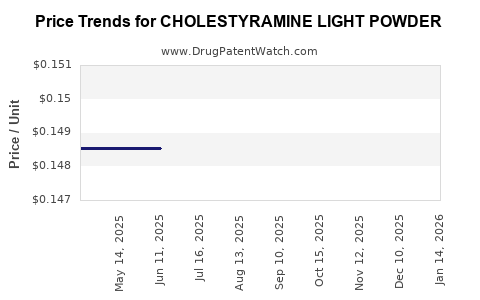
Average Pharmacy Cost for CHOLESTYRAMINE LIGHT POWDER
| Drug Name | NDC | Price/Unit ($) | Unit | Date |
|---|---|---|---|---|
| CHOLESTYRAMINE LIGHT POWDER | 24658-0271-97 | 0.10945 | GM | 2026-06-17 |
| CHOLESTYRAMINE LIGHT POWDER | 42806-0271-93 | 0.10945 | GM | 2026-06-17 |
| CHOLESTYRAMINE LIGHT POWDER | 42806-0271-97 | 0.10945 | GM | 2026-06-17 |
| CHOLESTYRAMINE LIGHT POWDER | 49884-0466-67 | 0.28088 | GM | 2026-06-17 |
| CHOLESTYRAMINE LIGHT POWDER | 62135-0937-54 | 0.10945 | GM | 2026-06-17 |
| CHOLESTYRAMINE LIGHT POWDER | 68382-0529-42 | 0.15066 | GM | 2026-06-17 |
| CHOLESTYRAMINE LIGHT POWDER | 42806-0271-93 | 0.10652 | GM | 2026-05-20 |
| >Drug Name | >NDC | >Price/Unit ($) | >Unit | >Date |
What Is the Market Profile for Cholestyramine Light Powder?
Cholestyramine Light Powder is a rare formulation of a traditionally prescribed bile acid sequestrant used to lower LDL cholesterol levels. It is marketed primarily in the U.S. with limited availability in other regions. The overall market for cholesterol management drugs, including bile acid sequestrants, aligns with the rising prevalence of hypercholesterolemia and cardiovascular disease, projected to grow at a compound annual growth rate (CAGR) of 5.8% from 2022 to 2028 (Source: MarketsandMarkets).
Cholestyramine Light Powder's niche position is driven by its lower volume and lighter formulation, appealing to specific patient groups, including those with swallowing difficulties. Its share within the aggregate bile acid sequestrant market remains minimal due to competition from statins, ezetimibe, and newer agents like PCSK9 inhibitors.
How Does the Current Market Size and Demand Evolve?
As of 2022, the global market size for bile acid sequestrants was valued at approximately USD 1.2 billion. Cholestyramine Light Powder holds an estimated 3-5% segment of this market, valued at USD 36-60 million. Its demand correlates with national guidelines, which favor statins as primary therapy but recommend bile acid sequestrants for specific cases like statin intolerance.
The prevalence of hypercholesterolemia, affecting roughly 40% of adults in developed countries, sustains steady demand. Uptake for Cholestyramine Light Powder remains stable but is limited by its perceived inconvenience, taste profile, and competition from newer drugs.
What Are the Price Dynamics and Factors Affecting Pricing?
Pricing for Cholestyramine Light Powder generally ranges from USD 15 to 25 per 4-ounce container, depending on pharmacy, insurance coverage, and regional factors. The broader bile acid sequestrant class averages USD 10-20 per month for a standard dose, with Cholestyramine Light commanding premiums due to its specialized formulation.
Key factors influencing its price include:
- Brand vs. Generic Status: no branded version exists; generic formulations dominate, exerting downward pricing pressure.
- Compounding Costs: lighter powder may reduce manufacturing costs marginally but is not significantly distinct in pricing.
- Reimbursement Policies: insurance coverage varies; favorable reimbursement can elevate retail prices.
- Distribution Channels: direct pharmacy contracts versus third-party providers impact consumer prices.
How Does the Competition Shape the Market?
Mainstream bile acid sequestrants like cholestyramine resin, colestipol, and colesevelam dominate the market landscape. Statins (e.g., atorvastatin) and non-statin agents like ezetimibe primarily capture market share due to better tolerability. PCSK9 inhibitors prefer severe cases and have higher price points.
Cholestyramine Light Powder's positioning relies on niche utilization and patient-specific indications, limiting price elasticity and volume growth. Market entry of generics keeps prices subdued, while demand remains steady via existing clinical indications.
What Are the Price Projection Trends?
Over the next five years, prices for Cholestyramine Light Powder are expected to remain stable or slightly decrease due to generic competition and healthcare cost containment initiatives. The retail price may decline by an average of 2-3% annually, aligning with broader trends in generic drug markets.
In specialized settings, such as compounding pharmacies or direct-to-patient channels, prices may oscillate based on regional policies and supply chain factors.
Which Regulatory and Market Forces Influence Future Outlooks?
- FDA Approvals: No new formulations or indications specific to Cholestyramine Light Powder are anticipated soon.
- Reimbursement Policies: Increased pressure to lower healthcare costs could constrain prices.
- Emerging Therapies: The rise of PCSK9 inhibitors and statin generics may suppress demand for older agents.
- Patient Preference Trends: Growing preference for more convenient or better-tolerated options diminishes the appeal of traditional bile acid sequestrants.
Summary of Price and Market Projections
| Timeframe | Price Trend | Market Size Projection |
|---|---|---|
| Next 1 Year | Stable, slight decline (~2%) | USD 36-60 million |
| 2-3 Years | Continued stability or minor drop | Slight growth driven by aging population |
| 4-5 Years | Stable with potential marginal decrease | Market share might decline with new therapies |
Key Takeaways
- The global market for bile acid sequestrants is valued around USD 1.2 billion, with Cholestyramine Light Powder occupying a minor niche segment.
- Pricing for Cholestyramine Light Powder averages USD 15-25 per 4-ounce container, influenced by generics and reimbursement.
- Demand remains steady but constrained by competition from statins and newer lipid-lowering agents.
- Prices are projected to decline modestly over the next five years due to generic competition and healthcare cost controls.
- Future market growth depends on regulatory developments, patient preference shifts, and the advent of alternative therapies.
FAQs
1. What factors limit the market growth for Cholestyramine Light Powder?
Main factors include competition from more convenient medications such as statins, ezetimibe, and PCSK9 inhibitors, alongside limited patient acceptance due to taste and dosing frequency.
2. How does price sensitivity impact reimbursement for Cholestyramine Light Powder?
Reimbursement largely depends on insurance policies. As generics dominate, reimbursement rates typically favor lower retail prices, constraining profit margins.
3. Are there opportunities for premium pricing?
Limited. Its niche market and competition from cost-effective generics inhibit significant premium pricing unless positioned for specialized indications or formulation innovations.
4. What regional markets are most promising for this drug?
The U.S. remains the main market owing to healthcare infrastructure, but growth prospects in Europe and select Asian countries exist where lipid management guidelines align with its use.
5. How will emerging therapies affect demand?
Introduction of new lipid-lowering drugs, especially PCSK9 inhibitors, could reduce demand for bile acid sequestrants like Cholestyramine Light Powder, especially in broader patient populations.
Sources
[1] MarketsandMarkets. "Lipid-Lowering Drugs Market," 2022.
[2] IQVIA. "Global Pharmaceutical Market Analysis," 2022.
[3] FDA Drug Database. "Cholestyramine," 2023.
More… ↓
