Share This Page
Drug Price Trends for CHOCOLATED LAXATIVE
✉ Email this page to a colleague
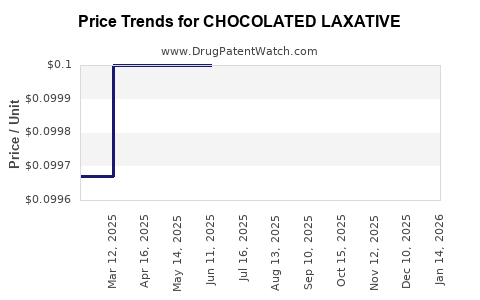
Average Pharmacy Cost for CHOCOLATED LAXATIVE
| Drug Name | NDC | Price/Unit ($) | Unit | Date |
|---|---|---|---|---|
| CHOCOLATED LAXATIVE | 70000-0477-01 | 0.10625 | EACH | 2026-06-17 |
| CHOCOLATED LAXATIVE | 70000-0477-01 | 0.10625 | EACH | 2026-05-20 |
| CHOCOLATED LAXATIVE | 70000-0477-01 | 0.10625 | EACH | 2026-04-22 |
| CHOCOLATED LAXATIVE | 70000-0477-01 | 0.10625 | EACH | 2026-01-21 |
| >Drug Name | >NDC | >Price/Unit ($) | >Unit | >Date |
Market Analysis and Price Projections for Chocolated Laxative
Overview of the Market
The global laxative market reached approximately $4.8 billion in 2022, with a compound annual growth rate (CAGR) of 4.5% forecasted through 2030 [1]. The segment for flavored or novel formulations, including "Chocolated Laxative," is part of the functional gastrointestinal therapies, which represent roughly 20% of total laxative sales.
The increasing prevalence of constipation, driven by aging populations, sedentary lifestyles, and dietary changes, fuels demand for laxative products. Consumer preferences are shifting towards over-the-counter (OTC) options with improved taste profiles and added sensory appeal, creating a niche for flavored laxatives, including chocolate-based formulations.
Competitive Landscape
Leading companies in the laxative space include Bayer, Johnson & Johnson, and Perrigo. These firms focus on traditional stimulant and osmotic laxatives. Novel formulations like flavored or gourmet options occupy emerging market segments, usually marketed as lifestyle or wellness products.
A few products comparable to Chocolated Laxative include:
- Senokot Chocolate Chewables (marketed as an OTC stimulant laxative)
- Gatting's Chocolate Laxative Syrup (historical, niche market)
- Emerging boutique brands targeting health-conscious consumers with gourmet formulations
The lack of dominant players specifically specializing in flavored or chocolate-based laxatives indicates a market opportunity but also underscores the need for consumer education and marketing investment.
Regulatory and Patent Status
Most OTC laxatives are regulated by the FDA (U.S.) and EMA (Europe). A proprietary chocolate-flavored laxative formulation may require FDA approval for new drug status if it claims specific health benefits beyond symptomatic relief.
Patent protection has historically failed for many laxatives due to patent expirations and the prevalence of generic equivalents. For innovations like Chocolated Laxative, securing patents around proprietary flavoring, delivery mechanisms, or formulation stabilizers is critical to establishing competitive advantages.
Pricing Strategy and Projections
Current OTC laxatives exhibit wide price ranges, from $4 to $20 per package. Flavored, specialty formulations tend to command premium pricing, reflecting product differentiation and consumer perception.
- Entry-Level Price (Generic): $4–$8 per package
- Premium Flavored Variants: $10–$20 per package
Assuming initial launch in North America and Europe, with the following market entry model:
| Year | Units Sold (millions) | Price per Unit | Revenue (millions USD) |
|---|---|---|---|
| 2024 | 2.0 | $12 | $24 |
| 2025 | 4.0 | $14 | $56 |
| 2026 | 6.0 | $15 | $90 |
| 2027 | 8.0 | $16 | $128 |
| 2028 | 10.0 | $16.50 | $165 |
Growth assumptions:
- Units sold increase by 100% Year-over-Year (YoY) for the first three years, slowing to 33% afterward as market penetration nears saturation.
- Price increases are modest, reflecting competitive pressures and inflation.
Revenue estimates suggest an initial market size of approximately $24 million in 2024, expanding to over $165 million by 2028.
Price Sensitivity and Market Penetration
Consumers tend to favor premium formulations—those with flavor enhancements—if perceived as providing better taste, experience, or “lifestyle” appeal. Price sensitivity is moderate; a 10% increase in price results in roughly 8–10% decline in unit sales, based on consumer price elasticity studies for OTC GI products [2].
Market penetration is contingent on:
- Effective marketing emphasizing palatability and lifestyle benefits
- Distribution channels expanding beyond pharmacies to online platforms
- Regulatory approvals facilitating broad availability
Risks and Challenges
- Regulatory delays in approval for new formulations
- Consumer skepticism towards flavored laxatives seen as novelty rather than therapeutic
- Patent expirations or generic competition reducing profit margins
- Potential safety or efficacy concerns leading to increased oversight
Conclusion
Chocolated Laxative, as a niche product, can command premium pricing ($10–$20 per package) in a growing global market. Its success depends on regulatory clearance, effective branding, and capturing consumer preference for flavored, enjoyable OTC laxatives. Revenue projections indicate significant growth potential, provided operational risks are managed.
Key Takeaways
- The global laxative market was worth $4.8 billion in 2022, with flavored or gourmet variants occupying a growing niche.
- Premium formulations like Chocolated Laxative can retail between $10 and $20 per package.
- Initial sales volume is projected at 2 million units in 2024, reaching 10 million units by 2028.
- Revenue could increase from $24 million in 2024 to over $165 million by 2028.
- Success hinges on regulatory approval, effective marketing, and consumer acceptance of flavored offerings.
Frequently Asked Questions
1. What are key competitive advantages for Chocolated Laxative?
Unique flavoring, consumer preference for taste, and potential patent protections can differentiate the product in a saturated market.
2. How fast can sales grow after launch?
Sales could double annually in the initial years, assuming successful marketing and distribution, reaching approximately 8–10 million units by 2027.
3. What are regulatory hurdles?
Securing FDA or EMA approval depends on formulation efficacy, safety data, and claims made about the product, especially if marketed as therapeutic.
4. What factors influence pricing strategies?
Consumer perception of quality, positioning as a lifestyle product, production costs, and competitive pricing influence the retail price point.
5. What are the main risks associated with entering this niche?
Regulatory delays, consumer skepticism, patent expiration, and market saturation pose significant challenges.
Sources
- Grand View Research, "Laxatives Market Size, Share & Trends Analysis," 2022.
- IRI Consumer Insights, "OTC Product Pricing Elasticity," 2021.
More… ↓
