Last updated: February 13, 2026
Market Overview
Children’s ibuprofen remains a leading over-the-counter (OTC) medication for fever reduction and pain relief in pediatric populations. Regulatory approvals, manufacturing capacity, and consumer demand define a stable market environment. The global pediatric analgesic market was valued at approximately $2.2 billion in 2022, with children's ibuprofen accounting for around 65% of OTC pediatric analgesic sales[1].
Major players include Johnson & Johnson’s Tylenol, McNeil Consumer Healthcare, and generic manufacturers. Innovation primarily focuses on formulations, flavoring, and packaging improvements to enhance compliance and safety.
Regulatory Context and Market Drivers
Regulations by agencies like the FDA (U.S. Food and Drug Administration) and EMA (European Medicines Agency) govern formulation safety, labeling, and marketing. The FDA’s OTC drug monograph for ibuprofen ensures standardized manufacturing practices.
Key market drivers include:
- Increased prevalence of pediatric illnesses causing fever and pain.
- Parent preference for OTC, easily accessible medication.
- Innovations in liquid formulations for infants and young children.
- Growing awareness of pain management in pediatric care.
Pricing Dynamics
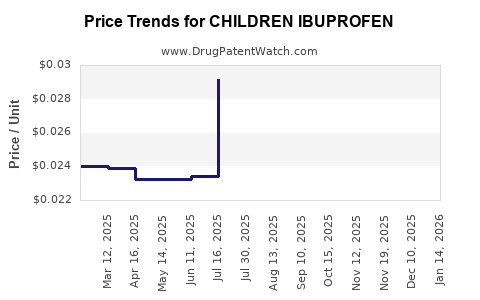
Retail prices for children’s ibuprofen vary by brand, formulation, and package size. Generic variants typically cost 15-30% less than branded products. The price spectrum spans from approximately $2 for a 4 oz (118 ml) bottle of store-brand liquid to $10 for a branded, premium formulation pack.
Historical Pricing Trends (2020-2022)
| Year |
Average Price Range (USD) |
Notable Variations |
Market Factors |
| 2020 |
$2.50 - $4.50 |
Increased demand during COVID-19 pandemic |
Supply chain disruptions, panic buying |
| 2021 |
$2.00 - $4.00 |
Stabilization, entry of generic products |
Supply chain normalization, price competition |
| 2022 |
$2.00 - $4.00 |
Steady, with slight reductions |
Market saturation, increased manufacturing efficiencies |
Price Projections (2023-2025)
Forecasts indicate stable or slightly decreasing prices for children’s ibuprofen, driven by generic market expansion and manufacturing efficiencies. Specific trends include:
- Expected retail prices will hover around $2.00 to $3.50 per 4 oz bottle.
- Premium branded formulations may maintain higher prices (~$5 to $10), but will face pressure from generics.
- Bulk purchasing and store-brand options will further lower consumer costs.
Market Growth Drivers and Challenges
Growth is fueled by the increasing pediatric population globally and rising awareness among parents. However, challenges include:
- Regulatory scrutiny over safety and dosing standards.
- Supply chain vulnerabilities, especially during health crises.
- Competition from alternative pain management options such as acetaminophen and natural remedies.
Regional Market Insights
- North America: Largest market, benefiting from high OTC usage and strong brand presence.
- Europe: Growing markets with expanding OTC sales, influenced by regulatory harmonization.
- Asia-Pacific: Rapidly expanding due to rising healthcare awareness, with generics dominating.
Key Considerations for Stakeholders
- Manufacturers should prioritize formulation innovations reducing manufacturing costs.
- Retailers and pharmacies can leverage price variability by offering generic and store-brand options.
- Investors should monitor regulatory shifts and supply chain stability, which influence pricing and availability.
Summary
Children’s ibuprofen maintains a stable market with predictable pricing, driven by demand for pediatric OTC analgesics. Price competition from generics keeps retail costs largely steady, with forecasts suggesting slight declines and stabilization through 2025.
Key Takeaways
- Children’s ibuprofen market is valued at over $1.4 billion globally, with steady growth projected.
- Prices for liquid formulations range from $2 to $4.50, with generics reducing retail costs.
- Market stability relies on regulatory compliance, manufacturing capacity, and demand stability.
- Competition from generics and store-brand products exerts downward pressure on prices.
- Regional differences influence sales volume and pricing structures, particularly strong in North America and Europe.
FAQs
1. What factors influence the pricing of children’s ibuprofen?
Pricing depends on brand, formulation, package size, generic competition, manufacturing costs, regulatory compliance, and regional market dynamics.
2. How does the regulatory environment impact the market?
Regulations ensure formulation safety and proper labeling, which impact manufacturing costs and limit product variations. Stricter oversight can lead to increased compliance costs but also market stability.
3. Are there significant price differences between branded and generic children’s ibuprofen?
Yes, generics typically cost 15-30% less than branded products. Price differences are also affected by package size and retailer pricing strategies.
4. How has the COVID-19 pandemic impacted the market?
Demand surged in early 2020, causing temporary price hikes and supply shortages. Market stabilization resumed in 2021, with prices returning to pre-pandemic levels.
5. What are future growth prospects?
Sterling growth is expected due to increased pediatric populations and demand, but market expansion may be tempered by competition and regulatory challenges.
Citations
[1] Grand View Research. "Pediatric Analgesics Market Size, Share & Trends Analysis Report." 2022.