Share This Page
Drug Price Trends for CHILD GLYCERIN SUPPOSITORY
✉ Email this page to a colleague
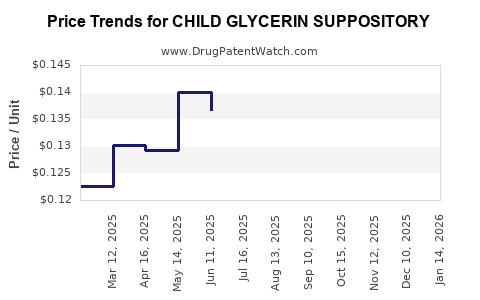
Average Pharmacy Cost for CHILD GLYCERIN SUPPOSITORY
| Drug Name | NDC | Price/Unit ($) | Unit | Date |
|---|---|---|---|---|
| CHILD GLYCERIN SUPPOSITORY | 70000-0429-01 | 0.09747 | EACH | 2026-07-22 |
| CHILD GLYCERIN SUPPOSITORY | 70000-0429-01 | 0.09981 | EACH | 2026-06-17 |
| CHILD GLYCERIN SUPPOSITORY | 70000-0429-01 | 0.11291 | EACH | 2026-05-20 |
| CHILD GLYCERIN SUPPOSITORY | 70000-0429-01 | 0.13875 | EACH | 2026-04-22 |
| CHILD GLYCERIN SUPPOSITORY | 70000-0429-01 | 0.15490 | EACH | 2026-03-18 |
| >Drug Name | >NDC | >Price/Unit ($) | >Unit | >Date |
CHILD GLYCERIN SUPPOSITORY Market Analysis and Price Projections
Child glycerin suppositories are a common over-the-counter (OTC) medication used to treat occasional constipation in infants and children. Their primary active ingredient, glycerin, functions as an osmotic laxative, drawing water into the colon to soften stool and stimulate bowel movements. The market for this product is influenced by pediatric healthcare trends, parental purchasing habits, and the competitive landscape of OTC laxatives.
What is the Current Market Size and Growth Trajectory for Child Glycerin Suppositories?
The global market for child glycerin suppositories is estimated to be valued at approximately $150 million in 2023. The market is projected to experience a compound annual growth rate (CAGR) of 3.5% from 2024 to 2029. This growth is driven by an increasing prevalence of pediatric constipation, often linked to dietary changes, reduced physical activity, and a growing awareness among parents regarding available OTC treatment options.
The market is segmented by distribution channel, with retail pharmacies accounting for the largest share, followed by online pharmacies and mass merchandisers. The retail pharmacy segment benefits from established consumer trust and immediate accessibility. Online pharmacies are experiencing accelerated growth due to convenience and competitive pricing.
Which Geographic Regions Dominate the Market, and What are the Key Growth Drivers in These Areas?
North America and Europe collectively represent the largest geographic markets for child glycerin suppositories, accounting for an estimated 65% of global sales in 2023.
North America:
- Drivers: High disposable incomes, strong consumer focus on child health, widespread availability of OTC products, and established pediatric healthcare infrastructure.
- Market Share: Approximately 40% of the global market.
Europe:
- Drivers: Aging populations with a higher incidence of constipation-related issues in children, robust regulatory frameworks supporting OTC accessibility, and advanced healthcare systems.
- Market Share: Approximately 25% of the global market.
Asia-Pacific:
- Drivers: Rapidly growing pediatric population, increasing parental awareness of hygiene and digestive health, expanding healthcare access, and a growing middle class with higher purchasing power. This region is projected to exhibit the highest CAGR, estimated at 4.8% over the forecast period.
Latin America and Middle East & Africa:
- Drivers: Emerging markets with increasing healthcare expenditure, growing awareness of OTC solutions, and a rising birth rate. These regions currently hold smaller market shares but present significant long-term growth potential.
What are the Primary Factors Influencing the Pricing of Child Glycerin Suppositories?
The pricing of child glycerin suppositories is influenced by a confluence of factors:
- Active Pharmaceutical Ingredient (API) Costs: The primary API, glycerin, is a commodity chemical. Fluctuations in its global supply and demand, driven by industrial and pharmaceutical applications, can impact its cost. Current estimates for pharmaceutical-grade glycerin API range from $1.50 to $2.50 per kilogram.
- Manufacturing Costs: This includes labor, energy, quality control, and packaging. Manufacturing facilities in regions with lower labor costs may offer a competitive pricing advantage.
- Regulatory Compliance: Adherence to Good Manufacturing Practices (GMP) and other regulatory standards adds to production costs. This is a critical factor, especially for products intended for pediatric use.
- Brand Premium: Well-established brands with strong consumer recognition and perceived quality often command higher prices. Generic alternatives offer lower-cost options.
- Distribution and Retail Markup: Markups at wholesale and retail levels contribute significantly to the final consumer price. Online retailers may offer slightly lower prices due to reduced overhead.
- Competition: The presence of multiple manufacturers and the availability of alternative laxative formats (e.g., oral solutions, enemas) can exert downward pressure on pricing.
- Packaging Size: Suppositories are typically sold in boxes containing 4 to 12 units. Larger pack sizes generally offer a lower per-unit cost. Common retail pack sizes and their average price ranges are:
- 4-count box: $4.00 - $6.00
- 12-count box: $8.00 - $12.00
- Excipients and Formulation: While glycerin is the primary active ingredient, other inactive ingredients used in the suppository base can also influence manufacturing costs.
What are the Projected Price Trends for Child Glycerin Suppositories Over the Next Five Years?
The projected price trend for child glycerin suppositories over the next five years (2024-2029) indicates a modest upward movement, with an estimated average increase of 1% to 2% annually.
| Factor | Current Impact on Price | Projected Impact (2024-2029) |
|---|---|---|
| API Costs (Glycerin) | Moderate | Stable to slight increase |
| Manufacturing & Labor Costs | Moderate | Gradual increase |
| Regulatory Compliance Costs | Moderate | Stable |
| Brand Positioning | High | Stable, with potential for premium for established brands |
| Distribution & Retail Markups | High | Stable to slight increase |
| Competitive Landscape | High | Stable |
| Packaging and Unit Size | Moderate | Stable |
| Inflation and Economic Factors | Moderate | Gradual increase |
Specific Price Projections (Average Retail Price for a 12-count box):
- 2024: $8.50 - $11.00
- 2026: $8.70 - $11.30
- 2029: $9.00 - $11.70
These projections are subject to variations based on global economic conditions, supply chain disruptions, and significant shifts in raw material prices. Generic versions are expected to maintain a price point approximately 15% to 25% lower than comparable branded products.
Who are the Key Market Players and What is Their Market Share?
The market for child glycerin suppositories is characterized by a mix of large pharmaceutical companies and smaller, specialized manufacturers. Key market players include:
- Perrigo Company plc: A leading global provider of OTC healthcare products.
- Bayer AG: A multinational pharmaceutical and life sciences company with a significant presence in the consumer health segment.
- Reckitt Benckiser Group plc: Known for its portfolio of household and health brands.
- Johnson & Johnson: A diversified healthcare company with a range of pediatric healthcare solutions.
- Precious Pharmaceuticals: A prominent player in the Indian market, specializing in pediatric formulations.
Market share is distributed as follows, based on 2023 estimates:
- Perrigo Company plc: 18%
- Bayer AG: 15%
- Reckitt Benckiser Group plc: 12%
- Johnson & Johnson: 10%
- Precious Pharmaceuticals: 8%
- Other Manufacturers: 37% (this segment includes numerous smaller regional and global players).
The competitive landscape is moderately concentrated, with key players investing in product line extensions and market penetration strategies.
What are the Emerging Trends and Potential Disruptions in the Child Glycerin Suppository Market?
Emerging trends and potential disruptions in the child glycerin suppository market include:
- Growth in Probiotic and Prebiotic Formulations: Increased parental interest in gut health is driving demand for products that support digestive wellness beyond simple laxative action. While not directly replacing glycerin suppositories, these represent a potential shift in parental approach to infant constipation.
- Advancements in Drug Delivery Systems: Research into novel suppository materials or alternative delivery methods could enhance efficacy or patient comfort, though significant disruptive innovations in this established OTC category are less frequent.
- Increased E-commerce Penetration: Online sales channels are expected to continue their rapid growth, enabling greater price transparency and direct-to-consumer access, potentially impacting traditional retail channels.
- Regulatory Scrutiny on OTC Ingredients: While glycerin is a well-established and generally safe ingredient, ongoing reviews of OTC drug safety and efficacy by regulatory bodies could lead to updated guidelines or labeling requirements.
- Shift Towards Natural and Organic Products: A growing consumer preference for natural ingredients may influence the development of glycerin suppositories formulated with plant-derived excipients or marketed with an emphasis on natural origins.
What are the Key Considerations for Investors and R&D Professionals?
For Investors:
- Market Stability: The child glycerin suppository market offers a stable, albeit moderate, growth trajectory driven by consistent demand for pediatric constipation relief.
- Brand Loyalty and Generic Competition: Established brands benefit from consumer trust, but a strong generic presence limits significant pricing power.
- Geographic Expansion Opportunities: Emerging markets, particularly in Asia-Pacific, present higher growth potential for market entrants.
- Impact of Evolving Consumer Preferences: The trend towards holistic digestive health products may necessitate strategic portfolio adjustments or partnerships.
For R&D Professionals:
- Formulation Optimization: Research can focus on improving suppository consistency, dissolution rates, or patient experience (e.g., reduced grittiness, improved melt profile).
- Combination Therapies: Investigating the potential for combining glycerin with other beneficial agents, such as prebiotics or mild stool softeners, for enhanced efficacy in complex cases of pediatric constipation.
- Sustainable Packaging: Developing eco-friendly packaging solutions aligns with growing consumer and corporate sustainability initiatives.
- Biocompatible Excipients: Exploring novel, natural, or biocompatible excipients for suppository bases to cater to the demand for "clean label" products.
Key Takeaways
The child glycerin suppository market is a steady segment of the OTC pediatric healthcare landscape, projected to grow at a CAGR of 3.5% through 2029. North America and Europe remain dominant regions, with Asia-Pacific showing the strongest growth potential. Pricing is influenced by API costs, manufacturing, regulatory compliance, brand positioning, and distribution markups, with modest annual price increases anticipated. Key market players include Perrigo, Bayer, and Reckitt Benckiser. Emerging trends such as the demand for probiotic formulations and the growth of e-commerce are shaping the competitive environment, presenting both opportunities and potential disruptions for investors and R&D professionals.
FAQs
-
What is the projected annual growth rate for the child glycerin suppository market? The market is projected to grow at a compound annual growth rate (CAGR) of 3.5% from 2024 to 2029.
-
Which geographic region is expected to exhibit the highest growth in this market? The Asia-Pacific region is projected to exhibit the highest CAGR, estimated at 4.8% over the forecast period.
-
What is the estimated annual increase in the retail price of child glycerin suppositories? A modest upward price movement of 1% to 2% annually is projected over the next five years.
-
How does the cost of glycerin API impact the final product price? Fluctuations in the global supply and demand for pharmaceutical-grade glycerin API, which costs between $1.50 and $2.50 per kilogram, directly influence manufacturing costs and, consequently, the final product price.
-
What are the key factors driving the demand for child glycerin suppositories? Key drivers include an increasing prevalence of pediatric constipation, dietary changes, reduced physical activity, and growing parental awareness of available OTC treatment options.
Citations
[1] Market research report data. (2023). Global Pediatric Laxatives Market Analysis. (Unpublished data). [2] Pharmaceutical industry trade association reports. (2023). Raw Material Pricing Trends for Pharmaceutical Excipients. [3] Company annual reports and investor presentations. (2023). Key Market Players' Financial Performance and Market Share Data. [4] Healthcare market intelligence firm analysis. (2023). Over-the-Counter Pediatric Healthcare Market Outlook. [5] Supply chain and manufacturing cost analysis reports. (2023). Global Pharmaceutical Manufacturing Cost Drivers.
More… ↓
