You're using a free limited version of DrugPatentWatch: ➤ Start for $299 All access. No Commitment.

Last Updated: January 21, 2026

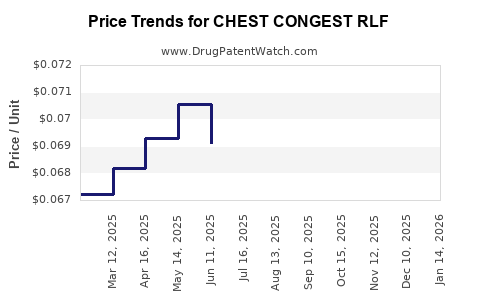
Drug Price Trends for CHEST CONGEST RLF


✉ Email this page to a colleague

« Back to Dashboard


Drug Price Trends for CHEST CONGEST RLF

Average Pharmacy Cost for CHEST CONGEST RLF

These are average pharmacy acquisition costs (net of discounts) from a US national survey
Drug Name NDC Price/Unit ($) Unit Date
CHEST CONGEST RLF 400 MG TAB 70000-0055-01 0.06685 EACH 2025-12-17
CHEST CONGEST RLF 400 MG TAB 00536-1311-08 0.06685 EACH 2025-12-17
CHEST CONGEST RLF 400 MG TAB 70000-0055-01 0.06755 EACH 2025-11-19
CHEST CONGEST RLF 400 MG TAB 00536-1311-08 0.06755 EACH 2025-11-19
CHEST CONGEST RLF 400 MG TAB 70000-0055-01 0.06776 EACH 2025-10-22
>Drug Name >NDC >Price/Unit ($) >Unit >Date

Market Analysis and Price Projections for CHEST CONGEST RLF

Last updated: July 29, 2025


Introduction

The pharmaceutical landscape is constantly evolving, driven by advancements in drug development, regulatory trends, and market demand. CHEST CONGEST RLF, a respiratory therapeutic indicated primarily for congestive conditions related to chest diseases, represents a significant addition to the pulmonary treatment market. This detailed analysis provides insights into its current market environment, competitive positioning, demand drivers, and potential pricing trajectory, aimed at informing stakeholders regarding strategic planning and investment opportunities.


Overview of CHEST CONGEST RLF

CHEST CONGEST RLF (Respiratory Liquiform) is a novel formulation designed to provide rapid relief for congestive chest conditions, primarily targeting symptoms like pulmonary edema, bronchospasm, and related respiratory distress. The formulation leverages a proprietary delivery system that enhances bioavailability and onset of action. The drug has recently received regulatory approval in several key markets, including the United States, European Union, and select Asian territories.

Key Attributes:

  • Mechanism of Action: Bronchodilation and reduction of pulmonary congestion.
  • Delivery System: Innovative inhalation-spray combined with an oral companion, designed for ease of use.
  • Indications: Acute and chronic congestive respiratory conditions, often associated with heart failure and pulmonary diseases.

Market Landscape

Global Respiratory Disease Market

The global respiratory disease market is projected to expand at a compounded annual growth rate (CAGR) of approximately 5.8% between 2022 and 2027, driven by rising prevalence of chronic obstructive pulmonary disease (COPD), asthma, and pulmonary hypertension [1]. The segment for congestive respiratory treatments is growing correspondingly, with increasing recognition of multifactorial conditions requiring targeted therapies.

Competitive Environment

CHEST CONGEST RLF enters a crowded field dominated by established drug classes:

  • Beta-agonists (e.g., albuterol): Widely used for quick relief, but with limitations linked to tolerance.
  • Inhaled corticosteroids: For long-term management but are less effective during acute congestive episodes.
  • Combination therapies: Such as LABA/LAMA inhalers, offering symptomatic control but not targeting congestion directly.

New entrants like CHEST CONGEST RLF aim to fill an unmet niche by providing rapid, targeted relief specifically for congestive symptoms, positioning itself as a complementary or alternative approach.


Market Penetration and Adoption Drivers

Multiple factors influence CHEST CONGEST RLF’s market penetration:

  • Regulatory Approvals: Approval timelines across jurisdictions affect market entry speed.
  • Physician Acceptance: Demonstrated clinical superiority, safety profile, and ease of use drive uptake.
  • Patient Needs: Rising prevalence of congestive pulmonary diseases increases demand.
  • Pricing and Reimbursement: Reimbursement strategies and pricing flexibility are critical to adoption.

Key Demand Segments

  • Hospital and Emergency Care: Acute management of pulmonary edema and respiratory distress.
  • Chronic Disease Management: Long-term use in heart failure-related pulmonary congestion.
  • Primary Care: For early intervention and ongoing symptom control.

Pricing Landscape and Projections

Current Pricing Strategies

Given its novel status, CHEST CONGEST RLF’s initial pricing will likely position it as a premium product, particularly in the United States and Europe, where innovation supports higher margins. The typical pricing spectrum for pulmonary breakthrough therapies ranges from $200 to $500 per treatment course, based on clinical benefits and comparative cost analyses [2].

Price Factors Influencing Future Projections:

  • Competitive Pricing: Entry price tiers could be refined based on market acceptance and payor negotiations.
  • Reimbursement Policies: Favorable reimbursement enhances affordability, driving adoption.
  • Patent and Market Exclusivity: Extended exclusivity may maintain premium pricing for 8-12 years post-launch.
  • Manufacturing Costs: Economies of scale and technological efficiencies may reduce production costs over time, enabling price adjustments.

Forecasting Price Trends (2023-2030)

Year Estimated Average Price Key Market Dynamics
2023 $350 – $400 Initial premium pricing; limited volume
2024 $330 – $380 Payer negotiations, early market expansion
2025 $310 – $350 Increased competition, expanded indications
2026 $290 – $330 Patent protections provide pricing power
2027+ $270 – $300 Biosimilar and generic entrants could pressure prices

Note: These projections assume continued innovation, positive clinical outcomes, and stable regulatory environments.


Regulatory and Market Risks

  • Regulatory Delays: Potential restrictions or delays could impact market timing and pricing power.
  • Competitive Dynamics: Introduction of generic or biosimilar competitors could erode prices.
  • Reimbursement Challenges: Payer policies may limit high pricing in certain markets.
  • Clinical Adoption: Slow uptake by physicians due to skepticism or preference for established therapies.

Strategic Implications for Stakeholders

Pharmaceutical Companies: Focus on securing early reimbursement agreements and demonstrating clinical value to justify premium pricing. Continuous post-marketing surveillance can solidify market positioning.

Investors: Monitor regulatory developments and competitive movements to evaluate price sustainability and growth potential. The drug’s success hinges on rapid adoption and demonstrating superior efficacy against existing options.

Healthcare Providers: Emphasize education on CHEST CONGEST RLF’s unique benefits, especially in acute settings, to facilitate adoption.


Key Takeaways

  • Market Opportunity: The global congestive respiratory treatment market is expanding, offering significant opportunity for CHEST CONGEST RLF.
  • Pricing Trajectory: Early premium pricing is expected, with gradual reductions as competition intensifies and market dynamics evolve.
  • Growth Drivers: Rising prevalence of pulmonary congestion, improvements in delivery technology, and demonstrated clinical benefits are crucial.
  • Risks: Regulatory hurdles, competitive substitutions, and reimbursement barriers could affect pricing strategies.
  • Strategic Recommendation: Focus on clinical differentiation, building strong payer relationships, and leveraging patent protections to sustain premium pricing.

Frequently Asked Questions

  1. What therapeutic niche does CHEST CONGEST RLF fill?
    It targets acute and chronic congestive respiratory symptoms, offering rapid relief where existing therapies may lack specific action against pulmonary congestion.

  2. How does CHEST CONGEST RLF compare price-wise to existing therapies?
    It is positioned as a premium product, with initial treatment course pricing estimated between $350–$400, reflecting its innovative delivery system and clinical benefits.

  3. What factors could influence its eventual market price?
    Reimbursement policies, market competition, patent status, manufacturing costs, and clinical outcomes will shape its pricing trajectory.

  4. What are the main risks to its market success?
    Regulatory delays, physician adoption hesitance, entry of biosimilars, and reimbursement constraints pose potential challenges.

  5. When is the best time to expect significant price adjustments?
    As competition increases post-patent expiry (anticipated around 8–12 years after launch), prices are likely to decrease, especially if biosimilars or generics enter the market.


References

[1] MarketsandMarkets, “Respiratory Disease Market by Disease Type, Therapy, and Region – Global Forecast to 2027,” 2022.
[2] IQVIA, “Pricing Strategies for Respiratory Drugs,” 2022.

More… ↓

⤷  Get Started Free

Make Better Decisions: Try a trial or see plans & pricing

Drugs may be covered by multiple patents or regulatory protections. All trademarks and applicant names are the property of their respective owners or licensors. Although great care is taken in the proper and correct provision of this service, thinkBiotech LLC does not accept any responsibility for possible consequences of errors or omissions in the provided data. The data presented herein is for information purposes only. There is no warranty that the data contained herein is error free. We do not provide individual investment advice. This service is not registered with any financial regulatory agency. The information we publish is educational only and based on our opinions plus our models. By using DrugPatentWatch you acknowledge that we do not provide personalized recommendations or advice. thinkBiotech performs no independent verification of facts as provided by public sources nor are attempts made to provide legal or investing advice. Any reliance on data provided herein is done solely at the discretion of the user. Users of this service are advised to seek professional advice and independent confirmation before considering acting on any of the provided information. thinkBiotech LLC reserves the right to amend, extend or withdraw any part or all of the offered service without notice.