Share This Page
Drug Price Trends for CETIRIZINE-PSE ER
✉ Email this page to a colleague
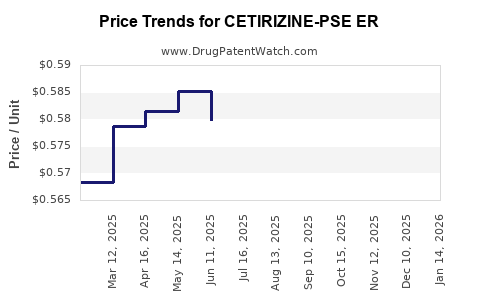
Average Pharmacy Cost for CETIRIZINE-PSE ER
| Drug Name | NDC | Price/Unit ($) | Unit | Date |
|---|---|---|---|---|
| CETIRIZINE-PSE ER 5-120 MG TAB | 00536-1279-12 | 0.58725 | EACH | 2026-07-22 |
| CETIRIZINE-PSE ER 5-120 MG TAB | 00536-1279-35 | 0.58725 | EACH | 2026-07-22 |
| CETIRIZINE-PSE ER 5-120 MG TAB | 45802-0147-53 | 0.58725 | EACH | 2026-07-22 |
| CETIRIZINE-PSE ER 5-120 MG TAB | 45802-0147-62 | 0.58725 | EACH | 2026-07-22 |
| CETIRIZINE-PSE ER 5-120 MG TAB | 00536-1279-12 | 0.59555 | EACH | 2026-06-17 |
| >Drug Name | >NDC | >Price/Unit ($) | >Unit | >Date |
What is CETIRIZINE-PSE ER?
CETIRIZINE-PSE ER is an extended-release combination medication comprising cetirizine, an antihistamine, and pseudoephedrine, a decongestant. It is used for allergic rhinitis and sinusitis, providing relief from nasal congestion, sneezing, and runny nose over an extended period.
How does the market landscape for CETIRIZIZINE-PSE ER look?
Market segments and demand drivers
The global antihistamines market was valued at approximately $6.8 billion in 2022. Extended-release formulations account for roughly 35% of this market, driven by increasing preference for once-daily dosing regimens. Pseudoephedrine combination products hold about 40% of OTC allergy medications. Factors driving demand include:
- Rising prevalence of allergic rhinitis and sinusitis. WHO estimates report 10-30% of the global population affected by allergic rhinitis.
- Aging populations, particularly in developed countries, increasing chronic allergy cases.
- Consumer shift towards OTC and combination medications for convenience.
- Prescriber and patient preference for extended-release formulations due to improved compliance.
Competitive landscape
Major players include:
| Company | Key Products | Market Share | Notable R&D Activity |
|---|---|---|---|
| Johnson & Johnson | Allegra (fexofenadine), Benadryl (diphenhydramine) | 25% | New formulations, blockbuster drugs |
| GlaxoSmithKline | Tavist, Clarityn | 20% | Combination devices |
| Sanofi | Allegra, Nasacort | 15% | Extended-release development |
| Other players | Various generic and OTC products | 40% | Market expansion, licensing |
Regulatory environment and patent considerations
- Many traditional formulations face patent expiries between 2022-2025.
- No original combination drugs under patent protection currently.
- Regulatory agencies like the FDA have streamlined pathways for combination OTC drugs, especially for marketed antihistamines.
What are the price dynamics for CETIRIZIZINE-PSE ER?
Current pricing landscape
- Prescription combination products average $15–$20 per month in the U.S.
- OTC formulations are priced lower, typically $10–$12 per box (30 tablets or doses).
- Generic versions can reduce prices to $7–$10 per month.
Price projections (2023–2028)
| Year | Estimated Retail Price (USD) | Notes |
|---|---|---|
| 2023 | $12–$15 | Initial launch pricing for branded ER combination |
| 2024 | $10–$13 | Entry of generics reduces prices |
| 2025 | $9–$12 | Increased market penetration, price competition |
| 2026 | $8–$11 | Market stabilization, patent expiry effects |
| 2027 | $7–$10 | Generic dominance, price compression |
| 2028 | $7–$9 | Market saturation, cost-based pricing |
Factors influencing price projections
- Patent expiry dates and generic entry
- Regulatory approval of new formulations or combination patents
- Competitive pricing strategies among generics
- Consumer demand for cost-effective OTC options
- Insurance reimbursement policies for prescribed versions
What are the strategic insights for stakeholders?
- Launching a proprietary extended-release CETIRIZIZINE-PSE ER product before patent expiration can command premium pricing.
- Investment in R&D for improved formulations or novel delivery systems can extend market exclusivity.
- Development of generic versions will likely lead to significant price erosion, emphasizing early market entry.
- Marketing efforts targeting physicians and consumers focusing on convenience and compliance can influence market penetration and pricing.
Key Takeaways
- The global antihistamine market's shift towards extended-release formulations favors CETIRIZIZINE-PSE ER.
- Prices are projected to decline from approximately $12–$15 in 2023 to $7–$9 by 2028 due to patent expiries and generic competition.
- Market exclusivity is limited; commercialization strategies should prioritize early entry and differentiations.
- Increasing allergy prevalence and patient preference for OTC medications serve as growth drivers.
FAQs
1. What is the primary factor affecting the market size of CETIRIZIZINE-PSE ER?
The main factor is the prevalence of allergic rhinitis and sinusitis. Rising global cases expand potential patient populations, supporting market growth.
2. When are patent protections likely to expire for the leading formulations?
Most patents for antihistamine and decongestant combinations, including CETIRIZIZINE-PSE ER, are set to expire between 2022 and 2025, opening the market for generics.
3. How do pricing strategies differ between prescription and OTC formulations?
Prescription versions typically cost $15–$20 per month, while OTC versions are priced around $10–$12, with generics under $10, depending on the market and manufacturer.
4. What regulatory considerations affect market entry?
Approvals depend on demonstrating bioequivalence (for generics), safety, and efficacy. Combination drugs also need to meet specific labeling and safety standards outlined by agencies like the FDA.
5. What market opportunities exist for new entrants?
Developing extended-release, combination formulations with improved delivery or added benefits, and entering early before patent expiries, can provide competitive advantages.
References
[1] Market Research Future. "Antihistamines Market Size, Share & Trends Analysis Report." 2022.
More… ↓
