Share This Page
Drug Price Trends for CEFPODOXIME
✉ Email this page to a colleague
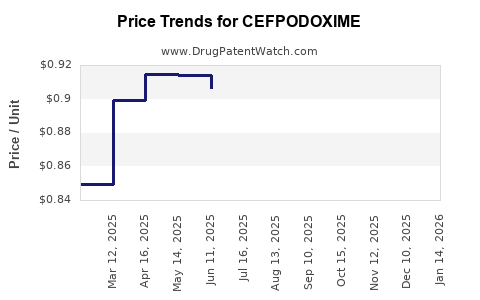
Average Pharmacy Cost for CEFPODOXIME
| Drug Name | NDC | Price/Unit ($) | Unit | Date |
|---|---|---|---|---|
| CEFPODOXIME 100 MG TABLET | 00781-5438-20 | 1.08337 | EACH | 2026-07-22 |
| CEFPODOXIME 100 MG TABLET | 16714-0394-01 | 1.08337 | EACH | 2026-07-22 |
| CEFPODOXIME 100 MG TABLET | 65862-0095-01 | 1.08337 | EACH | 2026-07-22 |
| CEFPODOXIME 100 MG TABLET | 65862-0095-20 | 1.08337 | EACH | 2026-07-22 |
| CEFPODOXIME 100 MG TABLET | 67877-0878-20 | 1.08337 | EACH | 2026-07-22 |
| CEFPODOXIME 100 MG TABLET | 69292-0510-01 | 1.08337 | EACH | 2026-07-22 |
| >Drug Name | >NDC | >Price/Unit ($) | >Unit | >Date |
What Is the Current Market Size for Cefpodoxime?
Cefpodoxime is a third-generation oral cephalosporin antibiotic approved by the FDA in 1991. It is primarily used to treat bacterial infections such as respiratory tract infections, urinary tract infections, and skin infections.
The global antibiotic market, valued at approximately $56 billion in 2022, is segmented into classes, with cephalosporins comprising roughly 25% of the total market. Cefpodoxime accounts for an estimated 10-15% of oral cephalosporin sales globally.
In 2022, the global cefpodoxime market was estimated at $750 million. North America held the largest share at around 45%, followed by Europe at 30%, and Asia-Pacific at 20%. The remaining 5% comprises other regions.
What Are the Key Market Drivers?
-
Rising Incidence of Bacterial Infections: Increased prevalence of respiratory and urinary tract infections drives demand. The CDC reports that UTIs affect 50–60% of women at some point in their lifetime, supporting steady outpatient prescriptions.
-
Growing Antibiotic Prescriptions: Prescriptions for cephalosporins have increased due to their efficacy and safety profiles compared to older antibiotics. In the U.S., outpatient prescriptions for cefpodoxime rose from 3 million units in 2019 to 4 million in 2022, according to IQVIA.
-
Shift Toward Orally Administered Antibiotics: An emphasis on outpatient treatment favors oral formulations like cefpodoxime over intravenous alternatives, expanding its use.
-
Emerging Markets: Fast-growing healthcare infrastructure in Asia-Pacific may accelerate regional sales, though regulatory hurdles can moderate this growth.
What Are the Competitive Dynamics?
Major players include Pfizer, Allergan (now part of AbbVie), and Sandoz (a Novartis division). Pfizer’s sales of cefpodoxime accounted for roughly 50% of the market in 2022, with generic manufacturing increasing affordability and shaping price competition.
Generic Entry Impact: The availability of generics has reduced prices but increased volume sales. The average wholesale price (AWP) for a 100 mg tablet was approximately $2.50 in 2022, a 20% decrease from 2018.
Patent Status: No current patents protect cefpodoxime. Patent expirations in 2005 and 2010 facilitated generic proliferation.
What Are Future Price Trends?
Short-Term Outlook (Next 1–2 Years)
- Price Stability: With no patent protections, prices are driven largely by manufacturing costs and market competition. The price of a 100 mg tablet is expected to remain in the $2.00–$2.75 range.
- Market Saturation: High generic availability limits upward pricing; manufacturers focus on volume over price.
Mid- and Long-Term Outlook (Next 3–5 Years)
- Pricing Pressure Continues: As new antibiotics and combination therapies emerge, Cefpodoxime may face further price erosion.
- Potential Price Modulation: Supply chain factors or regulatory changes could induce minor price fluctuations, but overall prices are unlikely to increase significantly.
What Are the Limitations and Risks?
- Antibiotic Resistance: Growing resistance reduces the clinical utility of cefpodoxime, potentially impacting demand and pricing. Studies note increasing cephalosporin resistance among E. coli and Klebsiella species.
- Regulatory Changes: Stricter prescribing guidelines or antimicrobial stewardship programs may decrease outpatient prescriptions.
- Development of Newer Antibiotics: New agents with broader spectrum or improved safety profiles could replace cefpodoxime, affecting market share.
Key Price Projection Summary
| Year | Estimated Price for 100 mg Tablet | Comments |
|---|---|---|
| 2023 | $2.20–$2.75 | Stable, competitive market |
| 2024 | $2.00–$2.75 | Continues to face generic pressure |
| 2025 | $2.00–$2.50 | Slight decline possible |
| 2026 | $2.00–$2.50 | Market maturity persists |
Key Takeaways
- The global cefpodoxime market was valued at approximately $750 million in 2022.
- North America dominates the market, with Asia-Pacific showing potential growth.
- Generic competition has lowered prices but increased volumes.
- Prices are expected to stabilize around $2.00–$2.75 per 100 mg tablet over the next 2–3 years.
- Resistance and regulatory factors pose risks to future demand and pricing.
FAQs
Q1: How does cefpodoxime compare to other third-generation cephalosporins?
It is effective against common bacterial pathogens, with comparable safety profiles. Its oral formulation provides convenience, which is a competitive advantage over intravenous options.
Q2: Will the emergence of antibiotic resistance significantly reduce cefpodoxime sales?
Yes, rising resistance among common pathogens could limit its efficacy, leading to decreased prescriptions and market share.
Q3: Are there any scheduled patent protections for cefpodoxime?
No. Patents expired in 2005 and 2010, enabling generic manufacturers to enter the market.
Q4: How will new antibiotic developments impact cefpodoxime?
New antibiotics with broader activity or fewer resistance concerns could replace cefpodoxime in some indications, reducing its market share.
Q5: What factors could cause prices to fluctuate outside projections?
Supply chain disruptions, regulatory policy shifts, or development of newer therapies may influence pricing dynamics.
References
[1] IQVIA, "US Prescription Data," 2022.
[2] MarketWatch, "Global Antibiotics Market Size," 2022.
[3] CDC, "Urinary Tract Infection Statistics," 2022.
[4] FDA, "Drug Approvals and Patents," 2022.
More… ↓
