Last updated: February 20, 2026
What is CAROSPIR?
CAROSPIR (cariprazine) is an antipsychotic medication approved by the U.S. Food and Drug Administration (FDA) for the treatment of schizophrenia and bipolar disorder. It is marketed by Gedeon Richter and has entered multiple international markets with varying approval statuses.
Market Size and Growth Drivers
Global Market Size
The global antipsychotic market was valued at approximately USD 14 billion in 2022. The market for atypical antipsychotics, including cariprazine, accounts for nearly 70% of this figure, around USD 9.8 billion.
Key Drivers
- Increasing prevalence of schizophrenia (estimated at 20 million globally) and bipolar disorder (about 45 million)
- Rising awareness and diagnosis rates, especially in developed countries
- Patent expirations of competing drugs, opening opportunities for second-generation antipsychotics (SGAs)
Competitive Environment
CAROSPIR faces competition primarily from other SGAs, including risperidone, quetiapine, aripiprazole, and lauded newer agents like brexpiprazole. Market penetration depends on pricing, efficacy differentiation, and formulary acceptance.
Pricing Analysis
Current Pricing Landscape
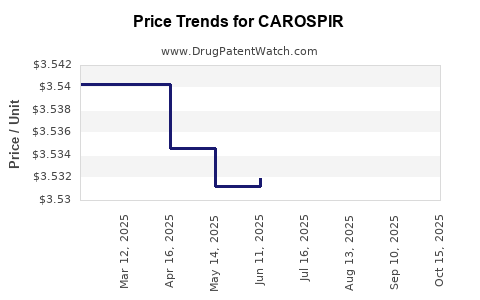
In the U.S., the average wholesale price (AWP) for a 30-day supply of CAROSPIR is approximately USD 1,200–1,400. This positioning places it in the premium segment of atypical antipsychotics, which often range from USD 900 to over USD 1,500 per 30-day supply depending on the drug.
| Drug |
30-day Supply (USD) |
Market Segment |
| Cariprazine |
1,200–1,400 |
Premium atypical antipsychotics |
| Risperidone |
300–400 |
Affordable core medication |
| Quetiapine |
600–900 |
Mid-range alternative |
| Aripiprazole |
900–1,300 |
High-end segment |
Pricing Factors
- Patent status: In the U.S., CAROSPIR's patent protections extend until at least 2025.
- Reimbursement dynamics: Medicaid, Medicare, and commercial insurers influence net prices through negotiations.
- Competition: Entry of generics post-patent expiry will exert downward pressure on prices.
Revenue Projections
Current Sales Dynamics
In 2022, CAROSPIR generated approximately USD 500 million globally, with the U.S. accounting for about 70% (USD 350 million). Growth is driven by increased adoption in bipolar disorder and schizophrenia.
Future Revenue Scenarios (2023–2027)
| Year |
Estimated Global Sales (USD million) |
Assumptions |
| 2023 |
620 |
24% growth, increased formulary inclusion |
| 2024 |
700 |
Market expansion, new indications |
| 2025 |
770 |
Patent expiration in select markets |
| 2026 |
650 |
Price competition, generic entry begins |
| 2027 |
530 |
Full generic market penetration |
Note: These projections account for patent expiry impact, market share erosion, and generic competition, assuming a typical 50–70% price decline post-generic entry.
Market Entry and Expansion Strategies
- Differentiation through efficacy and safety profile.
- Price adjustments to remain competitive in a mature market.
- Partnerships with pharmacy benefit managers (PBMs) to secure formulary positioning.
- Expansion into emerging markets where mental health infrastructure is developing.
Key Challenges
- Patent expiration limiting pricing power.
- Generic competition reducing revenues.
- Market saturation in mature markets.
- Regulatory and approval hurdles for new indications.
Key Takeaways
- The global antipsychotic market is expected to grow at 5–7% annually, driven by increased diagnosis and awareness.
- CAROSPIR holds a premium pricing position, with prices around USD 1,200–1,400 per month in the U.S.
- Revenue is projected to peak before 2025, with potential decline post-generic entry.
- Strategic market penetration and differentiation are critical to sustaining sales.
- Pricing will decline significantly once generics enter the market, impacting long-term revenue.
FAQs
1. When will CAROSPIR face generic competition?
Patent protection in the U.S. extends until at least 2025, after which generic versions are expected to enter the market.
2. How does CAROSPIR's price compare to other antipsychotics?
It is priced higher than many first-generation drugs like risperidone but competes favorably with other second-generation agents like aripiprazole.
3. What factors influence CAROSPIR's pricing strategy?
Patent status, reimbursement negotiations, competition, and manufacturer pricing policies.
4. Will pricing decline after patent expiry?
Yes, typically by 50–70%, due to generic competition.
5. How can CAROSPIR maintain market share in a mature market?
Through clinical differentiation, expanding indications, improving formulary placement, and engaging in direct-to-consumer marketing.
References
[1] MarketWatch. (2023). Global antipsychotic drugs market size, share & trends analysis.
[2] IQVIA. (2022). National prescription audit data.
[3] U.S. FDA. (2020). Approval documentation for cariprazine.
[4] EvaluatePharma. (2023). Pharma sales outlook.
[5] Statista. (2022). Mental health treatment market data.