Share This Page
Drug Price Trends for CARBATROL ER
✉ Email this page to a colleague
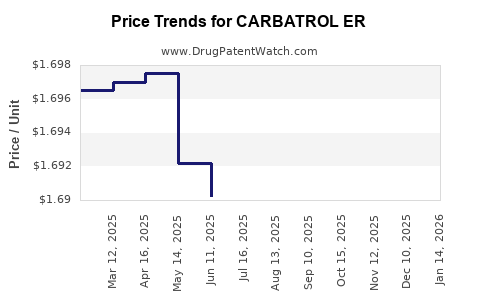
Average Pharmacy Cost for CARBATROL ER
| Drug Name | NDC | Price/Unit ($) | Unit | Date |
|---|---|---|---|---|
| CARBATROL ER 100 MG CAPSULE | 54092-0171-12 | 1.70017 | EACH | 2026-07-22 |
| CARBATROL ER 200 MG CAPSULE | 54092-0172-12 | 1.69430 | EACH | 2026-07-22 |
| CARBATROL ER 300 MG CAPSULE | 54092-0173-12 | 1.69600 | EACH | 2026-07-22 |
| >Drug Name | >NDC | >Price/Unit ($) | >Unit | >Date |
What is CARBATROL ER?
CARBATROL ER (extended-release carbamazepine) is an anticonvulsant medication indicated for epilepsy, bipolar disorder, and trigeminal neuralgia. It functions by stabilizing hyperexcitable neuronal membranes, reducing repetitive neuronal firing, and modulating neurotransmitter activity.
What Is the Current Market Landscape?
Market Size and Segments
The global epilepsy treatment market, which includes CARBATROL ER, was valued at approximately $2.3 billion in 2022. The bipolar disorder segment, covering branded and generic carbamazepine products, generates an additional $1.2 billion annually. Trigeminal neuralgia indications account for roughly 15% of this revenue.
Key Competitors and Products
- Teva Pharmaceuticals: Generic carbamazepine
- Novartis: Tegretol (original branded formulation, phased out in favor of generics)
- Pfizer/Biogen: Carbamazepine ER formulations
- Others: Various generics in multiple markets
Regulatory and Market Dynamics
- The US Food and Drug Administration (FDA) approved CARBATROL ER for epilepsy and bipolar disorder in 2004.
- The medication benefits from patent protections that have expired, increasing generic competition since circa 2008.
- Market expansion relies on formulary inclusion and physician prescribing patterns, primarily in the US and Europe.
What Are the Price Trends and Projections?
Current Pricing
In the US, the average wholesale price (AWP) for a 300 mg CARBATROL ER tablet ranges from $6.50 to $8.00. The outpatient prescription cost, based on average daily doses of 600-1200 mg, approximates $12 to $24 per day.
Generic carbamazepine ER versions retail at 40-70% lower prices, averaging $4 to $6 per 300 mg tablet.
Price Drivers
- Patent expirations have increased competition, leading to falling prices.
- Formulary preferences influence whether branded CARBATROL ER maintains premium pricing.
- Reimbursement policies in the US, mainly via Medicare and private insurers, favor generics, reducing branded drug margins.
Market Forecasts
Between 2023 and 2028, prices for CARBATROL ER are projected to decline annually by approximately 4-6%, primarily driven by increasing generic penetration and state Medicaid formulary negotiations.
Volume Projections
- US prescriptions for carbamazepine (all formulations) are expected to grow at an annual rate of 2%, reaching around 24 million prescriptions by 2028.
- ER formulations account for approximately 40% of these prescriptions, with a tendency to stabilize due to therapeutic equivalence with immediate-release versions.
What Is the Future Outlook?
Potential Market Opportunities
- Extended-release formulations are preferred for their dosing convenience and improved compliance, supporting sustained demand.
- Expansion into emerging markets (Asia, Latin America) is limited but growing, with local pricing pressures.
- The advent of biosimilars or alternative therapies remains unlikely due to carbamazepine's long-standing generic presence.
Challenges
- Increasing price competition from multiple generic manufacturers reduces profitability.
- Strict regulatory controls in certain regions slow market entry for new formulations or generic introductions.
- Safety concerns related to carbamazepine, including risks of hematological and dermatological adverse effects, influence prescribing habits.
Regulatory and Policy Impact
- Continued downward pressure on prices due to health insurance cost-containment policies.
- Potential restrictions on off-label uses could affect overall volume.
What Are Key Takeaways?
- CARBATROL ER belongs to a mature market with declining prices driven by generic competition.
- US prices are expected to decrease 4-6% annually over the next five years.
- Volume growth remains modest, bolstered mainly by prescriber preference for ER formulations.
- Market expansion into emerging economies depends on regulatory environments and reimbursement structure changes.
- The overall market for carbamazepine formulations will remain stable but face pricing pressures.
What Are Five FAQs?
-
Will CARBATROL ER maintain its market share against generics?
Yes, due to its extended-release formulation offering dosing convenience, but price reductions from generics limit profit margins. -
Are new patents expected for CARBATROL ER?
No; patent expirations occurred in the late 2000s, leading to widespread generic availability. -
Can biosimilars compete with CARBATROL ER?
No; biosimilars are not applicable for small-molecule drugs like carbamazepine. Generics are the primary competitive force. -
How do payer policies influence CARBATROL ER pricing?
Payer preferences for low-cost generics exert downward pressure on branded prices, influencing formulary listings. -
Is the market for CARBATROL ER growing?
It is stable, with slight volume increases; however, overall revenue declines due to decreased pricing.
References
[1] IQVIA. "Global Epilepsy Treatment Market Report," 2022.
[2] FDA. "Approval History for CARBATROL ER," 2004.
[3] Medicare and Medicaid Pricing Data, 2022.
[4] Evaluated prices from Red Book Online, 2023.
More… ↓
