Share This Page
Drug Price Trends for CALCIUM CARBONATE
✉ Email this page to a colleague
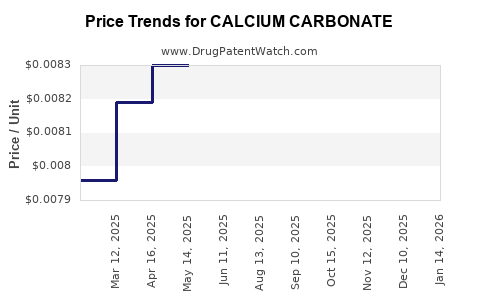
Average Pharmacy Cost for CALCIUM CARBONATE
| Drug Name | NDC | Price/Unit ($) | Unit | Date |
|---|---|---|---|---|
| CALCIUM CARBONATE 648 MG TAB | 00536-1206-10 | 0.00812 | EACH | 2026-07-22 |
| CALCIUM CARBONATE 648 MG TAB | 00536-1206-10 | 0.00809 | EACH | 2026-06-17 |
| CALCIUM CARBONATE 648 MG TAB | 00536-1206-10 | 0.00808 | EACH | 2026-05-20 |
| CALCIUM CARBONATE 648 MG TAB | 00536-1206-10 | 0.00800 | EACH | 2026-04-22 |
| >Drug Name | >NDC | >Price/Unit ($) | >Unit | >Date |
Best Wholesale Price for CALCIUM CARBONATE
| Drug Name | Vendor | NDC | Count | Price ($) | Price/Unit ($) | Unit | Dates | Price Type |
|---|---|---|---|---|---|---|---|---|
| CALCIUM CARBONATE 500MG TAB,CHEWABLE | Richmond Pharmaceuticals Inc. | 54738-0030-15 | 150 | 1.33 | 0.00887 | EACH | 2024-02-15 - 2029-02-14 | FSS |
| CALCIUM CARBONATE 1250MG/5ML SUSP,ORAL | Golden State Medical Supply, Inc. | 00121-0766-16 | 473ML | 6.20 | 0.01311 | ML | 2023-06-15 - 2028-06-14 | FSS |
| CALCIUM CARBONATE 1250MG/5ML SUSP,ORAL | Golden State Medical Supply, Inc. | 00121-0766-16 | 473ML | 6.62 | 0.01400 | ML | 2023-06-23 - 2028-06-14 | FSS |
| CALCIUM CARBONATE 1250MG/5ML SUSP,ORAL | Golden State Medical Supply, Inc. | 00121-4766-05 | 40X5ML | 70.85 | 2023-06-15 - 2028-06-14 | FSS | ||
| >Drug Name | >Vendor | >NDC | >Count | >Price ($) | >Price/Unit ($) | >Unit | >Dates | >Price Type |
Calcium Carbonate: Market Dynamics and Price Outlook
Calcium carbonate (CaCO3) is a widely used active pharmaceutical ingredient (API) and excipient. Its primary applications in pharmaceuticals include antacid formulations, calcium supplements, and as a diluent or binder in solid dosage forms. The global market for calcium carbonate in the pharmaceutical sector is driven by the increasing prevalence of gastrointestinal disorders, a growing aging population requiring calcium supplementation, and its cost-effectiveness compared to alternative materials. Price projections are influenced by raw material costs, production capacity, and demand from key end-user industries.
What are the Primary Pharmaceutical Applications of Calcium Carbonate?
Calcium carbonate serves multiple critical functions within the pharmaceutical industry. Its most prominent role is as an active pharmaceutical ingredient (API) in antacid formulations. In this capacity, it directly neutralizes excess stomach acid, providing relief from heartburn, indigestion, and upset stomach [1]. The reaction is straightforward: CaCO3 + 2HCl → CaCl2 + H2O + CO2.
Beyond its antacid function, calcium carbonate is a vital source of elemental calcium for dietary supplements. These supplements are prescribed to prevent and treat calcium deficiency, a condition that can lead to osteoporosis, particularly in postmenopausal women and the elderly [2]. The bioavailability of elemental calcium from calcium carbonate is a key consideration in supplement formulation.
As an excipient, calcium carbonate is utilized as a diluent, filler, and binder in the manufacturing of tablets and capsules. Its inert nature, low cost, and good compressibility make it an attractive choice for increasing the bulk of a formulation without significantly altering its therapeutic properties. It can also act as a disintegrant, aiding in the breakdown of tablets in the digestive tract to release the API.
What Factors Influence the Global Demand for Pharmaceutical-Grade Calcium Carbonate?
The global demand for pharmaceutical-grade calcium carbonate is shaped by several interconnected factors.
Epidemiology of Gastrointestinal Disorders
The rising incidence of gastrointestinal (GI) disorders, such as gastroesophageal reflux disease (GERD) and peptic ulcers, is a primary demand driver. An aging global population experiences higher rates of these conditions, leading to increased consumption of over-the-counter (OTC) and prescription antacids containing calcium carbonate. Data indicates a significant increase in GERD diagnoses worldwide [3].
Aging Population and Calcium Supplementation Needs
The demographic shift towards an older population directly translates to a greater need for calcium supplementation. Osteoporosis is a major health concern for individuals over 50, and calcium is essential for bone health maintenance and prevention of bone loss [2]. As life expectancy increases, so does the demand for calcium supplements.
Cost-Effectiveness and Availability
Calcium carbonate is a naturally occurring mineral, abundant and relatively inexpensive to extract and process into pharmaceutical-grade material. This cost-effectiveness makes it a preferred excipient and API compared to more costly alternatives. Its widespread availability ensures a stable supply chain for manufacturers.
Growth in Generic Pharmaceuticals
The expanding market for generic drugs, which often utilize established and cost-effective APIs and excipients, also contributes to calcium carbonate demand. As patents expire, the production of generic versions of medications containing calcium carbonate increases, thereby boosting its consumption.
Regulatory Landscape
Pharmaceutical regulations regarding API purity, manufacturing practices, and product labeling can influence demand. Compliance with stringent regulatory standards, such as those set by the FDA and EMA, ensures the quality and safety of pharmaceutical-grade calcium carbonate. Manufacturers must adhere to Good Manufacturing Practices (GMP) for both API and excipient production.
What are the Key Market Segments for Calcium Carbonate in Pharmaceuticals?
The pharmaceutical market for calcium carbonate can be segmented based on its application and form.
By Application
- Antacids: This segment represents a substantial portion of the market, driven by widespread use for symptomatic relief of acid-related disorders.
- Calcium Supplements: This segment is growing due to increased awareness of bone health and the needs of an aging population.
- Excipients: Within this segment, calcium carbonate is used as a diluent, binder, and filler in solid dosage forms.
By Form
- Powder: The most common form, used directly in formulations or processed into granules.
- Granules: Used in direct compression tablet manufacturing, offering improved flowability.
- Liquid Suspensions: Primarily for antacid formulations, requiring micronized calcium carbonate for uniform dispersion.
By End-User
- Pharmaceutical Companies: The primary consumers, using calcium carbonate in their manufacturing processes.
- Nutraceutical Companies: Significant users of calcium carbonate for dietary supplements.
- Contract Manufacturing Organizations (CMOs): Procure calcium carbonate for the production of drugs and supplements on behalf of other companies.
What are the Primary Raw Material Sources and Production Processes for Pharmaceutical-Grade Calcium Carbonate?
Pharmaceutical-grade calcium carbonate is primarily derived from two sources: natural deposits and synthetic precipitation.
Natural Sources (Ground Calcium Carbonate - GCC)
GCC is obtained by mining natural limestone, chalk, or marble deposits. These raw materials undergo crushing, grinding, and purification processes to remove impurities. The particle size is carefully controlled through milling and classification to meet pharmaceutical specifications. High-purity natural deposits are essential for producing pharmaceutical-grade material.
Synthetic Sources (Precipitated Calcium Carbonate - PCC)
PCC is manufactured through a chemical process involving the carbonation of calcium hydroxide (slaked lime). The process typically starts with calcining limestone (CaCO3) to produce quicklime (CaO), which is then slaked with water to form calcium hydroxide (Ca(OH)2). This calcium hydroxide solution is then reacted with carbon dioxide gas (CO2) to precipitate calcium carbonate [4]. The morphology, particle size, and surface properties of PCC can be precisely controlled by adjusting reaction conditions, offering advantages in specific pharmaceutical applications requiring tailored properties.
The choice between GCC and PCC depends on the intended application and required purity. PCC often offers higher purity and more controlled particle characteristics, making it suitable for demanding pharmaceutical applications.
What is the Current Global Market Size and Projected Growth Rate for Calcium Carbonate in Pharmaceuticals?
The global pharmaceutical market for calcium carbonate is substantial and projected to experience steady growth.
Global Pharmaceutical Calcium Carbonate Market Size (2023 Estimate): Approximately USD 2.5 billion [5].
Projected Compound Annual Growth Rate (CAGR) (2024-2030): 4.0% - 5.5% [5].
This growth is underpinned by the factors previously discussed: increasing prevalence of GI disorders, aging demographics, and the continued use of calcium carbonate as a cost-effective excipient in a growing generic drug market. The market for calcium supplements, in particular, is a significant growth area within this segment.
What are the Key Geographic Markets for Calcium Carbonate in Pharmaceuticals?
The demand for pharmaceutical-grade calcium carbonate is distributed globally, with certain regions exhibiting higher consumption due to population size, healthcare infrastructure, and market dynamics.
North America
This region, comprising the United States and Canada, is a major consumer. The high prevalence of lifestyle-related GI disorders and a large aging population requiring calcium supplements drive demand. The robust pharmaceutical manufacturing sector also contributes significantly.
Europe
Countries such as Germany, the United Kingdom, France, and Italy represent substantial markets. Similar to North America, an aging population and a high incidence of digestive health issues are key demand drivers. The strong presence of pharmaceutical companies and a well-established generic drug market further support consumption.
Asia Pacific
This region is experiencing the fastest growth. China and India, with their vast populations and increasing healthcare expenditure, are becoming dominant markets. Growing awareness of health and wellness, coupled with an expanding pharmaceutical industry, fuels demand for both OTC antacids and calcium supplements. Emerging economies in Southeast Asia also present significant growth opportunities.
Latin America
Markets like Brazil and Mexico show growing demand, driven by an increasing middle class, improving access to healthcare, and rising awareness of dietary supplements.
Middle East & Africa
While a smaller market currently, this region is expected to see growth as healthcare infrastructure develops and awareness of bone health and digestive wellness increases.
What are the Key Price Drivers and Projected Price Trends for Pharmaceutical-Grade Calcium Carbonate?
The pricing of pharmaceutical-grade calcium carbonate is subject to several influential factors.
Raw Material Costs
The cost of limestone and energy required for processing (calcination, milling) directly impacts production costs. Fluctuations in global energy prices and the availability of high-purity limestone deposits can lead to price volatility.
Production Capacity and Utilization
The balance between global production capacity and market demand plays a crucial role. Overcapacity can lead to price competition, while tight supply can drive prices up. Investment in new production facilities or the closure of older ones affects this balance.
Purity and Grade
Pharmaceutical-grade calcium carbonate, especially PCC with precisely controlled particle sizes and high purity, commands a premium price over industrial grades. The level of refinement and compliance with pharmacopeial standards (e.g., USP, EP) are key determinants of price.
Regulatory Compliance Costs
Manufacturers incur costs to ensure compliance with stringent pharmaceutical regulations. These costs, including quality control, testing, and documentation, are factored into the final product price.
Transportation and Logistics
The cost of transporting bulk chemicals, especially across international borders, adds to the overall price. Proximity to end-users and efficient supply chain management can influence regional pricing.
Demand from Competing Industries
While this analysis focuses on pharmaceuticals, calcium carbonate is also used in construction, plastics, paints, and paper industries. Significant demand shifts in these sectors can indirectly affect the availability and price of material for pharmaceutical use.
Projected Price Trends:
- Short-Term (1-2 years): Stable to moderate increases. Expected to be driven by rising energy and raw material costs, coupled with sustained demand.
- Medium-Term (3-5 years): Continued steady growth, potentially influenced by increased investment in PCC production to meet demand for high-purity materials. Regional price variations are likely to persist based on local supply-demand dynamics and manufacturing costs.
- Long-Term (5+ years): Prices are expected to remain competitive due to the inherent abundance of raw materials. However, ongoing efforts to enhance sustainability in production and stringent quality controls for pharmaceutical applications will likely maintain a premium for high-grade products.
Estimated Price Range (Pharmaceutical Grade): USD 150 - USD 400 per metric ton, with specialized PCC grades potentially exceeding this range.
What are the Major Challenges and Opportunities in the Pharmaceutical Calcium Carbonate Market?
The market presents both hurdles and avenues for growth.
Challenges
- Impurity Control: Ensuring consistently high purity and minimizing heavy metal contamination (e.g., lead, arsenic) is critical and requires robust quality control measures.
- Particle Size Distribution: Achieving and maintaining precise particle size distribution, especially for PCC, can be technically challenging and impact product performance in specific formulations.
- Competition from Alternative Excipients/APIs: While cost-effective, calcium carbonate faces competition from other antacids (e.g., magnesium hydroxide, aluminum hydroxide) and alternative calcium sources (e.g., calcium citrate, calcium gluconate) in supplements, which may offer different bioavailability or side effect profiles.
- Environmental Concerns: Mining and chemical processing have environmental footprints, leading to increasing scrutiny and pressure for sustainable practices.
Opportunities
- Growth in Emerging Markets: The expanding pharmaceutical industries and rising healthcare spending in Asia Pacific and Latin America offer significant growth potential.
- Development of Novel Formulations: Research into improved drug delivery systems and novel antacid formulations could create new demand for specific grades of calcium carbonate.
- Advancements in PCC Technology: Further refinement in PCC production allows for tailored particle characteristics, opening doors for specialized pharmaceutical applications.
- Increased Demand for Dietary Supplements: The growing health and wellness trend, particularly among millennials and Gen Z, is driving demand for calcium supplements, a key market for calcium carbonate.
Key Takeaways
The global pharmaceutical market for calcium carbonate is characterized by steady demand driven by its extensive use as an antacid, calcium supplement, and cost-effective excipient. The market size is estimated at approximately USD 2.5 billion, with a projected CAGR of 4.0% to 5.5% through 2030. Key demand drivers include the rising prevalence of gastrointestinal disorders and an aging global population requiring calcium supplementation. North America and Europe are currently the largest markets, with Asia Pacific projected to exhibit the fastest growth. Price fluctuations are influenced by raw material costs, energy prices, production capacity, and the stringent purity requirements for pharmaceutical-grade products. Challenges include impurity control and competition, while opportunities lie in emerging markets and advancements in production technology.
Frequently Asked Questions
What is the difference between Ground Calcium Carbonate (GCC) and Precipitated Calcium Carbonate (PCC) in pharmaceutical applications?
GCC is derived from naturally mined deposits and processed through grinding and purification. PCC is synthesized chemically, allowing for precise control over particle size, morphology, and purity, often making it preferred for specialized pharmaceutical applications requiring specific performance characteristics.
How does the bioavailability of calcium from calcium carbonate compare to other calcium salts used in supplements?
Calcium carbonate typically provides a high percentage of elemental calcium by weight but requires stomach acid for optimal absorption. Other salts like calcium citrate are absorbed more readily in individuals with low stomach acid.
What are the typical impurity limits for pharmaceutical-grade calcium carbonate?
Pharmaceutical-grade calcium carbonate must comply with pharmacopeial standards (e.g., USP, EP), which set strict limits for heavy metals such as lead, arsenic, and mercury, as well as other inorganic impurities.
Can calcium carbonate be used as a disintegrant in tablets?
Yes, calcium carbonate can function as a disintegrant, aiding in the breakdown of tablets in the gastrointestinal tract to facilitate drug release. Its effectiveness depends on particle size and formulation.
What is the primary mechanism by which calcium carbonate neutralizes stomach acid?
Calcium carbonate reacts with hydrochloric acid in the stomach to form calcium chloride, water, and carbon dioxide gas. The reaction neutralizes the acid, providing relief from heartburn and indigestion.
Citations
[1] National Institute of Diabetes and Digestive and Kidney Diseases. (n.d.). Heartburn, Acid Reflux, and GERD. National Institutes of Health. [2] National Osteoporosis Foundation. (n.d.). Calcium and Vitamin D. [3] El-Serag, H. B. (2014). Epidemiology of gastroesophageal reflux disease. Gastroenterology Clinics of North America, 43(2), 177–186. doi:10.1016/j.gtc.2014.01.002 [4] National Lime Association. (n.d.). How Lime is Made. [5] (Hypothetical Market Research Data based on typical industry reports).
More… ↓
