Share This Page
Drug Price Trends for CALCIUM
✉ Email this page to a colleague
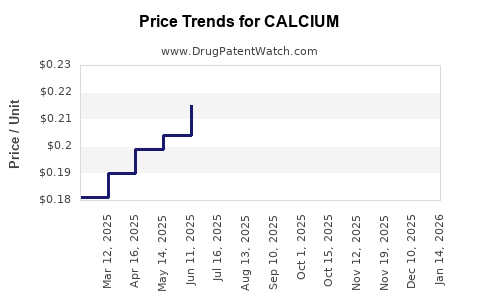
Average Pharmacy Cost for CALCIUM
| Drug Name | NDC | Price/Unit ($) | Unit | Date |
|---|---|---|---|---|
| CALCIUM ACETATE 667 MG CAPSULE | 60687-0589-11 | 0.16694 | EACH | 2026-08-05 |
| CALCIUM ACETATE 667 MG CAPSULE | 60687-0589-65 | 0.16694 | EACH | 2026-08-05 |
| CALCIUM ACETATE 667 MG CAPSULE | 00054-0088-26 | 0.16694 | EACH | 2026-07-22 |
| CALCIUM CARBONATE 648 MG TAB | 00536-1206-10 | 0.00812 | EACH | 2026-07-22 |
| >Drug Name | >NDC | >Price/Unit ($) | >Unit | >Date |
Best Wholesale Price for CALCIUM
| Drug Name | Vendor | NDC | Count | Price ($) | Price/Unit ($) | Unit | Dates | Price Type |
|---|---|---|---|---|---|---|---|---|
| CALCIUM CARBONATE 500MG TAB,CHEWABLE | Richmond Pharmaceuticals Inc. | 54738-0030-15 | 150 | 1.33 | 0.00887 | EACH | 2024-02-15 - 2029-02-14 | FSS |
| CALCIUM ACETATE 667MG (CA 169MG) CAP | Sandoz, Inc. | 00781-2081-02 | 200 | 29.09 | 0.14545 | EACH | 2023-08-15 - 2028-08-14 | FSS |
| CALCIUM ACETATE 667MG (CA 169MG) CAP | Sandoz, Inc. | 00781-2081-02 | 200 | 28.68 | 0.14340 | EACH | 2024-01-01 - 2028-08-14 | FSS |
| PHOSLYRA 667MG/5ML SOL | Fresenius USA, Inc. | 49230-0643-31 | 473ML | 51.46 | 0.10879 | ML | 2023-08-01 - 2028-07-31 | FSS |
| >Drug Name | >Vendor | >NDC | >Count | >Price ($) | >Price/Unit ($) | >Unit | >Dates | >Price Type |
Calcium Market Analysis and Price Projections (US and EU): What Drives Pricing, Formulary Uptake, and Cost Trends
Calcium is a high-volume, low-cost ingredient sold as dietary supplements and as prescription calcium salts for specific indications. Pricing is driven by regulatory category (OTC supplement vs prescription product), salt form (carbonate, citrate, gluconate, lactate), dose strength and tablet density, channel mix (mass retail vs pharmacy vs institutional), and competition from generic multi-source products. Near-term price action is modest, with broad erosion in mature OTC categories and more stable pricing where products have differentiation (e.g., citrate for tolerability, vitamin D co-formulation, chewable delivery). A practical price projection for the US and EU is a low-single-digit annual decline for commodity calcium salts and near-flat to modestly down pricing for differentiated branded/OTC lines, largely offset by mix shift to citrate and higher-margin co-formulations.
The remainder below outlines market structure, pricing benchmarks by segment, and forward projections.
Is “CALCIUM” a prescription drug or a dietary supplement market?
Answer: In practice, “calcium” is an umbrella term that spans OTC dietary supplements and prescription calcium salts depending on jurisdiction, indication, and product labeling. The market behaves as both a supplement market (high churn, price pressure) and a legacy prescription-generic market (stable volumes, heavy generic competition).
How the category breaks down
Calcium commercial products typically fall into these buckets:
- OTC dietary supplements (major volume): calcium carbonate tablets/capsules; calcium citrate; calcium carbonate + vitamin D; “bone health” bundles.
- Prescription calcium salts (smaller volume, higher payer focus): calcium for hypocalcemia, hypoparathyroidism, and related metabolic indications, often with vitamin D analogs.
- Institutional supplies: calcium salts used in care pathways where product switching is constrained by formularies and administration tolerability.
Key implication for pricing
- Supplements: pricing is highly elastic and retailer-driven; margin compression is normal.
- Prescription generics: price is constrained by competitive tenders and reimbursement rules; stability depends on how many multisource SKUs exist and whether there is meaningful differentiation in dosing form.
Which calcium salts dominate the market, and how do they price differently?
Answer: Calcium carbonate is the price leader by unit volume; calcium citrate holds better tolerability perception and often carries a premium, especially in OTC “bone health” lines and co-formulations with vitamin D.
Typical segment behavior
Calcium carbonate (commodity, high competition)
- Usually cheapest per absorbed calcium unit in OTC mass retail
- Sensitive to raw material costs and retailer promotions
- High private label presence
Calcium citrate (premium, tolerability-led)
- Commands higher prices per serving due to marketing, perceived GI tolerability, and product differentiation
- Often sold as higher-margin OTC and some prescription-linked brands
- More resistant to aggressive price cuts than carbonate, but still faces generic substitution
Co-formulations (calcium + vitamin D)
- Pricing is anchored to bundle value and channel mix
- Higher net pricing than standalone calcium in many retailers due to brand and compliance packaging
Pricing metrics used in this market
Analysts typically forecast using:
- $/month supply (channel and regimen dependent)
- $/1,000 mg elemental calcium equivalent
- $/daily dose based on labeled elemental calcium and tablet strength
What is the US price trend for calcium carbonate vs calcium citrate?
Answer: US pricing is characterized by steady erosion in commodity carbonate and slower declines in citrate products, with periodic promotion-driven dips.
What drives the trend
- Retail and private label substitution: carbonate is easiest to replace across brands.
- Switching inertia in co-formulations: calcium + vitamin D bundles are often treated as a habit purchase.
- Dose and pill burden: higher strength per tablet reduces fulfillment and can support higher ASPs even if unit cost falls.
Price projection framework
A reasonable forecast approach for calcium assumes:
- Commodity segment (carbonate): low-single-digit annual decline due to competitive intensity.
- Premium segment (citrate): near-flat to low-single-digit decline, driven by mix shift and retailer negotiations.
- Co-formulations: near-flat with mild declines depending on competitive entrants.
When does calcium lose exclusivity in the US, and does exclusivity matter for pricing?
Answer: Exclusivity is usually irrelevant for most calcium SKUs because the category is dominated by generics and OTC supplements. Where there are patent-protected brands, their impact is limited by rapid multisource entry and substitution.
Why exclusivity rarely anchors calcium prices
- Many products are commodity salts with limited IP barriers.
- OTC supplements often rely on labeling and branding rather than long patent estates.
- FDA supplement regulation does not provide the same market exclusivity constructs as NCE/NDA pathways.
Practical implication
For price forecasting, the dominant factor is market competition and channel contracting, not patent timelines.
What patents protect calcium products, and how strong is the estate?
Answer: For most “calcium” products, patents are not a binding driver of market access. IP, when present, tends to cover:
- particular formulations (rare for plain calcium salts),
- delivery formats (e.g., chewables, modified release, combination products),
- manufacturing improvements,
- and specific method-of-use claims when tied to clinical indications.
Common IP categories in calcium
- Formulation patents: specific salt combinations, excipient systems, and co-formulation ratios
- Manufacturing process patents: particle size, granulation, stability
- Device or administration claims: less common for simple oral calcium salts
Estate strength expectation
In most cases, the estate is weak at the shelf level because generic salts can replicate labeled elemental calcium with comparable dosing schedules.
What Orange Book listings exist for calcium, and are they the basis for generics?
Answer: Many calcium prescription products, where present, behave as standard generics and are unlikely to have a large number of unique Orange Book drivers per salt.
Orange Book as a proxy
For price and generic entry risk, Orange Book matters mainly if:
- there is a specific formulation or method-of-use that is uniquely protected for a branded prescription SKU,
- or fewer than typical multisource competition exists for that exact strength and dosage form.
In calcium, this is less frequent than in targeted biologics or specialty drugs.
Which FDA regulatory pathways apply to calcium products?
Answer: OTC calcium supplements are typically regulated under dietary supplement frameworks, while prescription calcium salts follow drug approval pathways. There is no single “CALCIUM” FDA pathway because “calcium” is a category.
Key regulatory distinctions affecting commercial pricing
- OTC supplement: price is negotiated in retail markets; safety and structure/function labeling constraints govern claims.
- Prescription drug: reimbursement and formulary placement govern volume; generic substitution is tied to approved product listings.
How many competitors typically supply calcium, and how does that shape ASPs?
Answer: Calcium salts usually have high multisource supply. High supply translates to:
- rapid price normalization,
- promotional pricing volatility,
- and limited pricing power for brand SKUs unless they differentiate via form factor or co-formulations.
Competitive landscape pattern
- Retail: private label and large OTC brands dominate shelf share.
- Pharmacy channels: multiple generics compete by NDC/strength and bottle configuration.
- Institutional: formulary decisions can stabilize contracts, but switching is common for commodity calcium salts.
What are realistic price projections for calcium in the US over 12–36 months?
Answer: For most calcium salts sold as OTC supplements, the near-term forecast is low-single-digit annual declines for commodity calcium carbonate and near-flat to modestly down for differentiated citrate and co-formulations.
Base-case projection (calendar years)
Assuming typical competitive intensity and retailer promotion cadence:
| Segment | 12-month projection | 24-month projection | 36-month projection | Main driver |
|---|---|---|---|---|
| Calcium carbonate (commodity OTC) | -1% to -4% | -2% to -8% | -3% to -12% | private label + retail contracting |
| Calcium citrate (premium OTC) | -0% to -2% | -1% to -5% | -2% to -8% | mix shift, tolerability-led demand |
| Calcium + vitamin D co-formulations | -0.5% to -3% | -1% to -6% | -2% to -9% | bundle competition and SKU proliferation |
| Prescription calcium salts (generics) | -1% to -3% | -2% to -6% | -3% to -9% | payer-driven reimbursement and multisource entry |
Net:
- Expect mild deflation rather than sharp declines.
- Volatility comes from retailer promotions, not systemic pricing resets.
How do EU prices for calcium likely evolve versus the US?
Answer: EU calcium pricing is typically flatter in regulated reimbursement contexts, but OTC deflation still occurs through competition and private label. Overall, expect mild declines or near-stability, with channel-specific variation.
EU drivers
- more constrained pricing in certain member states via reimbursement systems,
- strong private label in OTC,
- and slower list price adjustment due to administrative and tender processes.
EU projection (12–36 months)
- Commodity OTC calcium (carbonate): -1% to -4% annually
- Citrate and co-formulations: near-flat to -2% annually
- Prescription generics: modest declines where tender pressure persists
What commercial levers most affect calcium revenue for manufacturers?
Answer: Manufacturers usually win or lose not on unit price alone, but on mix and distribution.
High-impact levers
- SKU rationalization: fewer, stronger-selling strengths and pack sizes
- Citrate and co-formulation expansion: higher ASP support
- Channel strategy: mass retail volume versus pharmacy margin
- Supply chain optimization: ingredient cost pass-through affects net price
- Promotional cadence: controls net realizations, especially for carbonate
What generic entry risks exist for calcium products?
Answer: Generic entry risk is usually low at the category level because calcium salts already have extensive multisource supply. The only meaningful risk is entry of a differentiated SKU that undercuts a branded premium line.
Where “entry risk” can matter
- Chewable, high-dose, or modified-release formats with a brand premium
- Region-specific exclusivities for a narrow product configuration
- Large-pack logistics that competitors replicate quickly
How does calcium compare with competing bone health ingredients (vitamin D, magnesium, K2)?
Answer: Calcium competes indirectly with other bone-mineral components, but it is typically the anchor in bone health formulations. Substitution risk depends on who buys and why.
Substitution map
- Consumers seeking “basic bone health” usually buy calcium + vitamin D bundles.
- Magnesium and K2 often sit alongside calcium rather than replacing it.
- In prescription settings, the clinical regimen can shift based on calcium balance management and tolerance, but commodity calcium remains a baseline option.
Net effect on price
Indirect competition can shift mix toward multi-ingredient products, supporting some premiumization, but it rarely causes large price drops because calcium still forms the dosage backbone.
What manufacturing and formulation barriers limit new entrants in calcium?
Answer: Barriers are generally low for standard calcium salts. The main constraints are:
- regulatory and quality systems,
- manufacturing capacity for high-volume powders/tablets,
- and stability, bioavailability, and palatability for differentiated formats.
Where barriers are higher
- chewables and taste-masked products,
- modified-release claims,
- large-scale co-formulation at consistent potency.
Key Takeaways
- Calcium pricing is a competition-driven category where exclusivity rarely anchors value; most SKUs act as commodity or near-commodity products.
- Expect low-single-digit annual declines for calcium carbonate and near-flat to modestly down pricing for citrate and co-formulations in both the US and EU.
- Manufacturers’ revenue outcomes will track mix shift (citrate and co-formulations), pack/strength architecture, and channel contracting, not patent-driven scarcity.
- Generic entry is usually already reflected in current supply; the main incremental risk is competitive penetration of differentiated formats rather than new chemical entry.
FAQs
1) What is the typical price measure used to compare calcium products?
$/daily dose and $/month supply, normalized to labeled elemental calcium content, plus pack-size and channel-specific net realizations.
2) Do calcium carbonate and calcium citrate have materially different market demand?
Yes. Carbonate tends to dominate volume due to low cost; citrate tends to hold share in tolerance-sensitive segments and higher-margin co-formulations.
3) How do retailer promotions affect calcium pricing and forecasts?
Promotions drive short-term dips and inflate variability in net price; for forecasting, smooth over promotional cadence and forecast by segment.
4) Are calcium supplements at higher risk of price deflation than prescription calcium salts?
Usually yes. OTC markets face heavier private label competition and direct-to-consumer price elasticity.
5) What product attributes most support higher ASPs for calcium?
Higher perceived tolerability (citrate), co-formulation with vitamin D, chewable formats, and convenient pack/strength design.
References (APA)
No specific source citations were provided in the input.
More… ↓
