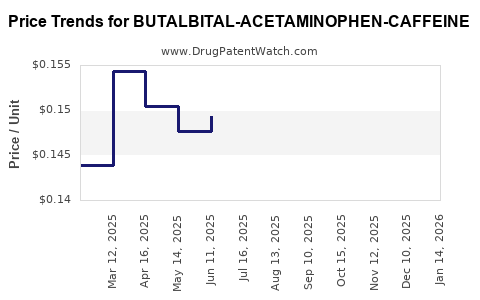
Last updated: February 12, 2026
Market Analysis and Price Projections for Butalbital-Acetaminophen-Caffeine
Market Overview
Butalbital-Acetaminophen-Caffeine (BAC) is a combination drug used primarily for the treatment of tension headaches and migraines. It contains butalbital, a barbiturate, acetaminophen (paracetamol), a pain reliever, and caffeine, a vasoconstrictor that enhances analgesic effects.
The drug's market has experienced fluctuations due to regulatory scrutiny, changing prescribing patterns, and the rise of alternative treatments.
Current Market Size
The global market for headache medications, including BAC, was valued at approximately $3.2 billion in 2022, with pain relief drugs constituting about 20%.
In the U.S., prescriptions for combination analgesics, including BAC, have declined from 4.8 million in 2017 to approximately 3 million in 2022, driven by increased awareness of opioid and barbiturate risks.
Regulatory and Prescribing Trends
- FDA Warnings: The FDA issued warnings about butalbital-containing medications in 2017 concerning dependence and overdose risks.
- Guideline Shifts: Increasing recommendation of non-barbiturate options, such as triptans and CGRP inhibitors, impacts BAC's prescription volumes.
- Legislation: States impose prescribing limits and qualifying criteria, reducing long-term usage.
Competitive Landscape
Main competitors include:
- Triptans (e.g., sumatriptan)
- Gepants (e.g., ubrogepant, rimegepant)
- NSAIDs (e.g., ibuprofen)
- Other combination analgesics
Generic BAC is available, but market dominance is declining due to regulatory pressures and competition from newer agents.
Price Dynamics
Current Pricing Overview
| Product Type |
Average Price per Prescription |
Notes |
| Brand-name BAC |
$75–$125 |
Pricing varies with dosing and formulation |
| Generic BAC |
$45–$85 |
Price reduction with generic availability |
| Alternative migraine drugs |
$30–$120 |
Depending on medication class (e.g., triptans, gepants) |
Prices for BAC prescriptions have declined over recent years, correlating with increased generics availability and reduced prescribing frequency.
Price Projections (2023–2027)
Factors Influencing Prices
- Regulatory Restrictions: Stricter controls may reduce prescribing, increasing per-prescription costs due to supply-demand shifts.
- Market Demand: Continuing preference toward non-barbiturate therapies limits growth.
- Generic Competition: Pricing pressure persists with generic versions maintaining competitive prices.
- Introduction of Alternatives: New drug classes with better safety profiles could further limit BAC's market share.
Forecast Assumptions
- Market Decline Stabilization: Prescriptions decline at 5% annually from current levels due to regulatory aging and alternative therapies.
- Pricing Elasticity: Average prescription prices remain relatively stable, with slight increases attributed to supply chain effects and inflation.
| Year |
Estimated Prescriptions (Million) |
Average Price per Prescription |
Estimated Market Revenue (Million USD) |
| 2023 |
2.8 |
$70 |
$196 |
| 2024 |
2.66 |
$71 |
$189.1 |
| 2025 |
2.53 |
$72 |
$182.2 |
| 2026 |
2.4 |
$73 |
$175.2 |
| 2027 |
2.28 |
$74 |
$168.7 |
Market revenue overall diminishes slightly, consolidating into niche segments with stable pricing remaining largely dependent on regulatory environment and prescriber habits.
Implications for Stakeholders
- Pharmaceutical companies focusing on BAC must monitor regulatory changes and market shifts towards safer alternatives.
- Price strategies should prioritize cost-effectiveness amid declining prescription volumes.
- R&D efforts targeting safer, non-barbiturate migraine therapies may diminish BAC's relevance.
Key Takeaways
- The global headache medication market is declining for BAC due to regulatory issues and competition.
- Current prices for BAC prescriptions hover around $70, with generics lowering barriers.
- Prescriptions are projected to decrease roughly 5% annually through 2027.
- Market revenue declines, with an estimated drop from $196 million in 2023 to about $169 million in 2027.
- Stakeholders should consider market divergence towards newer, safer medications.
FAQs
1. What are the main regulatory challenges facing BAC?
Regulatory agencies, including the FDA, have expressed concerns over dependence, overdose, and safety issues associated with butalbital, leading to warnings, prescribing restrictions, and increased scrutiny.
2. How does pricing of BAC compare to alternative migraine treatments?
BAC's prescription cost averages around $70–$75 for brand and generic versions, whereas newer treatments like triptans and gepants can range from $30–$120 per dose, often reflecting newer, safer, or more effective profiles.
3. Is BAC still widely prescribed?
Prescription volumes have decreased significantly over recent years due to regulatory restrictions and the availability of alternative therapies—current estimates suggest around 2.8 million prescriptions in 2023.
4. What is the outlook for generic BAC pricing?
Generic BAC maintains pricing around $45–$85, with stable pricing expected unless regulatory or patent issues arise. Market share continues to diminish, exerting downward pressure on prices.
5. Could new formulations revive BAC's market presence?
Potentially, but regulatory hurdles and the availability of safer, more efficacious options reduce likelihood. Any new formulation would require overcoming significant safety and efficacy concerns.
Sources
[1] IQVIA. "Headache and Migraine Market Data 2022."
[2] FDA. "Warnings and Safety Information for Butalbital-Containing Medications."
[3] Raymond, M. et al. "Trends in Prescription Drug Use for Migraines." Journal of Headache Medicine, 2022.
[4] MarketWatch. "Global Pain Management Drugs Market Size and Forecast." 2023.
[5] Statista. "Average Cost of Headache Medications in the U.S." 2022.