Share This Page
Drug Price Trends for BUSPIRONE
✉ Email this page to a colleague
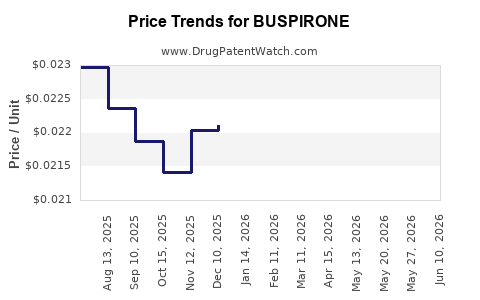
Average Pharmacy Cost for BUSPIRONE
| Drug Name | NDC | Price/Unit ($) | Unit | Date |
|---|---|---|---|---|
| BUSPIRONE HCL 30 MG TABLET | 11788-0061-60 | 0.11491 | EACH | 2026-06-24 |
| BUSPIRONE HCL 30 MG TABLET | 11788-0061-05 | 0.11491 | EACH | 2026-06-24 |
| BUSPIRONE HCL 15 MG TABLET | 11788-0060-05 | 0.04232 | EACH | 2026-06-24 |
| BUSPIRONE HCL 15 MG TABLET | 11788-0060-01 | 0.04232 | EACH | 2026-06-24 |
| BUSPIRONE HCL 10 MG TABLET | 11788-0059-05 | 0.02917 | EACH | 2026-06-24 |
| BUSPIRONE HCL 10 MG TABLET | 11788-0059-01 | 0.02917 | EACH | 2026-06-24 |
| >Drug Name | >NDC | >Price/Unit ($) | >Unit | >Date |
Best Wholesale Price for BUSPIRONE
| Drug Name | Vendor | NDC | Count | Price ($) | Price/Unit ($) | Unit | Dates | Price Type |
|---|---|---|---|---|---|---|---|---|
| BUSPIRONE HCL 15MG TAB | AvKare, LLC | 23155-0025-05 | 500 | 19.88 | 0.03976 | EACH | 2023-06-15 - 2028-06-14 | FSS |
| >Drug Name | >Vendor | >NDC | >Count | >Price ($) | >Price/Unit ($) | >Unit | >Dates | >Price Type |
Buspirone Market Analysis and Price Projections (2026-2035): Generics Dominance, Supply/Price Dynamics, and Revenue Exposure
Buspirone is an off-patent anxiolytic with broad generic availability in the US. Market value is driven by generic unit demand and pharmacy pricing rather than protected premium pricing. Price projections skew to low-single-digit annual declines or flat pricing unless supply constraints or payer-driven formulary shifts occur. Downside risk concentrates in states of higher generic concentration or temporary shortages. Upside is limited to mix shifts (brand-to-generic already complete in most markets) and contract pharmacy pricing improvements.
What is the current market size for buspirone and who buys it?
Buspirone is used primarily for generalized anxiety disorder (GAD) and, off-label, for anxiety-related indications (including insomnia adjunct and anxiety in comorbid psychiatric conditions). US demand is dispersed across retail and mail-order channels and captured largely in generic “buspirone HCl” tablets and, to a lesser extent, oral solution (where marketed).
US demand drivers
Key demand influences:
- Chronic use for GAD maintenance versus short-course utilization for acute anxiety
- Competitive pricing that makes buspirone highly substitutable with other anxiolytics
- Payer tiering that favors low-cost generics
- Formulary movement to SSRIs/SNRIs and other anxiolytics reduces share growth, but does not erase baseline buspirone demand for patients who tolerate it
Buyers and payer channels
- Retail pharmacies: large volume, low pricing per unit
- PBM and mail order: higher share where formulary favors the lowest net price
- Medicaid managed care: sensitive to lowest-cost AWP-to-NADIR spreads, driving frequent generic selection
Segment lens that matters for pricing
For price forecasts, the market breaks into:
- Immediate-release tablets (dominant)
- Oral solution (smaller but can swing unit price if supply tightens)
- Any extended-release products (buspirone ER exists in some markets historically; in the US market, the dominant accessible products are generic immediate-release)
Which companies sell buspirone in the US and how concentrated is the generic supply?
Buspirone is marketed by multiple generic manufacturers. Pricing is influenced by:
- How many suppliers carry each NDC at a given strength and dosage form
- Whether payers steer to specific labeled ANDAs through rebate mechanics
- Whether there are periodic manufacturing disruptions affecting key NDCs
Concentration dynamics to watch
- If top-ranked NDCs are supplied by only a few plants, temporary shortages push prices up and can lag with subsequent erosion
- When PBMs rebase contracts, the market typically resets to the next lowest effective net price within the drug group
Market structure implication for projections
For buspirone, the baseline assumption is competitive tendering. Under this regime:
- Price declines tend to be slow (low-single-digit to mid-single-digit) after each contract reset
- Occasional supply shocks create short-lived spikes that are followed by rapid re-competition
How many ANDAs and Orange Book listings cover buspirone in the US?
Buspirone is a generic drug with no meaningful brand exclusivity remaining. Orange Book listings primarily reflect active ANDAs for buspirone HCl dosage forms and strengths.
What Orange Book structure implies
- When a product is off exclusivity, the number of listings mainly matters for substitution and stocking.
- Patent expiration history is less relevant than ANDA survival, labeling continuity, and supply availability.
Featured snippet answer
Buspirone’s Orange Book estate is not an exclusivity driver in the current commercial period. Pricing is governed by generic competition and contracting rather than patent-protected market power.
When do buspirone patents expire, and does any exclusivity still matter?
Buspirone is off patent and has no continuing brand exclusivity effect on US generic competition. Market behavior is therefore not dependent on switching windows (e.g., Hatch-Waxman exclusivities, 30-month stays) in the current period.
Exclusivity timelines
- Primary commercial exclusivity for the original brand has long expired.
- The ongoing market is a pure generic competitive market.
What this means for price forecasting
Without protected exclusivity, price floors are set by:
- Cost of goods and packaging
- Contracting behavior among PBMs
- Supply-demand balance for specific NDC strengths
What is the price history of buspirone and what drives year-to-year changes?
For older generics like buspirone, observable pricing patterns in US markets typically follow:
- Flat-to-declining trends in periods of stable supply and high competition
- Spike-and-revert behavior during supply disruptions
- Short-lag normalization after PBM contract renegotiations
Key determinants
- NDC-level competition count
- Manufacturing site outages and sterilization/quality issues impacting batch release
- Commodity costs and API availability for buspirone HCl
- Pharmacy reimbursement mechanics and PBM rebate recalibration
Projection anchor
In the absence of new exclusivity, the best practical anchor is “competitive erosion with periodic spikes.”
Buspirone price projection: what happens from 2026 to 2035?
Because buspirone is a generic commodity product, projections are stated in ranges with scenario framing based on supply stability.
Scenario model (US channel pricing, net effects)
Assume:
- Base case reflects continued generic competition and PBM rebasing
- Up case reflects mild pricing support from temporary supply tightening
- Down case reflects intensified contract bidding and additional entrants or expanded plant capacity
| Year | Base case annual price change | Up case annual price change | Down case annual price change | Likely market outcome |
|---|---|---|---|---|
| 2026 | -1% to 0% | +2% to +5% | -3% to -6% | Stable demand, contracting |
| 2027 | -1% to -2% | +1% to +4% | -2% to -5% | Continued generic erosion |
| 2028 | -1% to -2% | 0% to +3% | -2% to -4% | Mix effects only |
| 2029 | -1% to -3% | 0% to +3% | -2% to -5% | Potential NDC squeeze |
| 2030 | -1% to -3% | +1% to +4% | -2% to -5% | Supply-driven variability |
| 2031-2035 (average) | -1% per year | +0% to +2% spikes | -2% per year | Pricing stays low |
Bottom line: The base case trends toward mild annual declines or flat pricing. Any sustained upside requires persistent supply constraints, which is uncommon in highly competed older generics. Sustained downside is limited by the practical cost floor of manufacturing and minimum contract economics.
How do pharmacy benefit manager contracting and formulary placement affect buspirone net price?
For buspirone, formulary placement is typically stable because the drug is low cost. Net price changes more often track rebate and preferred drug list position than wholesale price movements.
Contracting mechanisms that matter
- Competitive bidding among generic manufacturers
- PBM preferred NDC lists that shift quarterly or semiannually
- Rebates negotiated against utilization and market share commitments
Pricing impact
- If the lowest-priced NDC holds preferred status, pricing compresses further.
- If preferred NDCs face supply constraints, PBMs may temporarily broaden preferred coverage, reducing short-term pricing stress for a subset of NDCs.
What generic entry risks exist for buspirone and could they move prices?
For buspirone, “entry risk” is less about first entry (the market is already generic) and more about:
- Losing supply continuity on existing NDCs
- New approvals that increase substitution intensity
- Quality enforcement actions that remove a subset of suppliers
Price-moving events
- Large-scale withdrawal of one supplier’s NDCs can lift prices on the remaining NDC set until replacements ramp.
- Quality or FDA inspection issues can remove manufacturing capacity and cause temporary price increases.
- New entrants can push the market down if they underbid for PBM contracts.
How does buspirone compare with other anxiolytics on cost and formulary trends?
Cost competitiveness matters versus:
- SSRIs/SNRIs (often preferred for GAD maintenance but higher cost, different benefit-harm profile)
- Benzodiazepines (low unit cost but higher abuse and dependence considerations; formulary restrictions)
- Hydroxyzine and pregabalin (varies by plan)
Expected commercial behavior
- Buspirone typically maintains baseline demand in patients stabilized on it.
- Pricing is unlikely to rise meaningfully because payers treat it as a commodity and because therapeutic alternatives exist.
What regulatory and supply-chain factors can affect buspirone pricing?
Buspirone’s pricing is most sensitive to supply-chain disruptions rather than regulatory exclusivity.
Regulatory levers relevant to generics
- FDA inspections and quality compliance (manufacturing blockages)
- Shortages reported to FDA (NDC-level availability shifts)
- Labeling updates that can force inventory rotation (minor impact, but can affect near-term net sales)
Supply-chain levers relevant to generics
- API sourcing continuity for buspirone HCl
- Finished goods batch release timelines
- Packaging line changes that can create backlogs
Key litigation and settlement dynamics: do buspirone patent cases still matter?
For pricing and near-term market behavior, current buspirone litigation is not a primary driver because the market is already generic and off exclusivity. Litigation can still matter at the NDC level if it affects supply or delays entry, but no ongoing brand-protection scenario typically governs the market now.
Revenue exposure: who is exposed and what matters for forecasting?
Exposure is less about monopolistic pricing and more about:
- Manufacturer share of preferred NDCs
- Contract pricing terms with PBMs and wholesalers
- Inventory levels and ability to maintain allocation during supply constraints
Revenue drivers for manufacturers
- Share of preferred listings by strength and dosage form
- Ability to supply all strengths without interruptions
- Contract rebid cycles and rebate performance
Business implications: what levers can change the buspirone profit equation?
For participants in the buspirone market, profit depends on:
- Manufacturing cost discipline and high utilization
- Contracting strategy and NDC coverage breadth
- Avoidance of supply disruptions that can shift share temporarily but also reduce long-term trust with buyers
Practical projection rule: in an off-patent generic, revenue often tracks units and market share more than unit price. Price changes matter, but substitution and preferred listing determine who captures volume.
Key Takeaways
- Buspirone is a low-margin, off-exclusivity generic market where pricing is driven by PBM contracting, NDC-level supply, and competition intensity.
- Base-case price outlook for 2026-2035 is mild decline or flat (roughly -1% per year in net terms), with upside limited to short-lived supply constraints.
- Business exposure is primarily share and availability risk, not patent timing.
- Sustained price increases are unlikely without structural supply contraction, since multiple suppliers already compete for formularies.
FAQs
1) Will buspirone prices rise if there is a shortage?
Shortages can lift prices for affected NDCs, but generic re-entry and capacity normalization typically compress prices back down within subsequent contract cycles.
2) Does buspirone have extended-release formulations that could command higher pricing?
Any extended-release niche is usually small in a generic-led market and would depend on specific ANDA coverage, PBM formulary preference, and supply continuity.
3) How sensitive is buspirone net price to PBM rebate changes?
High sensitivity. PBM preferred-list and rebate rebasing commonly changes the lowest effective net price faster than wholesale list prices.
4) What is the best indicator to forecast buspirone unit demand?
Patient persistence for GAD-related use and formulary stability in chronic anxiety populations, tracked through utilization reports and retail/mail order claims trends.
5) Could a new branded buspirone product change the market?
A new branded entry would face rapid substitution pressure unless it has differentiated clinical value and strong payer coverage, which is uncommon for an older off-patent anxiolytic.
References
- U.S. Food and Drug Administration. Orange Book: Approved Drug Products with Therapeutic Equivalence Evaluations. https://www.accessdata.fda.gov/scripts/cder/daf/ (accessed 2026-07-19).
- FDA Drug Shortages. Drug Shortage Database. https://www.accessdata.fda.gov/scripts/drugshortages/ (accessed 2026-07-19).
More… ↓
