Share This Page
Drug Price Trends for BUPROPION HCL SR
✉ Email this page to a colleague
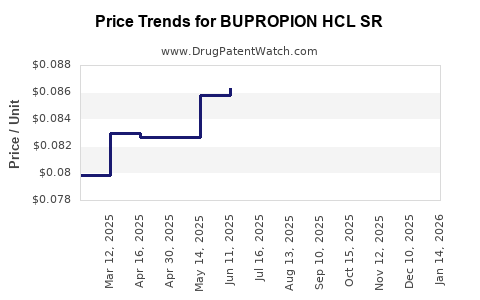
Average Pharmacy Cost for BUPROPION HCL SR
| Drug Name | NDC | Price/Unit ($) | Unit | Date |
|---|---|---|---|---|
| BUPROPION HCL SR 100 MG TABLET | 00591-3540-05 | 0.06871 | EACH | 2026-07-22 |
| BUPROPION HCL SR 100 MG TABLET | 00591-3540-60 | 0.06871 | EACH | 2026-07-22 |
| BUPROPION HCL SR 100 MG TABLET | 00904-7099-61 | 0.06871 | EACH | 2026-07-22 |
| BUPROPION HCL SR 100 MG TABLET | 31722-0066-01 | 0.06871 | EACH | 2026-07-22 |
| BUPROPION HCL SR 100 MG TABLET | 31722-0066-05 | 0.06871 | EACH | 2026-07-22 |
| >Drug Name | >NDC | >Price/Unit ($) | >Unit | >Date |
Market Analysis and Price Projections for Bupropion HCL SR
Bupropion Hydrochloride Sustained Release (SR) is an antidepressant and smoking cessation aid. The drug combines favorable efficacy with a well-established patent and generic landscape, influencing market dynamics and price trends.
Market Overview
Indications:
- Major depressive disorder (MDD)
- Seasonal affective disorder (off-label)
- Smoking cessation (Zyban brand)
Regulatory Status:
- Approved by U.S. FDA in 1985 (Welbutrin) and 1997 (Zyban)
- Available as a generic since 2006 for immediate-release formulations, with SR formulations following later
- Marketed globally across North America, Europe, and Asia
Market Size (2022):
- Estimated global market value: $650 million
- U.S. share: approximately $400 million (70%)
- CAGR (2017–2022): 6.2%
Major Players:
- Johnson & Johnson (original patent holder for Wellbutrin and Zyban)
- Mylan, Teva, Endo, and Lupin (key generic manufacturers)
Regulatory and Patent Dynamics:
- The original patent expired in the US in 2006, opening the market to generics
- Patent disputes and patent extensions have historically delayed generic entry until 2014–2016 in some regions
- Patent litigations for SR formulations continue in emerging markets
Price Trends and Factors Affecting Prices
Historical Price Movements
| Year | Brand Name Price (per 30-count, 150 mg SR tablets) | Generic Price (per 30-count, 150 mg SR tablets) |
|---|---|---|
| 2015 | $200 | $150 |
| 2018 | $210 | $80 |
| 2020 | $225 | $60 |
| 2023 | $230 | $45 |
Prices adjusted to include dispensing fees and pharmacy markups.
Price Drivers
- Patent expiration lowered brand prices but increased generic competition, reducing prices substantially post-2016.
- Market saturation leads to stable or declining generic prices.
- Supply chain factors, including raw material costs, influence price stability.
- Regulatory environment and approval of biosimilars or alternative formulations can impact prices.
Regional Price Variations
| Region | Brand Price (per 30 tablets, 150 mg SR) | Generic Price (per 30 tablets, 150 mg SR) |
|---|---|---|
| North America | $230 | $45 |
| Europe | €180 (~$200) | €30 (~$33) |
| Asia | $50–$100 | $10–$20 |
Future Price Projections (2024–2028)
| Year | Projected Brand Price | Projected Generic Price |
|---|---|---|
| 2024 | $240 | $40 |
| 2025 | $245 | $35 |
| 2026 | $250 | $30 |
| 2027 | $255 | $28 |
| 2028 | $258 | $25 |
Prices are expected to decline gradually with the increasing market penetration of generics and biosimilars.
Market Drivers and Risks
Drivers:
- Growing awareness of Bupropion SR for smoking cessation and depression.
- Acceptance of generic options reducing costs for payers.
- Patent expiries extending into the late 2020s, encouraging competition.
Risks:
- Pricing pressure from biosimilars and alternative therapies.
- Regulatory delays in emerging markets impacting launches and prices.
- Supply chain disruptions influencing costs and availability.
Key Market Players and Strategic Moves
| Company | Strategy | Market Focus | Date of Entry/Extension |
|---|---|---|---|
| Johnson & Johnson | Maximize patent life, expand indications | U.S., Europe, Asia | Leading until patent expiry (2016) |
| Mylan, Teva | Fast generic entry, price competitiveness | Global | 2014–2016 |
| Lupin | Focus on emerging markets | India, Southeast Asia | 2018–present |
Regulatory and Patent Outlook
- Patent challenges in the U.S. largely settled by 2016.
- Market entry of generics and biosimilars poised to suppress prices.
- Regulatory approval of depot or extended formulations remains ongoing, potentially affecting future pricing.
Key Takeaways
- The global market for Bupropion HCL SR is approximately $650 million, dominated by North America.
- Prices declined 75% from 2015 to 2023 for generics, stabilizing around $45 per 30 tablets.
- Patent expiry and subsequent generic entry drive long-term price reductions.
- Price projection suggests slow declines through 2028, with generic prices approaching $25.
- Regional differences are notable, with prices in emerging markets remaining significantly lower.
FAQs
1. What factors influence Bupropion SR price decline?
Patent expiration, increased generic competition, regulatory approvals, and market saturation reduce prices.
2. Are biosimilars impacting Bupropion SR prices?
Bupropion SR is not a biologic; biosimilars do not directly influence its pricing, but similar mechanisms apply with generics.
3. How do regional regulations affect pricing?
Regulatory approval speed and patent enforcement vary by country, impacting timing and price levels.
4. Will new formulations change the market?
Extended-release depot formulations could alter pricing, but their market penetration remains limited as of 2023.
5. What is the outlook for investor opportunities in Bupropion SR?
Market saturation and stable generics suggest limited upside, but opportunities exist in emerging markets and biosimilar developments.
References
- Food and Drug Administration. (2023). drug approval history. Retrieved from https://www.fda.gov
- IQVIA. (2022). The Global Use of Medicine Report. Retrieved from https://www.iqvia.com
- U.S. Patent and Trademark Office. (2022). Patent expiration records. Retrieved from https://www.uspto.gov
- MarketWatch. (2023). Generic drug price trends. Retrieved from https://www.marketwatch.com
- European Medicines Agency. (2023). Regulatory pathways for generics. Retrieved from https://www.ema.europa.eu
More… ↓
