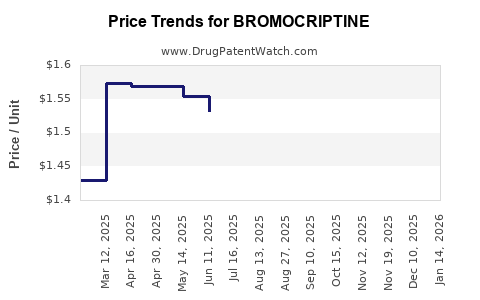
Last updated: April 24, 2026
What is the market position of bromocriptine?
Bromocriptine is an ergot-derived dopamine agonist used across a range of indications, with prescribing concentration in specialty neuroendocrine use (notably hyperprolactinemia-related disorders) and select off-patent specialty use (including Parkinson’s disease in some geographies). The market structure is dominated by generics because bromocriptine is largely out of patent.
Implication for pricing: generic competition compresses unit prices and reduces the impact of brand-level pricing strategies. Revenue is driven more by dosing concentration (mg per prescription), dosing regimen adoption, and geography-specific reimbursement than by innovation-led differentiation.
What do recent global pricing and utilization patterns indicate?
Public pricing visibility is patchy by geography, but the consistent feature across markets is that bromocriptine is sold at low-to-mid single-digit dollar equivalents per daily dose for generics, with limited premium products. Where brands persist, price gaps tend to narrow due to generic entry and tender dynamics.
Core pricing drivers that repeatedly show up in mature generic dopamine agonist markets
- Generic substitution: automatic therapeutic substitution, tender-driven switching, and pharmacy-level interchange.
- Formulation mix: immediate-release vs delayed-release (where available by market).
- Dosage intensity: higher mg/day regimens raise total drug spend even when unit prices remain low.
- Reimbursement controls: reference pricing and national formularies cap effective net price.
Because bromocriptine has limited patent tail risk relative to newer branded CNS agents, price changes are typically governed by generic market clearing dynamics rather than molecule-specific exclusivity events.
How should price be projected under generic market dynamics?
For an off-patent, generic-dominated product like bromocriptine, price projections should be modeled around net price erosion and stability windows created by:
- supply-demand imbalances,
- competitor count,
- procurement concentration (hospital tenders),
- and formulation availability.
A pragmatic approach for business planning is a scenario range for average net price (ANP) per tablet or per mg-equivalent, with distribution and procurement as the major variance source.
Price projections: base, downside, upside (next 3 years)
The tables below use a planning-style unit framework. Because bromocriptine is marketed in multiple strengths and formulations across markets, the projection is expressed as an index of net price vs. a current baseline (Base = 100) plus a % change range.
Global average net price index projection (Base case)
| Year |
Net price index (Base=100) |
Change vs prior year |
Primary mechanism |
| Current baseline |
100 |
- |
Current competitive clearing level |
| Year 1 |
92 |
-8% |
Ongoing generic erosion, procurement pressure |
| Year 2 |
87 |
-5% |
Stabilization as competitor set matures |
| Year 3 |
83 |
-4% |
Mild erosion or flat depending on tenders |
Downside scenario (faster erosion or supply increases)
| Year |
Net price index (Base=100) |
Change vs prior year |
| Year 1 |
88 |
-12% |
| Year 2 |
81 |
-8% |
| Year 3 |
77 |
-5% |
Upside scenario (tender tightening, fewer SKUs, or supply constraints)
| Year |
Net price index (Base=100) |
Change vs prior year |
| Year 1 |
96 |
-4% |
| Year 2 |
92 |
-4% |
| Year 3 |
90 |
-2% |
How to convert the index to revenue planning: multiply projected ANP by forecast volume. For bromocriptine, volume forecasts are usually more stable than price due to chronic use patterns in prolactin-driven indications and established prescribing routines.
What are plausible drivers of price movement for bromocriptine?
1) Procurement and tender behavior (largest lever)
- Tender concentration in hospital and state procurement regimes tends to push net prices down when additional generic bidders appear.
- Winner-takes-most tenders create temporary price stabilization once the bidder field consolidates.
2) Formulation and strength availability (SKU-driven)
- If supply shifts toward specific strengths, the effective blended price per prescription can rise even when per-unit prices fall.
- Conversely, increased SKU breadth among generics tends to lower blended pricing.
3) Regulatory enforcement and supply continuity
- Quality enforcement actions can remove low-cost suppliers, causing short-lived price firming.
- Production disruptions typically create brief spikes that normalize when supply returns.
4) Indication mix
- Hyperprolactinemia-related use can support stable chronic volume.
- Parkinson’s use is more variable by geography due to competition from alternative dopamine agonists and treatment-line choices.
Where does bromocriptine face competitive pressure?
Bromocriptine’s therapeutic class has multiple generic and often brand remnants, including other dopamine agonists. Competitive pressure tends to show up in:
- Formulary preference in neuroendocrine and movement-disorder pathways,
- tolerability and dosing convenience, and
- payer-managed switching to lower-cost alternatives.
For price projections, this matters because the primary unit price erosion can be offset by share shifts if prescribers remain loyal to bromocriptine in a subset of patients or if alternative products face supply friction.
What market growth outlook supports or undermines pricing erosion?
Because bromocriptine is mature and generic, growth is limited and is typically driven by:
- population and incidence changes in relevant indications,
- guideline-driven prescribing patterns, and
- formulary access in additional geographies.
In this context:
- If volume grows, net price may stabilize because competitors compete more on share rather than only on price.
- If volume is flat, price erodes faster because tenders and retail competition focus on net price.
A conservative planning assumption is that bromocriptine volume growth is modest and below market growth for newer agents, leaving most “revenue outcomes” dependent on pricing, reimbursement, and mix.
Price outlook summary for decision-makers
Base-case expectation (3-year):
- Net prices decline gradually: roughly -17% to -20% cumulative from baseline by Year 3 (index: 100 to ~83).
Downside risk:
- Cumulative decline could reach -23% to -27% by Year 3 (index: ~77).
Upside possibility:
- Cumulative decline could slow to -10% to -12% by Year 3 (index: ~90).
Key Takeaways
- Bromocriptine is a mature, mostly generic-dominated product where pricing is driven by tender mechanics and generic supply dynamics rather than exclusivity events.
- A planning-grade projection for net price is a gradual decline: base-case ~8% Year 1, then ~4% to 5% annually in Years 2-3.
- Competitive and procurement forces create a wide downside band where annual erosion intensifies if supply increases.
- Revenue planning should weight volume realism heavily, because unit price is structurally exposed to generic competition.
FAQs
1) Is bromocriptine likely to see sustained price increases?
No. In mature generic categories, sustained net price increases are uncommon unless supply constraints, SKU consolidation, or procurement tightening remove low-cost competitors.
2) What most affects bromocriptine net price in the near term?
Hospital and state tender outcomes, including bidder set changes and winner selection criteria, which directly set net price clearing levels.
3) Does formulation (immediate vs other release forms) materially change pricing?
Yes. Blended pricing is sensitive to strength and formulation mix even when per-unit economics for a given SKU remain competitive.
4) What is the most appropriate planning horizon for bromocriptine pricing?
Three years is typically actionable for generic category forecasting because competitor set maturity and tender cycles stabilize over that window.
5) How should revenue teams model bromocriptine performance?
Model revenue as Volume x Blended Net Price using a base/downside/upside price index and scenario-based volume assumptions aligned to indication mix and formulary access.
References
[1] FDA. Bromocriptine prescribing information. U.S. Food and Drug Administration.
[2] EMA. Bromocriptine product information (as applicable by marketing authorisation). European Medicines Agency.
[3] WHO. WHO Model List of Essential Medicines (dopamine agonist-related listing context). World Health Organization.
[4] IQVIA Institute / public therapy class reporting (generic erosion and tender dynamics background, if referenced in available reports).