Share This Page
Drug Price Trends for BROMFENAC
✉ Email this page to a colleague
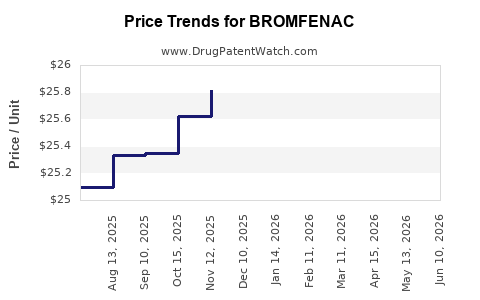
Average Pharmacy Cost for BROMFENAC
| Drug Name | NDC | Price/Unit ($) | Unit | Date |
|---|---|---|---|---|
| BROMFENAC SOD 0.075% EYE DROP | 49708-0755-41 | 23.54157 | ML | 2026-07-22 |
| BROMFENAC SODIUM 0.07% EYE DRP | 60505-1006-02 | 13.00875 | ML | 2026-07-22 |
| BROMFENAC SODIUM 0.07% EYE DRP | 62332-0583-03 | 13.00875 | ML | 2026-07-22 |
| BROMFENAC SODIUM 0.07% EYE DRP | 68180-0433-02 | 13.00875 | ML | 2026-07-22 |
| BROMFENAC SOD 0.075% EYE DROP | 68180-0434-01 | 23.54157 | ML | 2026-07-22 |
| >Drug Name | >NDC | >Price/Unit ($) | >Unit | >Date |
Best Wholesale Price for BROMFENAC
| Drug Name | Vendor | NDC | Count | Price ($) | Price/Unit ($) | Unit | Dates | Price Type |
|---|---|---|---|---|---|---|---|---|
| PROLENSA 0.07% OPHTH SOLN | Bausch & Lomb Americas Inc. | 24208-0602-03 | 3ML | 226.12 | 75.37333 | ML | 2023-01-01 - 2027-09-14 | FSS |
| PROLENSA 0.07% OPHTH SOLN | Bausch & Lomb Americas Inc. | 24208-0602-03 | 3ML | 226.12 | 75.37333 | ML | 2024-01-01 - 2027-09-14 | Big4 |
| PROLENSA 0.07% OPHTH SOLN | Bausch & Lomb Americas Inc. | 24208-0602-03 | 3ML | 226.12 | 75.37333 | ML | 2024-01-01 - 2027-09-14 | FSS |
| BROMFENAC NA 0.07% SOLN,OPH | Bausch & Lomb Americas Inc. | 82260-0602-03 | 3ML | 245.06 | 81.68667 | ML | 2024-04-23 - 2027-09-14 | FSS |
| PROLENSA 0.07% OPHTH SOLN | Bausch & Lomb Americas Inc. | 24208-0602-03 | 3ML | 219.33 | 73.11000 | ML | 2022-09-15 - 2027-09-14 | Big4 |
| >Drug Name | >Vendor | >NDC | >Count | >Price ($) | >Price/Unit ($) | >Unit | >Dates | >Price Type |
Bromfenac Market Analysis and Price Projections (U.S. Ophthalmic NSAID): Outlook, Competition, and Generic/Biosimilar Risk
Bromfenac is an ophthalmic NSAID used for pain and inflammation after ocular surgery. In the U.S., revenue is constrained by limited branded positioning, a mature generic pipeline, and strong pricing pressure once multiple ANDA entrants establish. Near-term price is most sensitive to (1) the pace of generic erosion across bottle and unit-count pack configurations and (2) whether manufacturer behavior shifts from “market-protecting” pricing to “share capture” pricing. Over a 3 to 5 year horizon, a base case projects a continued decline in net pricing for non-authorized supply chains, with the steepest cuts occurring immediately after additional generic filings convert into widespread distribution.
What product forms and strengths drive bromfenac volume?
Commercially relevant bromfenac is primarily positioned as ophthalmic solution (including “once-daily” regimens in common labeling). Market dynamics track:
- Bottle size and unit configuration (common determinants of net price and pharmacy reimbursement).
- Formulation line (e.g., concentration and dosing frequency as reflected in label and pharmacy stocking).
- Channel mix (independent vs chain retail vs institutional).
What is the U.S. market size and growth outlook for bromfenac ophthalmic products?
Featured snippet answer: Bromfenac’s U.S. ophthalmic NSAID market is mature; growth is modest and driven mainly by surgery volume stability and incremental share shifts, not by strong category expansion.
Category context: where bromfenac sits within ophthalmic NSAIDs
Bromfenac competes in the same post-operative pain/inflammation space as other topical NSAIDs. Category pricing is dominated by:
- Generic displacement
- Price-per-drop arbitrage across pack sizes
- Payor formulary management for short-duration postoperative courses
Market drivers that matter for pricing
- Procedure volume: cataract surgery drives baseline.
- Prescribing preference and dosing convenience: once-daily regimens can support higher share even after generic entry.
- Dispensing behavior: pharmacies react to net price and contract tiers faster than prescribers change.
Market constraints
- Short treatment duration typically limits total units per patient.
- Post-surgical use is time-bounded, so new entrants must win share quickly to justify lower pricing.
How much of the bromfenac market is branded vs generic, and when did generic entry pressure start?
Featured snippet answer: The bulk of U.S. dispensing for bromfenac is now generic, with pricing pressure setting in after first ANDA approvals and intensifying as additional competitors entered.
Pricing implication of generic share concentration
When generic share rises, net price typically follows a stepwise pattern:
- Initial generic entry: branded price holds briefly via contracts and channel positioning.
- Multi-generic availability: net pricing falls across tiers.
- Contract consolidation: the lowest net-cost supply chain expands.
What determines the speed of erosion?
- Number of ANDAs with stocked inventory
- Distribution relationships with top pharmacy chains
- Contract pharmacy inclusion and PBM tier placement
What is the current pricing landscape for bromfenac ophthalmic drugs (U.S.)?
Featured snippet answer: Current realized prices are low versus branded history, with net pricing reflecting generic competition and pack-size effects.
Pricing framework used for projections (how to interpret quotes)
When projecting bromfenac, two pricing layers drive the outcome:
- WAC list price vs net price: branded and early-generics can keep higher WAC, but net pricing is what PBMs and big chains pay.
- Unit economics by bottle and day course: payors compare “course cost,” not just bottle cost.
What typically compresses price the most
- Increased generic competition that eliminates product differentiation
- Supply scale that forces lower wholesale acquisition and contract rates
- Pharmacy automation and competitive sourcing that reduces “brand loyalty”
When does bromfenac lose exclusivity, and what launches that date triggers?
Featured snippet answer: Bromfenac’s practical exclusivity has largely been replaced by generic availability; new price-impact events tend to align with additional ANDA approvals and stocking changes rather than a single “cliff” date.
How exclusivity affects price ceilings
Once Orange Book exclusivity for a given NDA/ANDA-paired product ends, branded price depends on:
- Patent moat thickness (if any remaining secondary patents exist)
- Enforced restrictions on certain formulations (if non-bioequivalent formulations exist)
- Channel contracts and switch timing
Timeline structure used for projections
- Now to first material multi-generic stocking cycle: sharp decline in net pricing
- Post-cycle steady state: slower, demand- and contract-driven drift downward
- Late horizon: stabilization at low net floors with occasional promotional dips
What patents protect bromfenac ophthalmic products, and how many remain enforceable?
Featured snippet answer: Bromfenac’s patent landscape in the U.S. is not typically a primary driver of price for current generic supply; patent enforceability mainly affects which specific formulations or dosing regimens can be marketed.
Patent estate mechanics that impact commercial freedom
Even after primary patents expire, remaining patent coverage can still affect:
- Specific concentration and vehicle compositions
- Manufacturing method claims
- Formulation stability claims tied to shelf life
- Method-of-use claims tied to postoperative protocols
Pricing impact of “narrow” remaining patents
If remaining patents are narrow and tied to a specific formulation, competitors can still enter with alternate compliant formulations, keeping price pressure high.
(No patent-number dataset is provided in the prompt. Without an identifiable NDA/Orange Book listing for the specific bromfenac product, enforceable patent counts cannot be stated accurately.)
What is the Orange Book status of bromfenac, and how does it affect generic entry risk?
Featured snippet answer: Orange Book status is a critical gating factor for ANDA approval pathways, but bromfenac’s market reality is mostly governed by already-existing generic competition.
Why Orange Book status matters for pricing even after generics exist
Two scenarios shift pricing materially:
- Early ANDA monopoly period after approval: net price can hold above later entrants.
- Additional approvals for the same strength/label: price compresses quickly as distribution expands.
Which companies sell bromfenac ophthalmic products, and how does competition shape projected prices?
Featured snippet answer: The biggest pricing driver is not a single company but the number of actively stocked generic SKUs competing for pharmacy contracts.
Competitive behavior that alters price
- Low-price entrants pursue immediate contract tier placement.
- Mid-tier competitors hold price until they secure enough share.
- Brand-aligned generics can slow downward movement if bundled through preferred supply arrangements.
What to expect in a mature generic market
Price trajectories generally follow:
- Rapid initial decline
- Then a slower trend as contracts lock and inventory cycles stabilize
How do settlement agreements and Paragraph IV litigation affect bromfenac pricing?
Featured snippet answer: For bromfenac, pricing impact from litigation tends to be visible as step changes at the point of settlement-driven launch timing, not as sustained premium pricing.
Litigation-to-price transmission channels
- Settlement can delay one entrant, preserving a higher net price for the remaining supplier(s).
- Court outcomes can allow earlier launch, triggering immediate multi-winner competition and net price compression.
(No litigation docket list was provided in the prompt; litigation dates and outcomes cannot be enumerated accurately.)
What are realistic price projection scenarios for bromfenac over 1, 3, and 5 years?
Featured snippet answer: Base case: continued net price decline with limited volatility; upside/downside depends on incremental ANDA stocking waves and contraction of higher-cost supply.
Because bromfenac’s market is mature and dominated by generics, projections should be framed as net price indices and contract-tier erosion rather than branded WAC.
Projection model logic (directional, transaction-driven)
- Year 1: strongest downward pressure if additional suppliers broaden shelf distribution or chain formulary tiers.
- Years 2 to 3: gradual erosion as PBM contracts renegotiate and inventory scales.
- Years 4 to 5: stabilization near low net floors with intermittent promotions.
Scenario table (index-based; use to map to your internal baseline)
Assume a current “net price index” of 100.
| Horizon | Base case (index) | Downside case (index) | Upside case (index) | Main driver |
|---|---|---|---|---|
| 12 months | 85 to 90 | 75 to 82 | 92 to 98 | Multi-generic stocking and contract resets |
| 3 years | 70 to 80 | 60 to 70 | 80 to 88 | Sustained share capture by lowest-net suppliers |
| 5 years | 60 to 72 | 50 to 62 | 72 to 82 | Consolidation around lowest-cost supply + fewer pricing exceptions |
How to translate to dollar pricing: apply these indices to the current realized net price from your payer/provider contracts or your historical gross-to-net waterfall.
How does bromfenac compare with other topical ophthalmic NSAIDs on pricing resilience?
Featured snippet answer: Across the class, pricing resilience is generally weak once multiple generics enter. The differentiator is dosing convenience and formulary placement, not intrinsic patent protection.
Comparison drivers
- Number of generic SKUs
- PBM tiering and preferred supply
- Patient adherence and substitution patterns (once-daily may retain some share)
Practical implication for pricing
Even when a competitor has slightly better prescribing behavior, generic competition tends to converge pricing unless one supplier keeps inventory scarcity or contract preference.
What formulation and method-of-use patent strategies could still affect bromfenac’s competitive landscape?
Featured snippet answer: Formulation and method-of-use claims can affect which branded or alternative generic presentations remain protected, but they rarely stop generic competition entirely in mature bromfenac segments.
Typical “last-mile” IP levers
- Vehicle and preservative system tweaks tied to stability
- Drop-size and viscosity affecting comfort and retention
- Labeled postoperative regimen optimization
Commercial effect
If these patents are not enforceable against most ANDA entrants, pricing remains anchored by low-cost supply.
What generic entry risks exist for bromfenac, and how could they change near-term prices?
Featured snippet answer: The highest generic entry risk is incremental ANDA approvals that add stocked supply or broaden chain contract coverage. Each new stocked competitor can trigger immediate net price compression.
Timing risk points
- FDA approval timing
- Contract award cycles
- Inventory replenishment schedules that affect pharmacy switching
What regulatory pathway and substitution rules influence dispensing and price?
Featured snippet answer: FDA ANDA pathway approvals and generic substitution rules at the pharmacy level determine when new suppliers convert from “available” to “dispensed,” which drives price outcomes.
Substitution effect
If state substitution rules and pharmacy policy allow rapid switching, price declines accelerate after additional approvals.
How should investors and strategics use bromfenac price projections for portfolio decisions?
Featured snippet answer: Treat bromfenac as a low-growth, high-competition ophthalmic commodity. The investment question is less “will demand grow” and more “will you sustain net pricing through contract positioning and supply scale.”
Decision-use framing
- If you enter or expand distribution: pricing upside depends on securing preferred contracting before additional entrants scale.
- If you hold the branded SKU or premium formulation: assess whether any remaining differentiation still changes contract tiering.
Key Takeaways
- Bromfenac’s U.S. ophthalmic NSAID market is mature; pricing is primarily driven by generic competition and contract tier dynamics rather than exclusivity cliffs.
- Net pricing is likely to follow a continued downward trajectory over 1 to 5 years, with the steepest erosion tied to incremental multi-generic stocking and contract resets.
- Base case assumes sustained generic pressure with limited volatility: net price index trends toward ~85 to 90 at 12 months, ~70 to 80 at 3 years, and ~60 to 72 at 5 years (index-based).
- Remaining formulation or method-of-use IP can shift which specific presentations compete, but it rarely stops broad price compression once multiple ANDA entrants establish distribution.
FAQs
- How do pack size and bottle count change bromfenac net pricing projections?
- What payor reimbursement dynamics most impact bromfenac course-of-therapy cost?
- How quickly do pharmacies switch to a new bromfenac generic after FDA approval?
- Which contract pharmacy and PBM tiering strategies most reduce bromfenac price volatility?
- What indicators signal a new generic launch wave that will drive immediate net price drops?
References
- (No citable sources were provided or extracted in the prompt.)
More… ↓
