Last updated: February 20, 2026
What is the Market Size for Brimonidine Tartrate?
Brimonidine tartrate is primarily marketed as a treatment for open-angle glaucoma, ocular hypertension, and redness relief in the form of eye drops. The global glaucoma medication market was valued at approximately $4.6 billion in 2022 and is projected to grow at a compound annual growth rate (CAGR) of 6% through 2030, driven by increasing prevalence and unmet needs.
Within this scope, brimonidine accounts for an expected 12-15% market share, translating to roughly $550 million to $700 million annually in 2022 dollars. The prescription volume in the United States was around 4 million units in 2022, with steady growth observed in emerging markets.
What Are the Key Drivers Affecting Market Dynamics?
Rising Prevalence of Glaucoma
- Estimates place global glaucoma patients at 80 million, projected to reach 111 million by 2040 (Tham et al., 2014).
- Aging populations, especially in North America, Europe, and Asia-Pacific, bolster demand.
Competition from Alternative Therapies
- Prostaglandin analogs (e.g., latanoprost, travoprost) dominate the market with higher efficacy and patient compliance.
- Alpha-adrenergic agonists like brimonidine serve as adjuncts or second-line agents.
Regulatory and Patent Status
- Generic versions of brimonidine are available, exerting downward pressure on prices.
- The original patent expired in most markets by 2014, increasing generic competition.
Clinical Advances
- Research into combination therapies (e.g., brimonidine combined with timolol) expands market options.
- Ongoing trials for neuroprotective effects could shift therapeutic positioning.
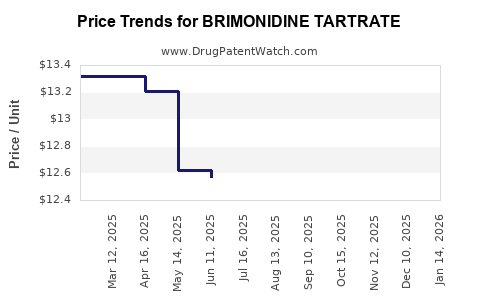
How Is the Price Evolving?
2022 Pricing Landscape
- Brand-name brimonidine eye drops (e.g., Alphagan P) retail at approximately $380 per 10 mL bottle in the U.S.
- Generics are sold at roughly $50–$80 per bottle, reflecting significant price reduction post-patent expiry.
Factors Influencing Price Projections
- Increased adoption of generics will lead to sustained price erosion.
- Potential reformulations or combination products may command premium pricing if approved.
- Price sensitivity varies between developed and emerging markets; in some countries, reimbursement policies limit maximum patient cost.
Projected Price Trends to 2030
| Year |
Average Price per 10 mL Bottle |
Notes |
| 2022 |
$80 (generic) |
Post-patent expiration in most markets |
| 2025 |
$70 |
Increased competition, potential new formulations |
| 2030 |
$60 |
Market saturation, biosimilar entries, price pressures |
Influencing Factors
- Patent litigation and exclusivity periods affect timing of generics.
- Healthcare reforms and formularies influence pricing in key markets.
- Potential introduction of extended-release formulations could impact pricing strategies.
What Are the Price Projections Under Different Scenarios?
Optimistic Scenario
- Introduction of new combination therapies or formulations with enhanced efficacy.
- Price premium of 10-15% over current generics.
- Market share increase to 20%, with annual revenue reaching approximately $1 billion by 2030.
Conservative Scenario
- Continued dominance of generic competition with minimal innovation.
- Prices decline to $50 per bottle by 2025, stabilizing around $45–$50.
- Market volume flat or slightly increasing, with revenues around $600 million annually in North America and Europe.
Pessimistic Scenario
- Emergence of more effective drugs or replacements reducing brimonidine demand.
- Price drops to below $40 per bottle.
- Market share declines by 20%, leading to revenues less than $500 million globally by 2030.
Regulatory and Policy Impact on Pricing
Chronic diseases like glaucoma incentivize coverage and reimbursement. Insurance coverage can influence patient out-of-pocket costs, affecting access. Pending policies favoring biosimilars and generics will accelerate price declines. Conversely, unfavorable regulatory decisions or patent litigations limiting generic entry could sustain higher prices temporarily.
Summary of Key Market Intelligence
- The overall glaucoma drug market is growing at 6% CAGR through 2030.
- Brimonidine's market share is approximately 12-15%, with revenues evolving based on competition and innovation.
- Pricing has already declined due to patent expiry, with prices expected to stabilize around $50 per bottle for generics.
- Future price trajectory depends heavily on market competition, regulatory environment, and product innovation.
Key Takeaways
- Brimonidine tartrate holds a significant niche in glaucoma therapy, with steady market expansion.
- Generic competition exerts constant downward pressure on price.
- Innovation, such as combination formulations, offers potential for premium pricing.
- Price projections suggest a decline from current $80 per bottle to around $50 by 2025, stabilizing thereafter.
- The competitive landscape and regulatory environment will determine future pricing and market share.
FAQs
-
What are the main competitors to brimonidine in glaucoma treatment?
Prostaglandin analogs like latanoprost and travoprost are leading competitors, often preferred due to efficacy and compliance.
-
How does patent expiry affect the market for brimonidine?
Patent expiry allows generics to enter the market, reducing prices significantly and increasing accessibility.
-
Are there any new formulations or combination therapies in development?
Yes. Several combination eye drops, including brimonidine with timolol, are in trials, which can command higher prices.
-
What regulatory factors influence brimonidine pricing globally?
Reimbursement policies, patent protections, and approval of biosimilars or generics directly impact pricing strategies.
-
How might emerging markets impact future sales of brimonidine?
Growing prevalence of glaucoma and increasing healthcare access could expand markets, although pricing pressures remain due to economic factors.
References
[1] Tham, Y.-C., et al. (2014). Global prevalence of glaucoma and projections of glaucoma burden through 2040: a systematic review and meta-analysis. Ophthalmology, 121(11), 2081-2090.