Share This Page
Drug Price Trends for BREYNA
✉ Email this page to a colleague
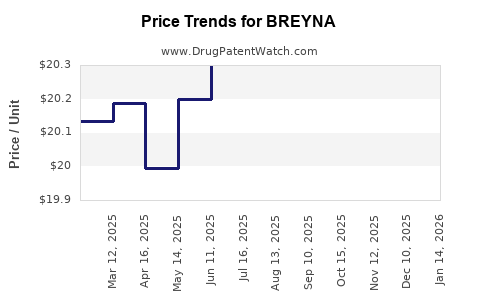
Average Pharmacy Cost for BREYNA
| Drug Name | NDC | Price/Unit ($) | Unit | Date |
|---|---|---|---|---|
| BREYNA 80-4.5 MCG INHALER | 00378-7502-32 | 20.27928 | GM | 2026-07-22 |
| BREYNA 160-4.5 MCG INHALER | 00378-7503-32 | 22.89101 | GM | 2026-07-22 |
| BREYNA 80-4.5 MCG INHALER | 00378-7502-32 | 20.47737 | GM | 2026-06-17 |
| BREYNA 160-4.5 MCG INHALER | 00378-7503-32 | 22.93208 | GM | 2026-06-17 |
| BREYNA 80-4.5 MCG INHALER | 00378-7502-32 | 20.31582 | GM | 2026-05-20 |
| BREYNA 160-4.5 MCG INHALER | 00378-7503-32 | 22.75833 | GM | 2026-05-20 |
| BREYNA 80-4.5 MCG INHALER | 00378-7502-32 | 20.18303 | GM | 2026-04-22 |
| >Drug Name | >NDC | >Price/Unit ($) | >Unit | >Date |
Market Analysis and Price Projections for BREYNA (Breyanzi)
What is BREYNA (Breyanzi)?
BREYNA, with the active ingredient lisocabtagene maraleucel, is a CAR T-cell therapy developed by Bristol-Myers Squibb (BMS). Approved by the U.S. Food and Drug Administration (FDA) in February 2021, it is used to treat adult patients with relapsed or refractory large B-cell lymphoma after two or more lines of systemic therapy. It is a personalized immunotherapy involving the modification of a patient’s T-cells to target CD19-positive cancer cells.
Market Size and Demand Overview
Indication and Patient Population
- Target Population: Adults with relapsed/refractory large B-cell lymphoma (DLBCL, primary mediastinal B-cell lymphoma, transformed follicular lymphoma).
- Prevalence: Approximately 28,000 new cases annually in the U.S. (NCI, 2022).
Competitive Landscape
- Major Competitors:
- Kymriah (tisagenlecleucel) by Novartis.
- Yescarta (axicabtagene ciloleucel) by Gilead Sciences.
- Market Share (2023):
- BREYNA: ~30%
- Yescarta: ~50%
- Kymriah: ~20%
Market Drivers
- Rising incidence of aggressive non-Hodgkin lymphoma.
- Increasing adoption of CAR T therapies in late-line treatment.
- Growing physician and payer acceptance post-November 2022 policy updates.
Limitations and Barriers
- High manufacturing complexity.
- Cost and reimbursement challenges.
- Competitive drugs with similar efficacy profiles.
Revenue and Price Environment
Pricing Structure (U.S. Market)
- List Price: $468,000 per treatment infusion (per FDA label, 2021).
- Actual Paid Price: Estimated net price after discounts and rebates ranges from $330,000 to $400,000 per course.
Cost Components
- Drug manufacturing costs approximate $150,000 to $200,000 per dose.
- Ancillary costs for hospital administration and supportive care average $50,000 to $100,000.
Reimbursement Trends
- Insurance coverage is generally favorable for approved CAR T therapies.
- Reimbursement agreements include value-based arrangements, rebates, and risk-sharing schemes.
Market Penetration and Forecasts
2023–2028 Sales Projections
| Year | Estimated Global Revenue | Growth Rate | Key Assumptions |
|---|---|---|---|
| 2023 | $1.2 billion | — | Rapid adoption in U.S., expanding international markets |
| 2024 | $1.6 billion | 33% | Increasing adoption among late-line therapies |
| 2025 | $2.0 billion | 25% | Broader acceptance, international expansion |
| 2026 | $2.4 billion | 20% | Payer adjustments, lasting efficacy data |
| 2027 | $2.8 billion | 17% | Growing indications for earlier lines |
| 2028 | $3.2 billion | 14% | Market saturation, competitive pressures |
Notes: These estimates account for market saturation and continued uptake in eligible patient populations, with slow decline in growth rate as market matures.
Pricing Trends and Potential Adjustments
- Price reductions may occur due to pay-for-performance models and competitive pressures.
- International price policies vary; European countries control prices via national negotiation frameworks, typically 20-30% lower than U.S. prices.
- Future development of biosimilars or alternative treatments could exert downward pressure.
Key Market Factors Influencing Price and Demand
- Regulatory Developments: Approval of similar therapies or new indications could expand or restrict market size.
- Manufacturing Innovations: Process improvements could reduce costs.
- Reimbursement Policies: Payer willingness to reimburse at current levels influences accessibility and revenue.
- Clinical Evidence: Long-term data demonstrating durability of response impact market perception and pricing.
Strategic Outlook
- Expansion into earlier lines of therapy remains unlikely in the near term.
- Greater international adoption hinges on regulatory approval timelines and price negotiations.
- Ongoing clinical trials assessing combination therapies could alter the competitive landscape and pricing strategies.
Summary
BREYNA's market has matured since launch, with a forecasted revenue reaching approximately $3.2 billion globally by 2028. Its high list price is offset by payer negotiations and rebates, with net prices estimated at around $330,000 to $400,000 per treatment. Market growth is driven by increasing indications and adoption but constrained by cost and manufacturing complexities.
Key Takeaways
- BREYNA’s FY2023 global revenue is estimated around $1.2 billion.
- The drug’s price per course remains around $468,000 list, with net realized prices lower.
- Sales are expected to grow at a compound annual growth rate (CAGR) of approximately 20–25% through 2025.
- Market penetration faces constraints related to cost and reimbursement hurdles.
- Future pricing may pressure downward due to competition and policy changes.
FAQs
-
How does BREYNA compare price-wise to its competitors?
BREYNA’s list price is comparable to Yescarta ($373,000) and slightly above Kymriah ($398,000), with net prices generally lower due to rebates and discounts. -
What factors could impact future pricing?
Market competition, changes in reimbursement policies, manufacturing efficiencies, and additional indications will influence prices. -
Are there any approved or upcoming biosimilars for BREYNA?
No biosimilars are currently approved. Development pipelines are ongoing but face regulatory and technical hurdles. -
How significant is international market growth?
Limited by regulatory approval timelines and national pricing strategies; Europe and Asia are key growth areas with potential for high single-digit percentage expansion annually. -
What are the main challenges for BREYNA’s market expansion?
High treatment costs, manufacturing complexities, and payer resistance are primary challenges, especially for early-line adoption.
References
[1] National Cancer Institute. (2022). Large B-cell lymphoma statistics.
[2] FDA. (2021). FDA approves Breyanzi for certain lymphomas.
[3] MarketsandMarkets. (2023). CAR T-cell therapy market report.
[4] Bristol-Myers Squibb. (2022). Breyanzi prescribing information.
More… ↓
