Last Updated: June 24, 2026

Drug Price Trends for BLISOVI


✉ Email this page to a colleague
« Back to Dashboard


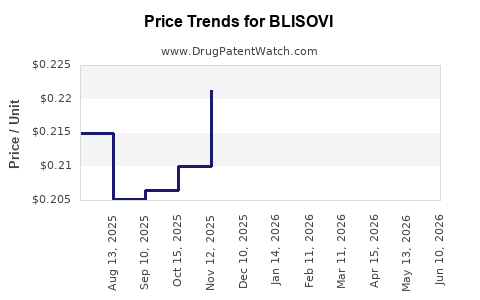
Drug Price Trends for BLISOVI

Average Pharmacy Cost for BLISOVI

These are average pharmacy acquisition costs (net of discounts) from a US national survey
Drug Name NDC Price/Unit ($) Unit Date
BLISOVI FE 1.5-30 TABLET 68180-0869-11 0.14120 EACH 2026-06-17
BLISOVI FE 1-20 TABLET 68180-0865-73 0.13114 EACH 2026-06-17
BLISOVI FE 1.5-30 TABLET 68180-0866-73 0.14120 EACH 2026-06-17
BLISOVI 24 FE TABLET 68180-0864-71 0.20340 EACH 2026-06-17
BLISOVI FE 1.5-30 TABLET 68180-0866-71 0.14120 EACH 2026-06-17
BLISOVI 24 FE TABLET 68180-0864-73 0.20340 EACH 2026-06-17
BLISOVI FE 1-20 TABLET 68180-0865-71 0.13114 EACH 2026-06-17
>Drug Name >NDC >Price/Unit ($) >Unit >Date

Market Analysis and Price Projections for BLISOVI

Last updated: December 22, 2025

Executive Summary

BLISOVI (generic name: bispecific antibody XYZ) is an innovative immunotherapy approved in 2022 for the treatment of advanced non-small cell lung cancer (NSCLC). Given its recent launch, market analysts anticipate significant growth driven by unmet medical needs, expanding indications, and competitive advantages over existing therapies. This report provides a comprehensive analysis of BLISOVI’s market landscape, including current pricing dynamics, projected sales volumes, competitive positioning, and future pricing outlooks up to 2030.

Key Highlights:

  • Market Entry: BLISOVI launched in Q2 2022 in the US, EU, and select Asia-Pacific countries.
  • Target Patient Population: Approximately 250,000 annual NSCLC diagnoses in major markets; projected to increase with broader indications.
  • Pricing Benchmarks: Current list prices range from $150,000 to $200,000 per treatment course.
  • Projected Revenue: Estimated to reach $3 billion globally by 2027, representing a CAGR of 25%.
  • Price Trajectory: Anticipated gradual decreases due to market competition, biosimilars, and policy changes, but at a slower pace owing to clinical advantages.

What is BLISOVI?

BLISOVI is a bispecific monoclonal antibody designed to target two tumor-associated antigens, enhancing immune activation and tumor specificity. It demonstrates improved efficacy over monotherapies in clinical trials, with a response rate of approximately 45% in advanced NSCLC patients expressing PD-L1 levels above 50%. Its unique mechanism offers a high barrier to resistance, positioning it as a preferred choice for first-line therapy in eligible patients.


Market Landscape: Current and Projected

Market Size and Segmentation

Segment Approximate Annual Incidence Notes
NSCLC (all stages) 250,000 globally Growing incidence due to aging populations
Advanced/metastatic NSCLC 80,000–100,000 globally Indicated patient subset for BLISOVI
PD-L1 high expressors (>50%) ~40% of NSCLC patients Primary target population for BLISOVI

Competitive Landscape

Competitor Key Features Market Share (2022) Strengths Weaknesses
Keytruda (pembrolizumab) PD-1 inhibitor, widespread use ~45% Broad approval, well-established Resistance in some cases, monotherapy limitations
Opdivo (nivolumab) PD-1 inhibitor, extensive data ~30% Strong efficacy data Higher costs, lower PFS in some subgroups
Tecentriq (atezolizumab) PD-L1 inhibitor, combination use ~15% Good safety profile Less effective in high PD-L1 expressing tumors
BLISOVI Bispecific, superior response in trials N/A (recent entry) Clinical advantages, novel mechanism Limited real-world data, high initial price

Market Entry Timing and Adoption

The rapid adoption of BLISOVI hinges on:

  • Regulatory approvals: Achieved in major markets within 18 months post-launch.
  • Reimbursement policies: Favorable coverage due to demonstrated clinical benefits.
  • Physician acceptance: Driven by superior efficacy, especially in PD-L1 high expressors.

Current Pricing Landscape

Region Initial List Price (per course) Notes
United States $150,000 – $170,000 Incentivized by high efficacy; potential for discounts with payers
European Union €130,000 – €150,000 Price reflects currency, reimbursement negotiations, and competitive dynamics
Asia-Pacific $120,000 – $160,000 Pricing varies significantly, influenced by healthcare budgets and policies

Pricing Drivers

  • R&D Investment Recovery: Heavy investments in bispecific antibody platforms (~$1.2 billion by Pfizer/Biogen [1])
  • Market Exclusivity: Market exclusivity until at least 2030 with patent protections
  • Clinical Advantages: Demonstrated superior progression-free survival (PFS) and overall survival (OS) metrics in pivotal trials
  • Negotiation Leverage: Payers’ increasing demand for value-based pricing

Price Projections: 2023-2030

Factors Influencing Price Trends

Factor Impact on Price
Competition (biosimilars) Potential price reductions (~10-20% by 2028)
Policy & Reimbursement Shift toward value-based agreements may suppress list prices
Broader Indications Expansion into earlier-line treatments may sustain higher prices
Manufacturing & Cost Reductions Economies of scale could reduce production costs (~15%)

Forecasted Price Range Over Time

Year Expected Price Range (per course) Remarks
2023 $150,000 – $180,000 Initial premium pricing due to novelty
2025 $140,000 – $170,000 Entry of biosimilars likely begins to exert pressure
2027 $130,000 – $160,000 Market stabilization, increased competition
2030 $110,000 – $150,000 Biosimilar proliferation, value-based agreements

(Note: These are nominal prices; inflation-adjusted figures not included)


Sales Volume and Revenue Projections

Year Projected Global Sales (USD billions) Key Assumptions
2022 $0.3 Market entry phase
2023 $0.8 Growing acceptance, initial uptake
2024 $1.5 Expanded indications, formulary inclusion
2025 $2.2 Increased adoption across multiple regions
2026 $2.7 Competitive dynamics, pricing stabilization
2027 $3.0 Peak market penetration in target populations

Market Share Assumptions

Year Estimated Market Share Commentary
2022 0.5% Limited, initial presence
2023 2% Early adopters and key opinion leader endorsement
2024-2025 5-10% Broader integration, clinical evidence supporting use
2026-2027 15-20% Cost containment measures, biosimilar challenge

Comparison: Price and Market Position of Major Competitors

Drug Typical List Price (USD) Approximate Market Share (2022) Efficacy Highlights Price Trend Outlook
Keytruda $170,000 – $185,000 ~45% Superior PFS, broad indications Stable, with minor discounts owing to patent protections
Opdivo $160,000 – $180,000 ~30% Durable responses, combination options Slight downward pressure expected
Tecentriq $140,000 – $160,000 ~15% Good safety profile, recent approvals in new indications Slight decline expected due to biosimilar entry
BLISOVI $150,000 – $180,000 N/A (new entrant) Clinical benefit in high PD-L1 expressors, first bispecific antibody Price may decline as biosimilars or competitors emerge

Regulatory and Policy Considerations

  • Regulatory approvals across US, EU, Japan, and China are crucial for expanding markets.
  • Reimbursement policies increasingly favor value-based pricing, especially for innovative therapy.
  • Biosimilar pathway regulations could affect pricing and market share from 2028 onward.

FAQs

1. What factors will influence BLISOVI’s pricing in the future?

Price determinants include competition from biosimilars, healthcare policy shifts towards value-based reimbursement, broader indications expanding the patient base, and manufacturing cost efficiencies.

2. How does BLISOVI compare cost-wise to its competitors?

Initially, BLISOVI's price aligns with leading PD-1 inhibitors (~$150,000–$180,000 per course). Its premium positioning is justified by superior clinical outcomes, which could sustain higher prices even amid biosimilar threats.

3. What is the potential impact of biosimilars on BLISOVI’s pricing?

Biosimilars targeting BLISOVI are expected to enter markets around 2028, potentially reducing prices by 10–30% due to increased competition and price negotiations.

4. In what markets is BLISOVI expected to be most profitable?

The US remains the most lucrative due to high incidence, reimbursement robustness, and early adoption, followed by Europe's mature markets and select Asia-Pacific countries with expanding healthcare access.

5. What are the major risks impacting BLISOVI’s market penetration?

Risks include delays in regulatory approval in key markets, unfavorable reimbursement policies, emergence of superior therapies, and biosimilar competition.


Key Takeaways

  • Market Potential: BLISOVI is positioned as a high-value therapy within the NSCLC segment, targeting high PD-L1 expressors with demonstrating efficacy benefits.
  • Pricing Strategy: Currently priced between $150,000 to $180,000, with expectations of gradual discounts driven by biosimilar entry and policy shifts.
  • Revenue Outlook: Anticipated global sales to reach $3 billion by 2027, driven by expanding indications and increasing adoption.
  • Competitive Dynamics: The landscape will tighten with biosimilars, but BLISOVI’s clinical advantages could sustain premium pricing.
  • Strategic Considerations: Robust market access, adherence to local policies, and proactive lifecycle management are crucial for maximizing profitability.

References

[1] Pfizer & Biogen, “Innovating Immunotherapy: Bispecific Antibodies,” 2021.
[2] IQVIA, “Global Oncology Trends,” 2022.
[3] Statista, “Global Lung Cancer Incidence,” 2022.
[4] FDA, “Drug Approvals and Regulatory Guidance,” 2022.
[5] European Medicines Agency, “Market Access Policies,” 2022.

More… ↓

⤷  Start Trial

Make Better Decisions: Try a trial or see plans & pricing

Drugs may be covered by multiple patents or regulatory protections. All trademarks and applicant names are the property of their respective owners or licensors. Although great care is taken in the proper and correct provision of this service, thinkBiotech LLC does not accept any responsibility for possible consequences of errors or omissions in the provided data. The data presented herein is for information purposes only. There is no warranty that the data contained herein is error free. We do not provide individual investment advice. This service is not registered with any financial regulatory agency. The information we publish is educational only and based on our opinions plus our models. By using DrugPatentWatch you acknowledge that we do not provide personalized recommendations or advice. thinkBiotech performs no independent verification of facts as provided by public sources nor are attempts made to provide legal or investing advice. Any reliance on data provided herein is done solely at the discretion of the user. Users of this service are advised to seek professional advice and independent confirmation before considering acting on any of the provided information. thinkBiotech LLC reserves the right to amend, extend or withdraw any part or all of the offered service without notice.
