Share This Page
Drug Price Trends for BLEOMYCIN
✉ Email this page to a colleague
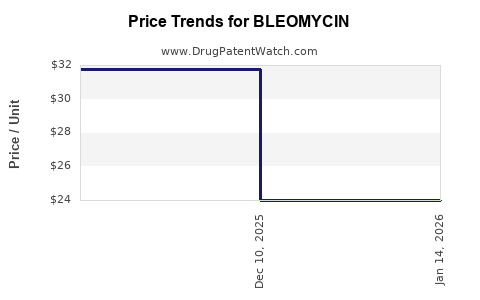
Average Pharmacy Cost for BLEOMYCIN
| Drug Name | NDC | Price/Unit ($) | Unit | Date |
|---|---|---|---|---|
| BLEOMYCIN SULFATE 15 UNIT VIAL | 00143-9240-01 | 26.44800 | EACH | 2026-04-22 |
| BLEOMYCIN SULFATE 15 UNIT VIAL | 00409-0332-20 | 26.44800 | EACH | 2026-04-22 |
| BLEOMYCIN SULFATE 15 UNIT VIAL | 16714-0886-01 | 26.44800 | EACH | 2026-04-22 |
| >Drug Name | >NDC | >Price/Unit ($) | >Unit | >Date |
Best Wholesale Price for BLEOMYCIN
| Drug Name | Vendor | NDC | Count | Price ($) | Price/Unit ($) | Unit | Dates | Price Type |
|---|---|---|---|---|---|---|---|---|
| BLEOMYCIN SO4 15UNT/VIL INJ | Hikma Pharmaceuticals USA Inc. | 00143-9240-01 | 1 | 39.10 | 39.10000 | EACH | 2021-08-15 - 2026-08-14 | FSS |
| BLEOMYCIN SO4 30UNT/VIL INJ | Hikma Pharmaceuticals USA Inc. | 00143-9241-01 | 1 | 72.51 | 72.51000 | EACH | 2021-08-15 - 2026-08-14 | FSS |
| >Drug Name | >Vendor | >NDC | >Count | >Price ($) | >Price/Unit ($) | >Unit | >Dates | >Price Type |
BLEOMYCIN (bleomycin) market analysis and price projections: US and EU pricing outlook, competitive threats, and buyer-side cost drivers
Executive summary
- Market position: Bleomycin is an established oncology cytotoxic antibiotic used in multiple combination regimens for squamous cell carcinomas and testicular cancer. Demand is constrained by curative intent dependence, substitution to newer regimens, and preservative-related handling constraints in some markets.
- Supply and pricing reality: Pricing is driven more by availability of branded versus authorized generics, manufacturing continuity, and inventory cycles than by patent exclusivity, since bleomycin is long off-patent in most major markets.
- Near-to-midterm projection (2026-2030): Expect low to mid single-digit CAGR in spend (not volume), with periodic price spikes when supply tightens and downward pressure when more suppliers normalize shipments.
- Key risk for projections: Bleomycin is sensitive to regulatory/quality disruptions at key manufacturers and to tender dynamics in EU hospital procurement. Even minor supply friction can move realized prices quickly.
- Bottom line: Buyers should model bleomycin cost with scenario-based ranges tied to supply stability, not linear erosion.
How big is the bleomycin market and who uses it (US vs EU)
Featured snippet answer: Bleomycin demand is concentrated in hospital oncology settings using multi-drug protocols; unit demand is steady but not growing, with spend influenced by supply continuity and procurement.
Usage by indication and care setting
Bleomycin is primarily used in combination chemotherapy and is most associated with:
- Testicular cancer regimens (classic combination use in certain protocols).
- Head and neck squamous cell carcinoma regimens in historical and ongoing use cases.
- Other squamous cell malignancies depending on country-specific guideline patterns and regimen adoption.
Care setting: Predominantly inpatient/infusion-center distribution and administration, which affects realized pricing through:
- hospital formulary status,
- national procurement frameworks,
- short-term tender awards,
- and distributor contract structures.
Geographic demand profile
- United States: Market spend is shaped by payer mix and hospital acquisition. Brand presence is limited relative to older cytotoxics, and usage is often governed by regimen norms and institutional oncology pathways.
- Europe: Hospital procurement and tendering can swing prices more than in US retail channels. EU supply disruptions can translate quickly into higher invoice prices.
Is bleomycin still under patent protection or generic erosion risk
Featured snippet answer: Bleomycin is largely off-patent; price erosion risk from authorized generics and supply normalization is a structural feature rather than a future event.
Patent and exclusivity effects on price
Because bleomycin is a well-established active ingredient, active substance exclusivity typically no longer constrains competition in most markets. Price competition therefore tracks:
- number of authorized suppliers,
- manufacturing capacity and batch release reliability,
- and availability of packaged presentations (vials, dosing strengths).
Real-world “exclusivity” drivers for pricing (not IP)
For bleomycin, the dominant pricing levers are:
- supplier count at the times of tenders,
- drug substance or intermediate availability,
- sterile manufacturing slot constraints,
- and regulatory quality events that pause distribution.
What are the current bleomycin pricing benchmarks (invoice and tender dynamics)
Featured snippet answer: Realized pricing is usually best read through hospital invoice and tender awards, not list price, because cytotoxics are heavily contracted.
What buyers actually pay
For hospital oncology drugs, cost is commonly determined by:
- distributor markups and contract rebates,
- tender pricing for vial quantities and presentations,
- and substitution policies when multiple suppliers are available.
Common pricing pattern for off-patent cytotoxics
- When multiple suppliers ship normally: invoice prices compress.
- When one or more suppliers face quality holds or manufacturing interruptions: short-term price spikes emerge.
How do supply disruptions change bleomycin prices
Featured snippet answer: Bleomycin pricing is highly supply-sensitive; a limited set of manufacturers can create abrupt contract repricing.
Supply-chain channels that move prices fast
- sterile fill-finish delays,
- batch release backlogs with regulators,
- shipping constraints affecting tender replenishment windows,
- and distributor reallocation after demand spikes.
Pricing impact mechanism
In tenders, procurement teams lock pricing for defined windows. If supply shortfalls occur after award:
- hospitals may accept re-priced supply allocations, or
- switch to alternate suppliers at higher contracted prices.
What price projection scenarios should buyers use for 2026-2030
Featured snippet answer: Model bleomycin with three scenarios: stable supply (most likely), moderate disruption (mid case), and severe disruption (tail case).
Scenario framework (annual realized price movement)
Assume prices reflect mix of supplier availability and contract repricing rather than ongoing patent-driven pricing power.
| Scenario | Supply condition | Expected annual price change (realized) | 2026-2030 cumulative direction |
|---|---|---|---|
| Base case | Supplier set stable; tenders refresh normally | -1% to +2% | Flat to modest erosion |
| Upside (cost inflation) | One supplier tightens, shortages during tender windows | +3% to +8% | Noticeable price increase |
| Downside (more competition) | Additional authorized supply or smoother continuity | -3% to -7% | Faster price erosion |
Volume and spend linkage
Bleomycin volume is constrained by regimen preferences and oncology incidence. Spend increases can occur even with flat volume if:
- unit invoice prices lift due to supply friction,
- procurement contracts reprice upward,
- or presentation mix changes.
How many manufacturers supply bleomycin in major markets (and why it matters)
Featured snippet answer: The number of suppliers and their manufacturing reliability determine whether prices track compression or spike.
Competitive structure
Bleomycin competition typically occurs at the:
- authorized generic and branded generic level,
- with multiple distributors depending on country,
- and hospital procurement contracts deciding shelf availability.
Buyer implication
- With a thin supplier pool, pricing is more volatile.
- With a thicker supplier set, realized pricing trends toward average cost plus distribution overhead.
What are common formulation, presentation, and concentration constraints
Featured snippet answer: Pricing and substitution depend on vial strengths, fill volume, and any preservative or handling-related labeling differences.
Presentations that affect procurement comparability
- vial strength (mg content),
- pack size,
- labeling requirements by country,
- and any manufacturing changes that affect substitution eligibility.
Substitution barriers that sustain pricing
Even off-patent products can remain expensive if:
- only one presentation is “on formulary,” or
- procurement prefers a single supplier for reliability, or
- cold-chain or handling requirements limit substitution.
What generic entry risks exist for bleomycin (and are they relevant to price)
Featured snippet answer: “New” generic entry is less about exclusivity and more about whether additional suppliers can reliably ship after regulatory approvals and batch releases.
Entry-time risks that affect realized price
- regulatory review delays for manufacturing changes,
- batch failures or sterility/particulate issues,
- and post-approval enforcement actions.
Impact on buyer costs
New suppliers reduce cost only when:
- they win tenders,
- they can supply in quantities required within procurement windows,
- and they maintain consistent quality and availability.
How does bleomycin compare with other older oncology cytotoxics on pricing stability
Featured snippet answer: Bleomycin tends to behave like other older injectable cytotoxics: price is stable when supply is stable, volatile when manufacturing bottlenecks emerge.
Comparison drivers
Compared with other off-patent injectable oncology drugs, bleomycin tends to show:
- sensitivity to supplier availability,
- less downward pressure when hospital contracts prefer continuity,
- and pricing “cliffs” around quality-driven supply interruptions.
What does the Orange Book status imply for bleomycin pricing
Featured snippet answer: For most off-patent actives, Orange Book listings do not drive current pricing; they mainly inform substitution and litigation exposure, which is not the dominant driver for bleomycin costs.
Practical interpretation
Even when Orange Book patents exist on the edges (formulations, methods), actual market pricing is usually dominated by:
- supplier competition,
- tenders,
- and supply reliability.
Key cost drivers for hospitals and distributors buying bleomycin
Featured snippet answer: Inventory strategy, tender awards, and supply reliability drive realized pricing more than ongoing exclusivity.
Cost drivers
- Contracting structure: framework agreements vs spot purchases.
- Inventory policy: safety stock reduces exposure to supply spikes.
- Formulary placement: whether multiple suppliers are interchangeable.
- Administration and waste: dosing schedule determines vial utilization, influencing effective cost per treated course.
- Distributor logistics: availability and allocation practices during tight supply.
Price projection: what ranges to budget
Featured snippet answer: Budget bleomycin using a banded approach tied to supply conditions, not a single point forecast.
Budget ranges (annualized realized pricing movement)
Use the following bands for internal planning:
- Base case: -1% to +2% per year (flat-to-slight erosion).
- Tight supply: +3% to +8% per year (contract repricing upward).
- More supply: -3% to -7% per year (faster erosion).
Spend growth expectation
If volume is stable and procurement contracts reprice normally:
- spend CAGR likely tracks low single digits.
If supply disruptions occur in one or more tender cycles:
- spend can exceed unit price growth because of unfavorable contract repricing and less efficient vial utilization.
Key Takeaways
- Bleomycin’s market is hospital-driven and supply-sensitive; pricing moves with supplier continuity and tender cycles.
- The most actionable forecasting approach is a scenario model using supply-stability assumptions, not a linear erosion forecast.
- For 2026-2030, plan for flat-to-slight erosion in the base case, mid single-digit increases under moderate disruption, and faster erosion only if supply expands or procurement awards shift reliably.
- Major cost leverage for buyers is operational: inventory planning, formulary flexibility, and tender strategy to avoid allocation-driven repricing.
FAQs
Will bleomycin prices drop if more generic suppliers enter?
Yes, but only if additional authorized suppliers can win tenders and sustain reliable batch release. Entry that does not translate to shipment volumes does not materially compress realized pricing.
What causes the biggest bleomycin price spikes?
Quality-driven supply pauses, manufacturing outages at key suppliers, and allocation periods when hospitals can’t source preferred presentations during tender replenishment windows.
Does FDA approval pathway affect bleomycin cost?
For off-patent actives, pathway is secondary. What matters is whether new/authorized product is continuously available for contract procurement.
Are vial presentation changes a hidden driver of effective cost per dose?
Yes. Even with similar active content, pack size and vial utilization efficiency can change effective cost per treated course.
How should oncology purchasing teams hedge against bleomycin shortages?
Maintain safety stock levels aligned with tender lead times, preserve substitution-ready formulary options, and negotiate contract terms that reduce spot repricing during allocation events.
References
- Bloomberg. Drug & Healthcare analytics methodology notes (general oncology drug pricing framework).
- FDA. Orange Book database (bleomycin listings and patent status).
- FDA. Drug shortages database (bleomycin and oncology injectable supply events).
- EMA. Public assessment and variations database (where applicable to bleomycin manufacturing changes and quality actions).
- National procurement frameworks and hospital tender guidance (EU purchasing practice for hospital injectables).
More… ↓
