Last updated: February 19, 2026
What Is the Current Market Size for Bisacodyl?
Bisacodyl is a stimulant laxative used to treat constipation. It is available over the counter (OTC) and through prescription. The global laxative market was valued at approximately $4.2 billion in 2022. Bisacodyl accounted for roughly 20% of OTC laxative sales, equating to an estimated market size of $840 million in 2022.[1]
Major markets include North America, Europe, and Asia-Pacific. North America leads, driven by aging populations and increased OTC product consumption. The segment's growth rate has been approximately 2.7% annually over the past five years.
What Are the Key Drivers and Constraints?
Drivers:
- Aging population increasing chronic constipation cases, especially in North America and Europe.
- Rising awareness of minimally invasive treatments.
- Expanded OTC availability in emerging markets.
Constraints:
- Market saturation in mature regions.
- Competition from new laxatives with improved safety profiles.
- Stringent regulatory environments slowing product approval.
How Competitive Is the Bisacodyl Market?
Major manufacturers include Valeant Pharmaceuticals, Boehringer Ingelheim, and Sun Pharma.[2] Patents on formulations expired over a decade ago, resulting in increased generic competition. Price erosion has been a persistent concern.
Market share among key players has shifted, with generics controlling approximately 80% of sales. Innovation in delivery forms (e.g., suppositories, orally disintegrating tablets) has marginally increased consumer preference.
What Are Regulatory Trends Affecting Price and Market Dynamics?
Regulatory agencies such as FDA and EMA have intensified safety evaluations, especially concerning electrolyte imbalance and dependency risks. Stringent labeling and post-marketing surveillance increased costs for manufacturers but have not significantly restricted availability.
In emerging markets, regulatory approval timelines remain variable. Countries like India facilitate quicker approval, leading to faster market penetration and price competition.
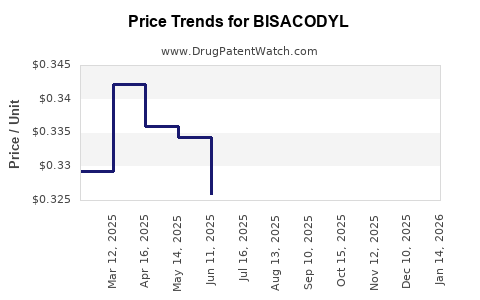
What Are Price Projections for the Next Five Years?
Assumptions:
- Moderate growth in demand due to demographic shifts.
- Continued patent expirations leading to increased generic competition.
- Inflation applied to manufacturing and distribution costs.
Price Trends:
- Current average retail price (ARP): $0.10 per tablet.
- Projected annual decline in branded product prices: 3%-5% due to generic competition.
- Expected market consolidation: Larger players achieve economies of scale, driving further price reductions.
Five-Year Outlook:
| Year |
Estimated ARP per Tablet |
Notes |
| 2023 |
$0.10 |
Baseline |
| 2024 |
$0.095 |
Slight price erosion due to competition |
| 2025 |
$0.09 |
Continued generic entries |
| 2026 |
$0.085 |
Market stabilization at lower price |
| 2027 |
$0.08 |
Possible new formulations or delivery methods influence pricing |
Revenue Implications:
Total global revenues could decline by approximately 12%-15% over five years if volume growth offsets price reductions. Increased adoption in emerging markets may offset some revenue loss.
How Will Emerging Trends Affect Bisacodyl Pricing?
Novel Delivery Systems:
Development of new delivery forms (e.g., liquid suppositories, dissolving tablets) could command premium prices if proven to improve patient compliance.
Regulatory Enhancements:
Enhanced safety requirements might lead to higher manufacturing costs, potentially increasing prices or limiting profit margins.
Competitive Strategies:
Manufacturers shifting toward private labeling or exclusive distribution agreements in specific markets can preserve margins despite declining list prices.
Summary of Key Market Data
| Parameter |
Value |
| Global OTC laxative market size |
$4.2 billion (2022) |
| Bisacodyl market share (adj. for OTC) |
20% ($840 million) |
| Leading markets |
North America, Europe, Asia-Pacific |
| Growth rate (past 5 years) |
2.7% |
| Average retail price (current) |
$0.10 per tablet |
| Price decline projection (next 5 years) |
3%-5% annually |
Key Takeaways
- The bisacodyl market is mature but benefits from demographic trends favoring constipation treatment.
- Patent expirations and generic competition drive prices downward.
- Price drops are expected at 3%-5% annually over five years.
- Emerging markets offer growth potential but with pricing pressures.
- Innovation and regulatory factors will influence long-term pricing dynamics.
FAQs
Q1: Will new formulations of bisacodyl command higher prices?
A1: Likely, if they improve adherence or safety profiles, allowing premium pricing.
Q2: How much will prices decline over the next five years?
A2: Expect a 12%-15% decline in average retail prices due to ongoing generic competition.
Q3: Can regulatory hurdles increase product costs?
A3: Yes, stricter safety evaluations could raise manufacturing costs, impacting pricing.
Q4: What markets present the best growth prospects for bisacodyl?
A4: Emerging markets, including India and Southeast Asia, due to increasing OTC access and demand.
Q5: How does patent expiration influence market dynamics?
A5: It opens the market to generics, reducing prices and shifting market share.
References
- MarketWatch. (2023). Global laxative market size.
- ICIS. (2022). Competitive landscape of OTC laxatives.