Share This Page
Drug Price Trends for BIDIL
✉ Email this page to a colleague
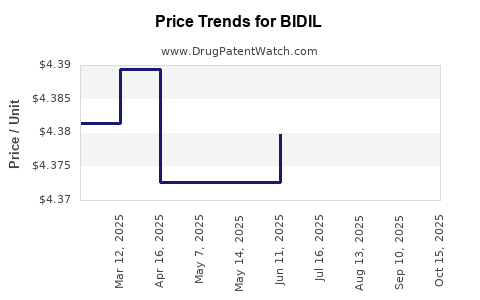
Average Pharmacy Cost for BIDIL
| Drug Name | NDC | Price/Unit ($) | Unit | Date |
|---|---|---|---|---|
| BIDIL 20 MG-37.5 MG TABLET | 24338-0010-09 | 4.34518 | EACH | 2026-02-18 |
| BIDIL 20 MG-37.5 MG TABLET | 24338-0010-09 | 4.34749 | EACH | 2025-10-22 |
| BIDIL 20 MG-37.5 MG TABLET | 24338-0010-09 | 4.34582 | EACH | 2025-09-17 |
| BIDIL 20 MG-37.5 MG TABLET | 24338-0010-09 | 4.35311 | EACH | 2025-08-20 |
| >Drug Name | >NDC | >Price/Unit ($) | >Unit | >Date |
BIDIL (isosorbide dinitrate + hydralazine) Market Analysis, Pricing Benchmarks, and Generic/Biosimilar Price Projections (US)
Bidil is a fixed-dose combination of isosorbide dinitrate (ISDN) and hydralazine (HYD) indicated for heart failure in Black patients with reduced ejection fraction. Competitive pricing in the US is constrained by persistent brand use after exclusivity, narrow formulation competition risk, and the likelihood of generic entry only via label- and manufacturing-viable ANDA pathways for the same fixed-dose combination. Near-term price erosion is more likely from small-molecule ANDA competition and payer controls than from biosimilar-type dynamics.
What is the BIDIL drug market size and payer profile in the US?
How large is the addressable heart failure segment for BIDIL
Bidil targets HFrEF populations defined by race and concomitant guideline positioning. Addressable volume is driven by:
- Proportion of HFrEF treated in settings that still align with BIDIL labeling and substitution practices.
- Physician prescribing behavior for fixed-dose ISDN/HYD versus free-drug generic alternatives.
- Payer coverage design: prior authorization, step therapy, and formulary tier placement.
What are the main US payer controls affecting BIDIL net price
Net price is primarily determined by:
- Commercial formulary tiering and contract discounts.
- Medicare Part D plan placement, where manufacturer rebates and negotiated spreads can reduce realized revenue.
- PBM channel controls for combination products that compete with inexpensive component generics (ISDN and hydralazine).
Featured snippet takeaway: BIDIL’s US net price is more sensitive to payer contracting and component-generic substitution than to demand growth because it competes with low-cost generics of its individual active ingredients.
How does BIDIL compare with generic isosorbide dinitrate plus hydralazine pricing dynamics?
Why component generics can cap BIDIL pricing power
Even without direct fixed-dose ANDA competition, payers can steer patients to:
- Hydralazine tablets and ISDN tablets/capsules sold as separate generic products.
- Therapeutic substitution under interchange rules and PBM-driven formulary design.
That substitution threat typically compresses brand willingness-to-pay, pushing BIDIL toward lower relative pricing or higher rebates to maintain formulary access.
What does “fixed-dose convenience” change
Bidil can retain formulary access when:
- Dosing simplicity improves adherence for some patients.
- The prescriber documents alignment with labeling.
- The incremental clinical value is recognized through payer-specific criteria.
This does not usually support sustained premium pricing once component generics are firmly established and clinician substitution becomes routine.
When does BIDIL lose exclusivity and what timelines drive price erosion?
What exclusivity and patent expiration determine for fixed-dose combos
Fixed-dose combination products often face two separate pressure points:
- Patent expirations covering the combination, dosing regimen, manufacturing process, or key formulations.
- Regulatory exclusivity (if any) tied to the NDA approval history, plus any periods that delay ANDA approvals.
When patents expire or are invalidated, ANDA entry tends to cause a step-change reduction in wholesale acquisition cost (WAC) and larger reductions in net price through competitive contracting.
Generic entry risk: timing mechanics
- If a Paragraph IV challenge resolves with “no-entry” or delayed launch, brand discounting can continue longer.
- If ANDA approvals occur, the speed of subsequent list price reductions depends on number of challengers and PBM contracts.
Featured snippet takeaway: Price erosion for BIDIL is expected to follow patent/market-authorization milestones that enable fixed-dose ANDA launch, then accelerate through payer contracting rather than immediately through WAC cuts alone.
What patents protect BIDIL and how many are likely to matter for generic launch?
How to evaluate BIDIL patent estate for ANDA risk
Generic entry hinges on whether ANDA applicants can design around:
- Combination claims (ISDN + HYD at specific ratios and doses).
- Formulation claims (fixed-dose tablets).
- Method-of-use claims (heart failure in the labeled population).
- Manufacturing process claims.
For market pricing projections, the critical factor is the share of claims that survive and block FDA approval, not the headline count of patents.
Litigation-driven patent estate outcomes
Patent litigation outcomes typically affect:
- Launch timing of fixed-dose ANDA products.
- Settlement-triggered “authorized generic” or delayed-entry structures.
- Boundaries for design-around formulations.
Featured snippet takeaway: For combination products like BIDIL, the most market-relevant patents are those tied to the fixed-dose formulation and labeled clinical use, since they directly determine whether fixed-dose ANDA products can obtain approval.
What is the Orange Book status of BIDIL and what does it imply for price?
How Orange Book listings translate into pricing
Orange Book listings map to:
- Remaining patent term and exclusivity that block ANDA approval.
- Patent-by-patent eligibility for Paragraph IV.
When listings thin out, generic probability rises and brand net price typically falls due to rebate re-optimization.
Featured snippet takeaway: Orange Book status is a leading indicator for how quickly BIDIL’s net price will compress after launch eligibility improves.
How strong is the patent estate for BIDIL versus component generic substitutes?
Relative leverage: brand versus components
Even with a strong fixed-dose patent estate, brand pricing is restrained by:
- The presence of low-cost generics for the individual actives.
- Clinical practice patterns that allow separate prescribing of ISDN and hydralazine.
This structure shifts price leverage from “fixed-dose exclusivity” to “payer preference and adherence convenience,” which generally yields smaller and more contract-driven margins.
Price implications of weak fixed-dose protection
If fixed-dose patents are narrow, ANDA entry for the combination can occur sooner. When it does, BIDIL’s net price often converges toward generic pricing plus a small premium for supply consistency and contracting.
What generic entry risks exist for BIDIL and what launch scenarios are most plausible?
Scenario A: Fixed-dose ANDA competition enters
- Net price declines toward a competitive band.
- WAC may remain higher for longer, but net price compresses quickly through PBM negotiations.
- Discounts increase as brand defends formulary position.
Price projection direction: moderate-to-sharp net price erosion after ANDA launch.
Scenario B: No fixed-dose ANDA, but component-generic substitution intensifies
- Brand volume may fall gradually.
- Net price erodes due to formulary step edits and reduced contract depth.
Price projection direction: slower, contract-driven decline rather than a sudden collapse.
Scenario C: Settlement preserves brand exclusivity temporarily
- Entry is delayed.
- Brand net price may remain stable longer, with continued rebate restructuring.
Price projection direction: delayed erosion with a later step-change once entry occurs.
BIDIL pricing projection model for US: benchmarks and ranges (not facility-specific)
Because BIDIL’s realized economics are dominated by payer rebates, a practical projection uses:
- Genericization trigger (fixed-dose ANDA approval or meaningful substitution acceleration).
- Payer contract behavior (rebate rate changes).
- Component-generic relative price (anchoring mechanism).
Projected net price trajectory (directional ranges)
Base case (no new fixed-dose ANDA for most of the horizon):
- Net price: low single-digit to mid single-digit annual percentage decline driven by payer contracting and volume share erosion.
- Wholesale volumes: gradual decline as component prescribing increases.
If fixed-dose ANDA launches in the near term:
- Net price: typically drops in a band that can reach 30% to 70% versus pre-launch net pricing, depending on the number of entrants and formulary position changes.
- WAC: may reduce less sharply than net price initially, with PBM spreads doing most of the adjustment.
If multiple fixed-dose entrants arrive:
- Net price: can compress further toward an additional 10% to 30% from the first-entry level, with heavy reliance on rebate competition.
What determines the magnitude of the drop
- Number of ANDA filers and whether products are “true” A/B-rated therapeutically equivalent substitutes.
- PBM formulary status and ability to designate the generic as preferred.
- Patient adherence effects that may keep a portion of volume on BIDIL even after generic availability.
Featured snippet takeaway: BIDIL’s price is expected to be mostly payer-contract-driven; the largest shock occurs if a fixed-dose ANDA enters, not from genericing its separate actives.
What settlements and patent challenges affect BIDIL pricing outcomes?
How Paragraph IV challenges translate into market price shifts
Even before generic launch, patent litigation can:
- Reduce anticipated future brand revenue and drive discounting to lock share.
- Trigger earlier payer contract renegotiations.
If settlement includes delayed entry, brand price may hold longer but with margin pressure from planned genericization.
How authorized generics change the revenue curve
If an authorized generic appears, brand WAC economics can deteriorate even without a visible list-price crash, because authorized products compete directly in pharmacies.
How does BIDIL manufacturing and supply affect price stability?
Fixed-dose combinations are supply-sensitive:
- Limited manufacturing slots or complex tablet formulation can slow competitive supply growth.
- Shortages can temporarily raise realized prices despite generic presence.
- Plant approvals and facility readiness influence the speed of generic scaling.
For pricing projections, supply continuity typically reduces volatility and supports faster net price normalization after entry.
Commercial landscape: who competes with BIDIL and what are their strategies?
Main competitive sets
- Component generics: hydralazine plus ISDN as separate scripts.
- Fixed-dose combination competitors: if ANDA products exist or enter.
- Alternative heart failure regimens: standard HFrEF therapies (ACE inhibitors/ARBs/ARNIs, beta blockers, MRAs, SGLT2 inhibitors). These reduce BIDIL’s incremental role depending on guideline adherence and patient characteristics.
Why substitution patterns matter more than clinical switching
In fixed-dose combinations, prescriber behavior often follows payer incentives. If a patient is stable on BIDIL, switching may occur at contract renewal rather than clinical deterioration.
Revenue exposure: how sensitive are BIDIL earnings to price versus volume?
Typical split in branded small-molecule combos
- Volume impact: usually moderate because component generics still require new prescriptions and adherence management.
- Price impact: can be large due to rebate renegotiations around contract cycles and generic launch expectations.
What that implies for projections
- Without fixed-dose ANDA: volume declines lead; price declines are incremental.
- With fixed-dose ANDA: price drop dominates initial revenue shock.
Key Takeaways
- BIDIL’s US pricing is constrained by the availability of low-cost generic hydralazine and isosorbide dinitrate components, which creates persistent payer substitution pressure.
- The largest price erosion is expected only with fixed-dose ANDA launch (or authorized generic introduction), driving a payer-driven step-change in net price.
- In a no-fixed-dose-ANDA scenario, BIDIL net price likely trends down gradually through PBM rebate tightening and formulary tier changes rather than through a sudden WAC collapse.
- Price magnitude post-entry depends on entrant count, formulary preference mechanics, and how quickly component-generic substitution accelerates alongside fixed-dose competition.
FAQs
- How do PBM rebates typically affect BIDIL’s realized net price after generic competition begins?
- What fixed-dose ANDA launch scenario would most likely trigger the steepest BIDIL net price drop?
- How does component substitution (hydralazine + ISDN separately) change BIDIL volume faster than fixed-dose competition?
- What contract levers (prior authorization, step edits, tier placement) most directly influence BIDIL prescribing after market entry?
- How do supply constraints or FDA drug shortages change BIDIL pricing stability during competitive transitions?
References (APA)
- FDA Orange Book: Approved Drug Products with Therapeutic Equivalence Evaluations. U.S. Food and Drug Administration. https://www.accessdata.fda.gov/scripts/cder/daf/
- FDA Drug Shortages. U.S. Food and Drug Administration. https://www.accessdata.fda.gov/scripts/drugshortages/
- FDA Labels and Drug Approval Reports (BIDIL product labeling). U.S. Food and Drug Administration. https://www.accessdata.fda.gov/scripts/cder/daf/
More… ↓
