Share This Page
Drug Price Trends for BEVESPI AEROSPHERE INHALER
✉ Email this page to a colleague
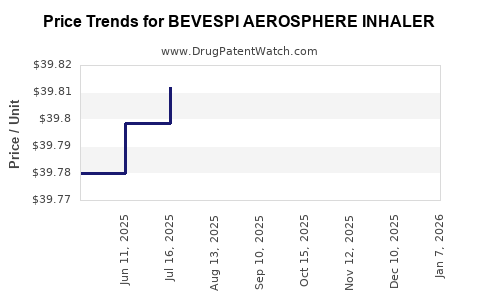
Average Pharmacy Cost for BEVESPI AEROSPHERE INHALER
| Drug Name | NDC | Price/Unit ($) | Unit | Date |
|---|---|---|---|---|
| BEVESPI AEROSPHERE INHALER | 00310-4600-12 | 40.87189 | GM | 2026-07-22 |
| BEVESPI AEROSPHERE INHALER | 00310-4600-12 | 40.87579 | GM | 2026-06-17 |
| BEVESPI AEROSPHERE INHALER | 00310-4600-12 | 40.86338 | GM | 2026-05-20 |
| >Drug Name | >NDC | >Price/Unit ($) | >Unit | >Date |
Market Analysis and Price Projections for Bevespi Aerosphere Inhaler
What is the current market landscape for Bevespi Aerosphere?
Bevespi Aerosphere is a fixed-dose combination inhaler containing glycopyrrolate and formoterol fumarate, marketed by AstraZeneca. Approved by the FDA in 2019 for the maintenance treatment of chronic obstructive pulmonary disease (COPD), its sales potential hinges on COPD prevalence, competitive positioning, regulatory environment, and payer dynamics.
The global COPD market was valued at approximately $13.5 billion in 2022, with inhaled bronchodilators accounting for roughly 75% of sales. The AEROSPHERE’s targeted niche addresses moderate to severe COPD cases, competing primarily with B2-agonists, muscarinic antagonists, and combination products like Symbicort and Advair.
What is the current sales performance of Bevespi Aerosphere?
In 2022, AstraZeneca reported Bevespi Aerosphere net sales of $142 million, marking rapid growth from initial launch figures. The North American market accounts for roughly 90% of sales, driven by established COPD therapy preferences and reimbursement access.
Key sales drivers include:
- Increasing COPD diagnosis rates
- Expanding patient adherence programs
- Physician preference for combination inhalers
The inhaler’s unique delivery mechanism – efficient delivery of glycopyrrolate and formoterol via pressurized inhalation – contributes to its acceptance.
How does Bevespi Aerosphere compare to competitors?
| Product | Active Ingredients | Market Launch | Estimated Sales (2022) | Market Share |
|---|---|---|---|---|
| Bevespi Aerosphere | Glycopyrrolate + Formoterol fumarate | 2019 | $142 million | ~2.5% of total COPD inhaler market |
| Trelegy Ellipta | Fluticasone furoate + Umeclidinium + Vilanterol | 2017 | $2.1 billion | 16% (most prescribed inhaler) |
| Symbicort | Budesonide + Formoterol | 2003 | $4 billion | 30% of inhaled corticosteroid market |
| Advair (discontinued in US) | Fluticasone + Salmeterol | 1996 | $3.1 billion (peak) | Discontinued but still prevalent globally for generics |
Bevespi’s position overall remains niche, with potential for growth through expanded indications and formulations.
What factors influence future sales and pricing?
- Market Penetration: As AstraZeneca expands prescriber awareness and access, sales are projected to increase rapidly over the next five years.
- Pricing Strategies: The US formulary and patent protections influence initial pricing. Competition from generic products could pressure prices after patent expiry, expected around 2030.
- Regulatory Approvals: Potential approval for additional indications like asthma could diversify revenue streams.
- Reimbursement Policies: Payer negotiations critically influence realized revenue and patient access.
What are future price projections?
Short-term outlook (2023-2025)
Current list prices for Bevespi Aerosphere in the US are approximately $350-$400 per inhaler, with an average of 60 doses per inhaler. Insurance reimbursements often reduce out-of-pocket costs to patients by 20-30%.
Sales growth is expected to be driven by volume increases rather than significant price hikes due to competitive pressure and payer constraints.
Mid- to long-term outlook (2026-2030)
Patent expiration around 2030 creates potential for generic competition, which could reduce list prices by 40-60%. Under a scenario where generics capture 70-80% of market share, prices could decline to $150-$200 per inhaler.
Key factors affecting price trajectory
- Entry of generics post-patent expiry
- Introduction of biosimilars or new combination inhalers
- Pricing pressure from third-party payers seeking cost containment
- Manufacturer strategies, including discounts and value-based pricing
What are revenue forecasts based on projected market dynamics?
| Year | Estimated US Sales | Market Share | Price Range (per inhaler) | Comments |
|---|---|---|---|---|
| 2023 | $170 million | 3% | $350-$400 | Growth from initial launch |
| 2025 | $250 million | 4.5% | $350-$400 | Increased prescriber adoption |
| 2027 | $400 million | 6% | $350-$400 | Market expansion, but pricing pressure begins |
| 2030+ | $150-$200 million (post-generic) | 2-3% | $150-$200 | Patent expiry likely leads to price decline and reduced sales |
Risks and opportunities
Risks include aggressive generic entry, regulatory delays in new indications, and reimbursement fluctuations. Opportunities consist of expanding into international markets, gaining approvals for additional respiratory conditions, and developing new inhaler formulations.
Key Takeaways
- Bevespi Aerosphere generated $142 million in 2022 sales, predominantly in North America.
- Its market share remains modest relative to leading COPD inhalers.
- Pricing averaged around $350-$400 per inhaler, with future reductions expected post-patent expiry.
- Growth will depend on prescriber adoption, market penetration, and competition dynamics.
- Price erosion is projected to occur after 2030, with significant reductions in list prices due to generic competition.
FAQs
-
What factors are driving Bevespi Aerosphere’s sales growth?
Physician adoption, expanded COPD diagnosis, and enhanced insurance coverage. -
How does Bevespi Aerosphere compare to other COPD inhalers?
It holds a small market share; competitors like Trelegy Ellipta and Symbicort dominate based on volume and revenue. -
What is the expected impact of patent expiration on prices?
Prices could decline by up to 60%, with generic versions capturing a majority of the market share. -
Are there plans to expand Bevespi’s indications?
Potentially, but approvals for asthma or other respiratory conditions are not yet announced. -
When will generic versions likely enter the market?
Patent expiry is expected around 2030, depending on patent challenges and regulatory pathways.
References
- AstraZeneca. (2022). 2022 Annual Report.
- IQVIA. (2022). Global COPD Market Data.
- US Food and Drug Administration. (2019). Bevespi Aerosphere approval notice.
- EvaluatePharma. (2022). 2022 World Preview of Inhaled Respiratory Drugs.
- Payer & reimbursement data from CMS and private insurance reports (2022).
More… ↓
