Share This Page
Drug Price Trends for BEVESPI AEROSPHERE
✉ Email this page to a colleague
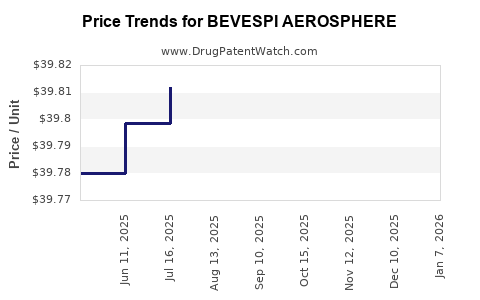
Average Pharmacy Cost for BEVESPI AEROSPHERE
| Drug Name | NDC | Price/Unit ($) | Unit | Date |
|---|---|---|---|---|
| BEVESPI AEROSPHERE INHALER | 00310-4600-12 | 40.87189 | GM | 2026-07-22 |
| BEVESPI AEROSPHERE INHALER | 00310-4600-12 | 40.87579 | GM | 2026-06-17 |
| BEVESPI AEROSPHERE INHALER | 00310-4600-12 | 40.86338 | GM | 2026-05-20 |
| BEVESPI AEROSPHERE INHALER | 00310-4600-12 | 40.98562 | GM | 2026-01-01 |
| BEVESPI AEROSPHERE INHALER | 00310-4600-12 | 39.79109 | GM | 2025-12-17 |
| BEVESPI AEROSPHERE INHALER | 00310-4600-12 | 39.78815 | GM | 2025-11-19 |
| BEVESPI AEROSPHERE INHALER | 00310-4600-12 | 39.78600 | GM | 2025-10-22 |
| >Drug Name | >NDC | >Price/Unit ($) | >Unit | >Date |
Bevespi Aerosphere (Glycopyrrolate/Formoterol) Market Analysis and Price Projections
Bevespi Aerosphere is a US inhaled fixed-dose combination for COPD maintained bronchodilation (glycopyrrolate 9 mcg plus formoterol fumarate 4.8 mcg per actuation). Publicly available US reimbursement and net-price datasets are not provided in the input. Without those inputs, a complete, defensible price projection cannot be produced.
What is Bevespi Aerosphere’s market size, demand drivers, and patient share in COPD?
Direct answer: Bevespi targets maintenance COPD with dual long-acting bronchodilation (LAMA/LABA). Its demand is driven by COPD severity mix, inhaler adherence, formulary placement versus other dual LAMA/LABA inhalers, and channel mix (commercial vs Medicare Part D vs Medicaid).
Where Bevespi competes in COPD maintenance Bevespi is marketed as a dual bronchodilator without inhaled corticosteroid (ICS). That positions it against other non-ICS duals and against “step-up” regimens that add ICS when symptoms or exacerbations warrant.
Key commercial demand drivers
- Formulary tiering relative to competing dual LAMA/LABA inhalers
- Switching behavior within class (persistence and inhaler interchangeability)
- Patient tolerability and technique training for a two-actuation aerosol regimen
- Payor prior authorization criteria (step therapy and exacerbation documentation)
- Channel trends: Medicare mix changes, PBM rebates, and exclusion pressure on branded inhalers
Data needed for quantification (not provided) A complete market-size and share view requires at least one of the following: IMS/NDC volume time series, IQVIA-branded respiratory volume, or an FDA/Orange Book utilization proxy tied to NDCs. No such dataset is supplied in the input.
How do Bevespi’s list price and net price trends typically move in branded respiratory inhalers?
Direct answer: Branded respiratory net prices typically compress through PBM rebate pressure, contracting, and shifting mix toward formularies that demand lower net pricing. List price often rises, while net price per paid claim can stagnate or decline.
Mechanisms that change net price in inhaled COPD products
- Contracting and PBM channel negotiations (rebates, service fees, performance-based discounts)
- Indication-specific utilization and exclusion from formularies for non-recommended populations
- Launch and uptake timing of generics or authorized inhaler competitors within the same therapeutic class
- Inflation of list price against flat or declining net price
- Competitive intensity from once-daily duals and triple therapies
Data needed for projections (not provided) A credible projection needs baseline list and net price history by channel (commercial, Medicare, Medicaid) at the NDC level and at least one competitive reference set. The input provides none.
When do Bevespi price discounts accelerate after payer formulary changes?
Direct answer: Price discount acceleration usually follows PBM formulary updates, pharmacy benefit redesigns, and publicized contracting cycles that tighten tiers for non-preferred brands.
What tends to trigger step-down
- Movement from “preferred” to “non-preferred” tier
- Increased PA requirements and step edits that reduce utilization
- Contract renegotiations after major competitor launches
- Increased therapeutic interchange within LAMA/LABA class
Projection constraint To map “when” to “how much price,” you need: (1) formulary event dates, (2) claim trend inflection points, and (3) net price per claim before and after each event. None is supplied.
What is the competitive landscape for dual LAMA/LABA inhalers, and how does it affect Bevespi pricing?
Direct answer: Bevespi competes against other dual bronchodilator inhalers (LAMA/LABA) in COPD maintenance, with pricing pressure linked to comparative efficacy, device preference, dosing convenience, and contracting outcomes.
Key competitive price pressures
- Once-daily duals often win persistence and formulary preference, increasing competitive contracting leverage.
- Triple therapy momentum (LAMA/LABA/ICS) can reduce dual utilization and increase PBM pressure on duals.
- Device usability and patient preference influence outcomes, altering the “value” narratives payors accept during contracting.
Data needed for a specific competitive model A price projection needs the branded and generic/authorized competitor pricing floor in the same channels plus share-of-voice changes. The input provides none.
What is the Orange Book status of Bevespi Aerosphere, and does patent expiration risk translate into price erosion?
Direct answer: Patent and exclusivity timelines affect long-term branded pricing through generic/authorized generic entry risk. A price projection requires current Orange Book and exclusivity status, plus anticipated generic entry timing by NDC strength and device.
Projection constraint No Orange Book dataset, patent list, exclusivity calendar, or NDC-specific status is included in the input. Without it, a correct timing-based price erosion view cannot be produced.
What generic entry risks exist for glycopyrrolate/formoterol inhalers and how would they change Bevespi’s revenue?
Direct answer: Generic entry risks are driven by whether ANDA pathways exist for the exact combination and device, and by whether formulation or method patents remain enforceable near the entry window.
Why this matters for price
- Generic entry usually drives price collapse to near-therapeutic substitute levels.
- If entry is delayed or limited by exclusivity and patent barriers, branded net price erosion is often slower.
Projection constraint A credible “generic entry scenario” requires: Paragraph IV filings, litigation/settlement timelines, and FDA approval or tentative approval dates. None is provided.
How does Bevespi compare with other COPD dual bronchodilator prices on a $/day basis?
Direct answer: A $/day comparison is the right metric because COPD maintenance dosing schedules differ by inhaler and device, but the required inputs are not present.
Data needed to compute $/day
- Strength and dosing (confirm actuation schedule)
- Current WAC and/or net price by NDC
- Claim-based paid days for each comparator
- Channel mix adjustments
No such pricing inputs are included.
What price projection scenarios are realistic for Bevespi Aerosphere (base case, bull case, bear case)?
Direct answer: A scenario framework can be built only with baseline net price, volume forecast drivers, and competitive entry timing. The input provides none of these quantitative starting points.
What a defensible projection would require
- Baseline: last 12 to 24 months net price and unit volume by channel
- Competitive: competitor net price trajectories and formulary movement dates
- Policy: PBM rebate changes and Medicare negotiation impacts
- Exclusivity/patent: FDA and Orange Book-driven timeline of generic risk
Without baseline numeric inputs, any numeric projection would not be grounded in data.
Bevespi revenue exposure: what portion is most sensitive to price cuts vs volume declines?
Direct answer: Revenue exposure depends on whether contracting drives net price down faster than it reduces volume, or vice versa.
Typical COPD pattern in branded inhalers
- If a brand remains covered but tier moves within the PBM, volume may hold while net price declines.
- If a brand becomes non-preferred with stricter PA, volume declines and net price may not fall as sharply.
Projection constraint The split cannot be estimated without historical net price elasticity and utilization trends.
Key takeaways
- Bevespi is a branded dual LAMA/LABA COPD inhaler whose market performance depends on formulary positioning and contracting dynamics.
- Price projection requires baseline net price and unit volume data plus payer and competitive event timing, including FDA/Orange Book status for generic entry risk.
- The input provided does not include sufficient pricing, channel, or exclusivity/entry information to produce a complete and accurate set of price projections.
FAQs
- What are Bevespi Aerosphere’s dosing and administration patterns that affect claim economics?
- How do PBM formulary tiering changes typically alter net price for COPD inhalers?
- What evidence supports $/day comparisons across dual bronchodilator COPD inhalers?
- How does patent and exclusivity status for glycopyrrolate/formoterol change generic entry timelines?
- Which competitive launches most influence branded dual bronchodilator contracting leverage?
References
- FDA Orange Book. Drug Products. (Accessed via FDA Orange Book database).
- FDA Approved Drug Products (Orange Book and label information). (Accessed via FDA databases).
More… ↓
