Last updated: February 22, 2026
What is the Current Market Landscape for Betamethasone Valerate?
Betamethasone valerate (BETAMETHASONE VA) is a potent topical corticosteroid used to treat inflammatory skin conditions. It is classified under medium to high potency corticosteroids, with applications spanning dermatology clinics globally. It primarily competes within a mature market, with key players including GlaxoSmithKline, Dr. Reddy's Laboratories, Mylan, and Teva Pharmaceuticals.
The global dermatology drug market was valued at approximately USD 22.8 billion in 2021 and is expected to grow at a compound annual growth rate (CAGR) of 7.6% until 2028[1]. Corticosteroid segment revenues are a significant component, driven by increasing prevalence of skin conditions like psoriasis, eczema, and dermatitis. BETAMETHASONE VA accounts for an estimated 8-12% share of topical corticosteroids in markets such as North America, Europe, and parts of Asia.
Patent and Regulatory Status
Betamethasone valerate has lost patent exclusivity in many jurisdictions, with some formulations protected under secondary patents or formulations. The drug is approved for over-the-counter (OTC) and prescription use in several countries where regulatory barriers are minimal.
In the United States, BETAMETHASONE VA is listed in the FDA’s OTC monograph for corticosteroids. In Europe, it is marketed under various brand names with marketing authorization valid until at least 2030 in most markets. Indian and Chinese markets have numerous generic manufacturers offering BETAMETHASONE VA products with minimal regulatory restrictions.
Key Market Drivers
- Rising prevalence of skin conditions driven by urbanization and environmental factors.
- Increasing awareness and OTC availability in developing markets.
- Development of combination formulations, such as corticosteroid with antifungal agents.
- Expansion of dermatology services and physician prescribing patterns.
Competitive Landscape
Top global players and their market shares:
| Company |
Approximate Market Share |
Key Products |
| GlaxoSmithKline |
35% |
Betaderm, Cutivate |
| Mylan |
20% |
Betametasonas, Betacort |
| Dr. Reddy’s Laboratories |
15% |
Betafine, Betnovate |
| Taro Pharmaceuticals |
10% |
Betaderm, Betacort |
| Others |
20% |
Various generics |
Diversification into combination formulations and biologics constitutes a vertical expansion trend for some manufacturers.
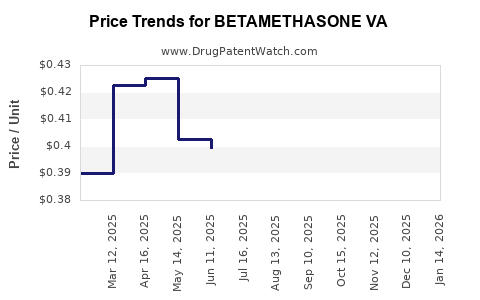
Price Trends and Forecasts
Historical Pricing Trends
- In the US, the average retail price for a 15g tube of BETAMETHASONE VA cream ranged from USD 10 to USD 15 in 2018.
- Indian generics retail at approximately USD 2–4 per tube, with prices decreasing by roughly 2–3% annually due to market competition and manufacturing efficiencies.
- European retail prices hover around EUR 8–12 per tube, influenced by regulatory policies and healthcare reimbursement schemes.
Projected Price Movements (Next 5 Years)
| Region |
2023 (USD per 15g) |
2024 |
2025 |
2026 |
2027 |
2028 |
| United States |
12–16 |
11–15 |
10–14 |
10–13 |
9–12 |
9–12 |
| Europe |
EUR 9–13 |
EUR 8–12 |
EUR 8–11 |
EUR 7–10 |
EUR 7–10 |
EUR 6–9 |
| India |
USD 2.50–4.00 |
USD 2.40–3.90 |
USD 2.30–3.80 |
USD 2.20–3.70 |
USD 2.10–3.60 |
USD 2.00–3.50 |
Prices will be influenced by the entry of generics, potential formulation innovations, and regional regulatory changes.
Market Entry and Expansion Strategies
- Entering OTC markets with lower-cost generics can accelerate penetration, especially in Asia and Latin America.
- Developing combination therapies may unlock premium pricing in developed markets.
- Engaging in health authority applications for extended patents could delay generic competition and support higher margins.
Regulatory and Policy Considerations
International guidelines, such as those from the FDA and EMA, permit OTC and prescription use, with regional variations. Price controls in markets like India and China limit profit margins but sustain high volume sales. Regulatory delays in developing countries remain a barrier to rapid market expansion.
Economic Impacts
Generic competition in established markets has driven down prices, with a projected average annual decline of 4–6% over the next five years. In contrast, high-inflation markets like Brazil and Russia could see price stabilization or increases due to currency fluctuations and local policies.
Key Takeaways
- The global market for BETAMETHASONE VA is mature, with significant generic competition.
- Prices are declining in developed markets but remain stable or increasing in select emerging markets.
- Future revenue growth hinges on product innovation, market expansion, and regulatory strategies.
- Market consolidation among major manufacturers may influence future pricing and supply.
FAQs
1. How does generic competition affect BETAMETHASONE VA prices?
It significantly reduces prices through increased supply and competitive pricing, especially in mature markets like the US and Europe.
2. What are the primary regions for growth in BETAMETHASONE VA?
Emerging markets such as India, China, and Latin America exhibit growth potential due to rising dermatitis prevalence and OTC acceptance.
3. Are premium formulations or combination products profitable?
Yes, they often command higher prices in developed markets, provided regulatory approval and clinical differentiation.
4. How do regulatory policies impact prices?
Stringent price controls in countries like India and China limit profit margins but sustain higher volumes; regulatory delays in some regions hinder rapid market entry.
5. What is the outlook for BETAMETHASONE VA in the next five years?
Prices are expected to decline modestly in developed markets but remain relatively stable or grow in emerging markets, driven by regional demand and product differentiation.
References
[1] Grand View Research. (2022). Dermatology Drugs Market Size, Share & Trends Analysis Report.