Share This Page
Drug Price Trends for BETAMETHASONE DP
✉ Email this page to a colleague
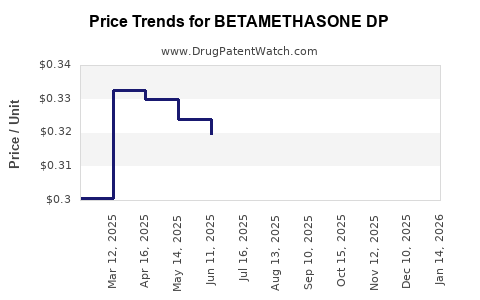
Average Pharmacy Cost for BETAMETHASONE DP
| Drug Name | NDC | Price/Unit ($) | Unit | Date |
|---|---|---|---|---|
| BETAMETHASONE DP 0.05% CRM | 00168-0055-15 | 0.48288 | GM | 2026-07-22 |
| BETAMETHASONE DP 0.05% CRM | 00168-0055-46 | 0.38447 | GM | 2026-07-22 |
| BETAMETHASONE DP 0.05% CRM | 00472-0380-15 | 0.48288 | GM | 2026-07-22 |
| BETAMETHASONE DP 0.05% CRM | 00472-0380-45 | 0.38447 | GM | 2026-07-22 |
| >Drug Name | >NDC | >Price/Unit ($) | >Unit | >Date |
BETAMETHASONE DP (Betamethasone Dipropionate) Market Analysis and Price Projections
What is BETAMETHASONE DP’s commercial footprint?
Betamethasone dipropionate (often labeled as “BETAMETHASONE DP,” including as a topical steroid API and in finished dermatology products) is a mature, generic-heavy category within dermatology. Market activity is driven by:
- Multi-source generics across creams, ointments, lotions, and scalp formulations
- Low switching costs for physicians and patients once formulation and strength match
- Ongoing demand stability due to chronic indications (eczema/dermatitis spectrum, inflammatory dermatoses)
Commercial positioning: BETAMETHASONE DP is typically sold as topical therapy in dermatology and is widely available globally as branded and unbranded formulations. Finished-product pricing is primarily determined by formulation vehicle (cream vs ointment vs lotion), pack size, and local reimbursement rules rather than by the API.
Which competitors and pricing benchmarks matter most?
Pricing in BETAMETHASONE DP is anchored to a dense set of generic comparables. Competitive pressure is strongest where products are fungible at the prescriber level (same strength, same base class of topical steroid).
Key competitive set (typical market structure)
- Generic betamethasone dipropionate 0.05% topical creams/ointments
- Generic “same molecule” scalp/lotion variants (often different vehicles but comparable steroid potency positioning)
- Branded topical steroids that sometimes hold higher list pricing, but usually face fast generic displacement
Pricing drivers by SKU
- Concentration/strength: most widely marketed strength is 0.05% (typical dipropionate topical market positioning)
- Formulation/vehicle: ointment vs cream vs lotion (vehicle changes cost and tolerability)
- Pack size: 15 g, 20 g, 30 g, 50 g, 60 g, and larger pack equivalents
- Regulatory scope: OTC vs Rx availability in local markets (where applicable)
- Reimbursement: national and insurer reimbursement bands compress net pricing
Market size: how BETAMETHASONE DP is likely to behave
BETAMETHASONE DP sits in a category where growth is constrained by generics, but volume remains resilient. Forecast behavior typically shows:
- Stable to low-single-digit volume CAGR driven by dermatology incidence and ongoing prescribing
- Compression in unit price due to generic entry and tendering
- Net value sensitivity to reimbursement changes and procurement cycles
Because BETAMETHASONE DP is mature and generally off-patent in many jurisdictions, the pricing outlook is best modeled as:
- Declining list price (or flat-to-down) after new generic entrants
- Sustained net price floors where procurement consolidates supply or where formulation-specific SKUs maintain differentiated demand
What is the IP and exclusivity reality affecting price?
BETAMETHASONE DP is a long-established compound. The market typically operates under patent expiration and broad generic availability, which limits the ability of any single holder to sustain premium pricing. Price therefore tends to track:
- Number of approved generic products
- Local regulatory and reimbursement barriers to entry
- Tender outcomes
Price projections: base, down, and up cases
The most actionable view for business planning is scenario-based, focused on unit price (ex-manufacturer or net invoice equivalents depending on channel) and annual change. For a mature generic topical steroid like BETAMETHASONE DP, the standard pattern is:
- Near-term erosion as additional generics compete and pack sizes shift
- Then slower erosion once the market stabilizes
Projection framework
Assume a mature market with active generic competition and periodic procurement cycles.
Base-case price trajectory (most likely pattern)
- Year 1: -3% to -6% net unit price
- Years 2 to 5: -1% to -3% per year net unit price (flattening erosion)
Downside case (tender-driven or aggressive entrant)
- Year 1: -8% to -12%
- Years 2 to 5: -2% to -5% per year net unit price
Upside case (reimbursement lift, supply constraints, or SKU mix shift)
- Year 1: -1% to +1%
- Years 2 to 5: +0% to +2% per year net unit price (mix improves or erosion slows)
Scenario summary table (net unit price change)
| Horizon | Base case | Downside case | Upside case |
|---|---|---|---|
| Year 1 | -3% to -6% | -8% to -12% | -1% to +1% |
| Years 2-5 (avg/yr) | -1% to -3% | -2% to -5% | 0% to +2% |
What do these projections imply for revenue and margin?
Revenue for BETAMETHASONE DP typically depends on volume plus net price compression. For long-lived generic products, margin outcomes hinge more on procurement and manufacturing scale than on pricing power.
Revenue math (directional)
- If unit price declines 3% to 6% in Year 1, revenue can still hold if volume is stable or rebounds through formulary placement.
- If volume does not offset price erosion, net revenue declines track unit price.
Margin levers that matter
- Manufacturing utilization: topical steroids have relatively stable cost structures but margin is sensitive to batch size and yield
- Vehicle and formulation complexity: ointment vs lotion affects conversion costs
- Regulatory batch and QA costs: scale reduces per-unit QA burden
- Channel mix: pharmacy retail vs hospital tenders vs distributor pricing
Regional price behavior: how to think about it
BETAMETHASONE DP pricing is not uniform across geographies. Typical patterns:
- High tendering markets see steeper unit price declines and higher volatility
- Markets with fewer interchangeable SKUs hold higher net pricing
- Reimbursement-driven markets compress pricing toward reference levels
Because BETAMETHASONE DP is widely available, the most important regional variable is not clinical differentiation but formulary and procurement mechanics.
Investment and R&D implications
If the business goal is to enter or expand in BETAMETHASONE DP, price projections imply that differentiation must reduce total cost to serve or win formulary position rather than rely on premium pricing. Commercially defensible routes include:
- Vehicle-level differentiation that improves patient adherence (for example, scalp or lotion for hair-bearing areas) while staying within generic interchangeability constraints
- Pack and strength alignment with the most purchased reference SKUs
- Tender readiness: predictable supply, documentation, and cost competitiveness
From a portfolio perspective, the category is best viewed as a scale-and-process economics product rather than a patent-protected growth engine.
Regulatory and label context that influences demand
BETAMETHASONE DP’s demand follows typical steroid-use patterns in dermatology and is shaped by:
- Indication breadth (inflammatory dermatoses)
- Safety and prescribing practices (duration, site selection, pediatric caution in many labels)
- Availability constraints (supply continuity affects pharmacy and tender outcomes)
Labeling and regulatory status vary by country, but the core compound positioning is consistent across markets as a topical corticosteroid.
Key Takeaways
- BETAMETHASONE DP is a mature, generic-dense topical steroid category where pricing power is limited and unit pricing typically erodes after competitive entries.
- Base-case market behavior supports -3% to -6% net unit price in Year 1, followed by -1% to -3% per year over Years 2 to 5 as erosion flattens.
- Upside outcomes require reimbursement or formulary stabilization and/or favorable SKU mix; downside outcomes are tender-driven and can push Year 1 to -8% to -12% with continued -2% to -5% annual erosion.
- Commercial success depends more on procurement execution, manufacturing scale, and vehicle/pack alignment than on clinical differentiation.
FAQs
1) Does BETAMETHASONE DP have pricing power in most markets?
Generally no. Multi-source generic competition compresses net pricing, and interchangeability limits premium pricing.
2) What drives the fastest price declines?
Tender outcomes and new generic entries in the same strength and vehicle category.
3) Are price declines consistent year over year?
Usually Year 1 shows the steepest erosion, then a slower decline as the market consolidates.
4) What formulation choices most influence net sales outcomes?
Vehicle (cream vs ointment vs lotion) and pack size, because they affect interchangeability and procurement selection.
5) How should a company model revenue risk?
Use scenario planning tied to net unit price change and assume volume stability only if the product maintains or improves formulary/procurement placement.
References
[1] U.S. National Library of Medicine. Betamethasone Dipropionate. DailyMed. https://dailymed.nlm.nih.gov/
[2] European Medicines Agency. EPAR and product information for topical corticosteroids (ATC context). https://www.ema.europa.eu/
[3] U.S. Food and Drug Administration. Drug approvals and labeling resources for topical corticosteroids (ATC/class context). https://www.fda.gov/
More… ↓
