Last updated: July 27, 2025
Market Overview
Betamethasone, a potent corticosteroid, is widely used in the treatment of various skin diseases, allergic conditions, and inflammatory disorders. The market for betamethasone, particularly in its ointment and sodium phosphate forms, is experiencing significant growth driven by several key factors.
Market Size and Growth Projections
The global betamethasone market is anticipated to see substantial growth over the coming years. Here are some key projections:
- Global Betamethasone Ointment Market: Expected to grow from $795 million in 2023 to $1,112.1 million by 2032, at a Compound Annual Growth Rate (CAGR) of 3.80% during the forecast period[2].
- Global Betamethasone Sodium Phosphate Market: Projected to grow at a CAGR of 6.51% from 2024 to 2031, expanding from $607.2 million in 2023 to $1005.67 million by 2031[3][5].
Key Drivers of Market Growth
Increasing Prevalence of Health Conditions
The rising incidence of skin disorders such as psoriasis, asthma, rheumatoid arthritis, and systemic lupus erythematosus is a major driver of the betamethasone market. These conditions require effective treatments, and betamethasone, with its anti-inflammatory properties, is a preferred choice for many healthcare providers[1][3].
Expanding Pharmaceutical Industry
The rapid expansion of the pharmaceutical industry, particularly in emerging nations, is creating new opportunities for the betamethasone market. This includes the development of different formulations and the introduction of new products to cater to a broader range of health conditions[1].
Geriatric Population Growth
The increasing geriatric population globally is another significant factor. Older adults are more prone to chronic diseases such as arthritis and skin conditions, which in turn drives the demand for betamethasone and other corticosteroids[4].
Market Segmentation
By Type
The betamethasone ointment market is segmented into several types, including:
- Betamethasone Dipropionate: Commonly used for treating skin conditions such as eczema and dermatitis.
- Betamethasone Sodium Phosphate: Often used for injections to treat conditions like arthritis and allergies.
- Betamethasone Valerate: Used for various skin conditions and allergic reactions[1].
By Region
Geographically, the market is analyzed across:
- North America: Includes the U.S., Canada, and Mexico.
- Europe: Includes Germany, the UK, France, Italy, Spain, and the rest of Europe.
- Asia-Pacific: Includes Japan, China, India, Australia, South Korea, and the rest of Asia-Pacific.
- LAMEA (Latin America, Middle East, and Africa): Includes Brazil, Saudi Arabia, South Africa, and the rest of LAMEA[1].
Key Players
The betamethasone market is competitive, with several key players:
- GlaxoSmithKline plc.
- East West Pharma
- Omega Remedies Pvt Ltd.
- Moraceae Pharmaceuticals Pvt. Ltd.
- Emson Medichem Pvt. Ltd.
- Dermocare Laboratories (Guj.) Pvt Ltd
- Cipla Inc.
- Micro Labs Ltd
- Pharmtak Ophtalmics Pvt. Ltd.
- Psyco Remedies[1].
Price Trends and Projections
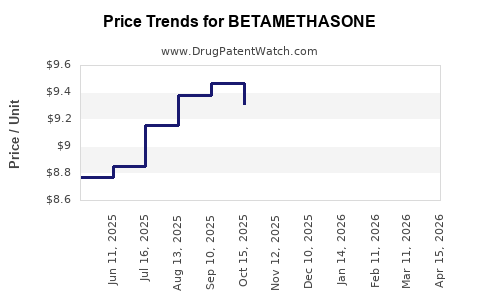
The prices of betamethasone vary significantly by region and type. Here are some recent price trends:
- United States: The price of betamethasone reached $1,015,000 USD/MT in Q2 2023.
- China: The price was $918,500 USD/MT in Q2 2023.
- Germany: The price was $978,000 USD/MT in Q2 2023[2].
These prices are influenced by factors such as raw material costs, supply-demand dynamics, geopolitical factors, and industry-specific developments. The report also provides insights into historical price trends and future price forecast models, enabling stakeholders to make informed strategic decisions[2].
Challenges and Restraints
Despite the growth potential, the betamethasone market faces several challenges:
- Side Effects: Muscle weakness and allergic reactions are common side effects associated with betamethasone, which can restrain market growth[1].
- Regulatory Compliance: Stringent regulatory requirements, especially in regions like Europe, can impact the market by increasing costs related to new product development and service offerings[4].
Mechanism of Action
Betamethasone acts through both genomic and non-genomic pathways to exert its anti-inflammatory effects. The non-genomic pathways elicit a faster response by modulating monocyte activity, T-cells, and platelets, while the genomic pathways involve the activation of glucocorticoid receptors, leading to the transcription of anti-inflammatory genes[3].
Market Opportunities
The betamethasone market presents several opportunities for growth:
- Untapped Markets: Emerging nations offer significant untapped market opportunities, driven by increasing healthcare expenditure and a growing demand for effective treatments for chronic diseases[1].
- New Formulations: The introduction of different formulations of betamethasone can cater to a broader range of health conditions, further expanding the market[1].
Conclusion
The betamethasone market is poised for significant growth, driven by increasing demand for treatments of various health conditions, expanding pharmaceutical industry, and growing geriatric population. Understanding the market segmentation, key drivers, and challenges is crucial for stakeholders to capitalize on the prevailing market opportunities.
Key Takeaways
- The global betamethasone market is expected to grow significantly over the next few years.
- Increasing prevalence of skin disorders, asthma, and rheumatoid arthritis drives market growth.
- The market is segmented by type and region, with key players like GlaxoSmithKline plc. and Cipla Inc.
- Price trends vary by region, influenced by raw material costs and supply-demand dynamics.
- Side effects and regulatory compliance are key challenges to market growth.
- New formulations and untapped markets in emerging nations offer growth opportunities.
FAQs
1. What are the primary uses of betamethasone?
Betamethasone is primarily used to treat skin diseases such as dermatitis, allergic conditions, and itching. It is also used for injections to treat conditions like arthritis and allergies[1][3].
2. What are the different types of betamethasone ointments?
The betamethasone ointment market is segmented into betamethasone dipropionate, betamethasone sodium phosphate, and betamethasone valerate[1].
3. Which regions are analyzed in the betamethasone market report?
The market is analyzed across North America, Europe, Asia-Pacific, and LAMEA (Latin America, Middle East, and Africa)[1].
4. What are the key drivers of the betamethasone market growth?
The key drivers include the increasing prevalence of health conditions such as psoriasis, asthma, and rheumatoid arthritis, as well as the rapid expansion of the pharmaceutical industry and the growing geriatric population[1][3].
5. What are the potential challenges to the betamethasone market?
The potential challenges include side effects such as muscle weakness and allergic reactions, and stringent regulatory requirements that can increase costs related to new product development[1][4].
Sources
- Allied Market Research - Betamethasone Ointment Market Size, Share & Industry Analysis 2026
- Allied Market Research - Betamethasone Ointment Market Report Highlights
- IMARC Group - Betamethasone Pricing Report 2024: Price Trend, Chart, Market Analysis, News, Demand, Historical and Forecast Data
- MarketsandData - Betamethasone Sodium Phosphate Market Size, Growth, Report 2031
- The Business Research Company - Corticosteroids Global Market Report 2025
- Drug Patent Watch - BETAMETHASONE SP-AC Market Analysis and Financial Projection