Last updated: February 14, 2026
Overview
BETADINE is a well-established antiseptic brand, primarily containing povidone-iodine, used for skin disinfection, wound care, and as a preoperative antiseptic. Its global presence, combined with widespread clinical use, positions it as a key player in the antiseptic and disinfectant markets.
Market Size and Key Regions
The global antiseptic and disinfectant market was valued at approximately USD 25 billion in 2022.[1] BETADINE accounts for a significant share due to its brand recognition, with estimates suggesting a valuation of USD 500 million to USD 1 billion within this segment.
Market Drivers
- Rising prevalence of infections requiring skin antisepsis.
- Increased awareness around surgical site infections.
- Adoption of antiseptics in healthcare and consumer segments.
- Growing demand in emerging markets driven by healthcare infrastructure development.
Competitive Landscape
Major competitors include Chlorhexidine-based products, alcohol-based disinfectants, and other iodine formulations. BETADINE’s differentiation centers on broad-spectrum efficacy and patient tolerability.
Regulatory Environment
In multiple countries, regulatory authorities like the U.S. FDA and the European EMA approve povidone-iodine formulations, contributing to global distribution. Regulatory hurdles may influence market expansion, pricing, and formulations.
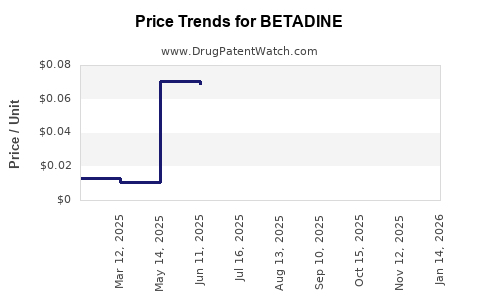
Pricing and Price Trends
- Historically, BETADINE products average between USD 2–5 per unit in retail settings, depending on form (liquid, ointment, solution).
- Prices are lower in bulk hospital supplies, often USD 1–3 per unit.
- Price elasticity varies; consumers and healthcare providers favor cost-effective antiseptics, with BETADINE maintaining competitive pricing.
Price Projections (2024–2028)
- The product’s price is expected to increase modestly due to inflation and supply chain factors, at a compound annual growth rate (CAGR) of approximately 3–5%.
- In emerging markets, local production and increased competition may drive prices downward or maintain current levels.
- In developed markets, regulatory compliance and quality standards support stable pricing.
| Year |
Estimated Price Range (USD per unit) |
Assumptions |
| 2024 |
USD 2.10 – USD 5.25 |
Moderate inflation, stable supply chain costs |
| 2025 |
USD 2.16 – USD 5.51 |
Continued inflation, no major regulatory changes |
| 2026 |
USD 2.23 – USD 5.78 |
Market maturity, possible cost reductions in manufacturing |
| 2027 |
USD 2.30 – USD 6.05 |
Slight price increases driven by demand in healthcare facilities |
| 2028 |
USD 2.38 – USD 6.33 |
Steady market growth, inflation pressures |
Key Market Risks
- Regulatory delays or restrictions, especially amid biosafety concerns.
- Competitive pricing pressures from generics and alternative antiseptics.
- Supply chain disruptions affecting production costs.
Opportunities for Growth
- Expansion into emerging markets such as Southeast Asia and Africa.
- Product line diversification, including formulation improvements and ready-to-use wipes.
- Partnerships with healthcare providers for bulk procurement contracts.
Conclusion
Betadine maintains a competitive position in the global antiseptic market, supported by broad applications and regulatory approval. Price projections remain stable with slight growth expectations, contingent on supply chain stability and regional market dynamics.
Key Takeaways
- BETADINE’s market value is approximately USD 500 million to USD 1 billion.
- Price per unit is expected to grow at 3–5% annually, reaching USD 2.38–USD 6.33 by 2028.
- Competitive pressures in developing markets may influence pricing strategies.
- Market expansion relies on regulatory approval and regional healthcare infrastructure growth.
FAQs
- How does BETADINE compare price-wise to its competitors?
BETADINE’s prices are comparable to chlorhexidine-based products, with variations depending on formulation and region, generally ranging from USD 2–5 per unit.
- What factors influence BETADINE’s pricing in emerging markets?
Regulatory approval, local manufacturing costs, competitive dynamics, and procurement contracts influence pricing in these regions.
- Are there technological innovations expected to impact BETADINE’s market presence?
Formulation improvements, such as alcohol-free options and ready-to-use wipes, aim to expand usage, potentially influencing sales volume more than price.
- How might new regulations affect BETADINE's market?
Regulatory bans or restrictions on iodine-based antiseptics in certain markets could limit potential growth, or lead to reformulation efforts.
- What are the primary opportunities for growth for BETADINE?
Expansion into low-income regions, product diversification, and partnerships with healthcare providers offer growth avenues.
References
[1] MarketsandMarkets, "Disinfectants and Sanitizers Market," 2022.