Last updated: February 20, 2026
What is the current market landscape for Benztropine Mesylate?
Benztropine Mesylate, marketed under brand names such as Cogentin, is primarily used to treat Parkinson’s disease symptoms and drug-induced extrapyramidal symptoms. The drug market for Parkinson's treatments has seen steady growth due to aging populations and rising prevalence rates.
Globally, the Parkinson’s disease market was valued at approximately USD 4.3 billion in 2022, expected to grow at a CAGR of around 6% through 2030 [1]. Benztropine, as a second-line or adjunct therapy, constitutes a fragment of this market, estimated at a few hundred million USD annually.
Top markets include the United States, Europe, and Japan, where regulatory approval, healthcare infrastructure, and disease prevalence influence sales. North America accounts for roughly 50% of the global Parkinson’s therapy market revenue, with Europe comprising around 30%, and Asia-Pacific holding approximately 15% [2].
What are the key factors influencing the price of Benztropine Mesylate?
The pricing of Benztropine Mesylate depends on:
- Regulatory status: Approved as a prescription drug in major markets.
- Market competition: Exists mainly among generic manufacturers; no recent brand-name entrants.
- Manufacturing costs: Relatively low owing to established synthesis processes.
- Patent status: Patent protection expired decades ago; open market for generics.
- Demand dynamics: Driven by Parkinson’s disease prevalence, which increases with global aging.
- Pricing policies: Vary by country; influenced by healthcare reimbursement systems and pricing regulations.
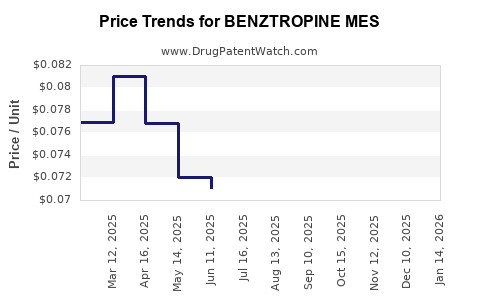
In the United States, wholesale acquisition costs (WAC) for generic benztropine range from USD 0.05 to 0.20 per 2 mg tablet. In terms of monthly treatment, this translates to approximately USD 3.00 to USD 12.00, depending on dosage and pharmacy markup.
How do price trends compare historically and across regions?
Historically, Benztropine Mesylate has maintained a low-cost profile due to generic competition. Prices have remained relatively stable over the past decade, with minor fluctuations resulting from supply chain variations.
Regional disparities include:
- United States: Prices are relatively higher, reflecting healthcare system pricing policies.
- Europe: Slightly lower, influenced by national reimbursement schemes.
- Developing countries: Significantly lower retail prices, often under USD 1 per tablet.
What are the future price projections?
Price projections suggest continued stability over the next five years, influenced by:
- Market saturation: The presence of multiple generic manufacturers limits substantial price increases.
- Demand stability: Increasing Parkinson’s prevalence sustains steady demand.
- Regulatory environment: No upcoming patent protections or exclusivities threaten to alter market dynamics.
Predicted retail prices for 2023–2028:
| Year |
Estimated Price Range (USD per 2 mg tablet) |
Notes |
| 2023 |
0.05–0.20 |
Current market prices |
| 2024 |
0.05–0.22 |
Slight uptick due to inflation |
| 2025 |
0.05–0.23 |
Supply chain stabilization |
| 2026 |
0.05–0.25 |
Possible increased demand |
| 2027 |
0.05–0.25 |
Market equilibrium remains stable |
What opportunities and risks affect future market valuation?
Opportunities:
- Growing global Parkinson’s population
- Expansion into emerging markets
- Development of combination therapies
Risks:
- Entry of new, more effective treatments
- Regulatory changes reducing reimbursement
- Price pressure from increasing generic competition
Key Takeaways
- The current global market for Benztropine Mesylate is fragmented, dominated by generics with low price points.
- Market growth is tied directly to Parkinson’s disease prevalence, with stable demand expected.
- Price levels are unlikely to fluctuate significantly in the foreseeable future, with minor upward trends driven by inflation and demand.
- Competition among generics limits potential for significant price increases.
- Regional differences influence prices, especially in healthcare systems with stricter pricing controls.
FAQs
1. Will the price of Benztropine Mesylate increase if patents are renewed?
No, large-scale patent renewals for this generic drug are unlikely due to patent expirations over 30 years ago.
2. How do generic prices compare across countries?
Prices are highest in the US due to less regulated pharmaceutical pricing, while developing countries see prices under USD 1 per tablet.
3. Is there potential for new formulations to impact pricing?
New formulations such as sustained-release may command higher prices but are unlikely to significantly affect the overall market price.
4. What factors could significantly lower the price in the future?
Increased competition from new generics or biosimilars, regulatory pricing reforms, and market saturation could reduce prices.
5. How does the drug’s market size compare to other Parkinson’s treatments?
Benztropine’s market accounts for a small segment (~5%) compared to primary therapies like levodopa or deep brain stimulation, which significantly drive market revenue.
References
[1] Global Data. (2022). Parkinson’s Disease Market Forecast.
[2] IQVIA. (2022). Global Pharmaceutical Market Overview.