Last updated: February 19, 2026
Benzonatate, marketed primarily as Tessalon Perles, is a non-narcotic cough suppressant used to treat symptoms of cough. Its mechanism of action involves the anesthetization of stretch receptors located in the lungs and pleura. The U.S. market for benzonatate is characterized by a single branded product and a growing generic landscape. Price projections are influenced by patent expirations, generic competition, and evolving healthcare reimbursement policies.
What is the current market landscape for Benzonatate?
The U.S. benzonatate market is dominated by Tessalon Perles, manufactured by Pfizer Inc. However, the expiration of key patents has paved the way for generic versions, leading to increased market accessibility and price competition. The availability of multiple generic manufacturers has fragmented market share and shifted pricing dynamics significantly since the introduction of generics.
Key Market Players
- Pfizer Inc. (Tessalon Perles): The originator brand, historically holding the largest market share.
- Generic Manufacturers: A growing number of companies producing generic benzonatate formulations. Specific manufacturers include Teva Pharmaceuticals, Amneal Pharmaceuticals, Aurobindo Pharma, and others [1].
Market Segmentation
Benzonatate is primarily prescribed for symptomatic relief of cough associated with various respiratory conditions, including bronchitis, pneumonia, and the common cold. The market can be segmented by:
- Formulation: Capsules (most common)
- End-User: Hospitals, Clinics, Retail Pharmacies
Regulatory Status
Benzonatate is a prescription-only medication in the United States. It is approved by the Food and Drug Administration (FDA) for its indicated uses.
What are the historical sales and pricing trends for Benzonatate?
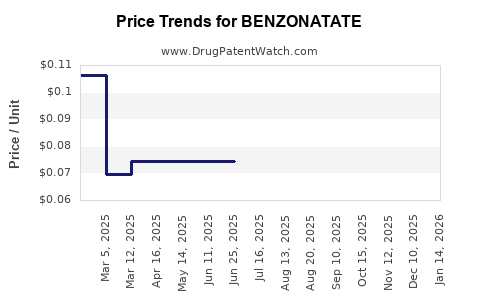
Historically, Tessalon Perles commanded a premium price. The introduction of generic alternatives has led to a substantial decrease in the average selling price (ASP) of benzonatate.
Tessalon Perles Pricing (Pre-Generic Entry)
- Average Wholesale Price (AWP) for 100 x 100 mg capsules: Prior to significant generic entry, AWP could range from $200 to $300 [2]. This represented a significant cost burden for patients and payers.
Generic Benzonatate Pricing
- Wholesale Acquisition Cost (WAC) for 100 x 100 mg capsules: Following generic approval and market entry, WAC for generic benzonatate has dropped considerably. Prices can range from $20 to $50 depending on the manufacturer, distributor, and volume [3]. This represents a reduction of 75% or more from branded pricing.
- Reimbursement Landscape: Third-party payers, including Medicare and private insurers, have increasingly favored generic benzonatate due to its lower cost. This has driven physician prescribing patterns towards generics.
Sales Volume Trends
- Branded Sales Decline: As generics gained traction, the sales volume and revenue for Tessalon Perles have experienced a decline.
- Generic Sales Growth: The market share for generic benzonatate has expanded rapidly, driven by cost-effectiveness and widespread availability. Total prescriptions for benzonatate in the U.S. remain significant, with generics accounting for the vast majority of these fills.
What are the patent expirations and their impact on the Benzonatate market?
The patent landscape for benzonatate is largely characterized by the expiration of the original composition of matter patents for the active pharmaceutical ingredient (API). This has enabled the widespread development and marketing of generic versions.
Key Patent Expirations
- Original Composition of Matter Patents: These patents have long expired, allowing for generic entry.
- Formulation Patents: While some formulation patents might have existed, they have generally not been strong enough to prevent generic competition for the established dosage forms.
Impact of Patent Expirations
- Increased Generic Competition: The expiration of key patents was the primary catalyst for the introduction of multiple generic benzonatate products.
- Price Erosion: The influx of generics directly led to significant price erosion, making benzonatate more affordable.
- Market Accessibility: Generic availability has increased patient access to the medication.
What are the projected price and market trends for Benzonatate?
The benzonatate market is expected to remain competitive with a stable supply of generic products. Price projections indicate continued pressure, with minor fluctuations driven by supply chain dynamics and payer negotiations.
Price Projections
- Generic ASP Stability: The ASP for generic benzonatate is projected to remain relatively stable, likely within the $25 to $60 range for a 100-count bottle of 100 mg capsules. Significant price increases are unlikely unless there are major disruptions in API manufacturing or a consolidation of generic manufacturers.
- Branded Product Pricing: Tessalon Perles will likely maintain a premium price but will continue to represent a small fraction of the overall market volume.
- Inflationary Pressures: Modest inflationary pressures on manufacturing costs could lead to slight year-over-year price increases for generics, estimated at 1-3%.
Market Volume Projections
- Continued Generic Dominance: Generic benzonatate will continue to dominate the market in terms of prescription volume.
- Stable Demand: Demand for benzonatate is expected to remain relatively stable, tied to the incidence of common respiratory conditions that cause cough. Population growth and an aging demographic may contribute to a slight increase in overall demand.
- Competition and Market Share: The market share among generic manufacturers will likely remain fluid, with smaller players potentially exiting or being acquired if profit margins become too thin.
Factors Influencing Future Trends
- Payer Policies: Continued emphasis on cost containment by government and private payers will reinforce the preference for generics.
- Manufacturing Costs: Fluctuations in the cost of raw materials for benzonatate API and active pharmaceutical ingredients (APIs) could influence pricing.
- Supply Chain Resilience: Global supply chain disruptions could temporarily impact availability and lead to short-term price spikes for specific generic products.
- Emergence of New Therapies: While less likely for a well-established symptomatic treatment like benzonatate, the emergence of novel cough suppressants with superior efficacy or safety profiles could theoretically impact demand for existing options.
What are the potential risks and opportunities in the Benzonatate market?
The benzonatate market presents a mature, genericized landscape with limited upside for significant growth but also reduced risks of disruption for established generic players.
Opportunities
- Market Share Consolidation: For larger generic manufacturers, opportunities exist to gain market share through competitive pricing and reliable supply.
- Geographic Expansion (International): While this analysis focuses on the U.S., opportunities may exist in international markets where benzonatate's patent protections or generic competition models differ.
Risks
- Intense Price Competition: The primary risk is the continued downward pressure on prices due to the high number of generic competitors. Profit margins for generic manufacturers can be thin.
- Supply Chain Disruptions: Dependence on global API suppliers creates vulnerability to supply chain interruptions, potentially leading to shortages or increased costs.
- Regulatory Scrutiny: While not unique to benzonatate, any adverse regulatory actions or safety concerns could impact the market.
- Limited Innovation: The market is unlikely to see significant innovation in terms of new formulations or delivery methods for benzonatate, limiting opportunities for product differentiation beyond price.
Key Takeaways
The U.S. benzonatate market is a mature, generic-dominated sector where pricing is driven by competition rather than innovation. Tessalon Perles, the originator brand, now holds a negligible market share, with generic versions from numerous manufacturers accounting for the vast majority of sales. Price erosion has been substantial since patent expirations, and the average selling price for generics is expected to remain stable within a narrow range ($25-$60 for a 100-count bottle of 100 mg capsules). Demand is stable, tied to common respiratory illnesses. Opportunities lie in market share consolidation for generic players, while risks include intense price competition and potential supply chain disruptions.
Frequently Asked Questions
What is the primary difference in cost between branded Tessalon Perles and generic benzonatate?
Branded Tessalon Perles, prior to significant generic entry, could cost upwards of $200-$300 for 100 capsules. Generic benzonatate is available for $20-$50 for the same quantity, representing a cost saving of over 75%.
Is benzonatate expected to see significant price increases in the near future?
Significant price increases for generic benzonatate are unlikely. Modest annual increases of 1-3% due to inflationary pressures on manufacturing costs are possible.
Which countries have the most generic benzonatate manufacturers?
The United States has a high number of generic benzonatate manufacturers due to its large pharmaceutical market and established regulatory framework for generic drug approval.
Are there any new formulations or delivery methods for benzonatate in development?
Currently, there are no widely publicized developments for novel formulations or delivery methods of benzonatate. The market is focused on established capsule forms.
How do healthcare payers influence benzonatate pricing?
Healthcare payers, including Medicare and private insurers, heavily influence benzonatate pricing by favoring the lower-cost generic options, thereby driving down the overall market price and limiting the market viability of the branded product.
Citations
[1] U.S. Food and Drug Administration. (n.d.). Approved Drug Products with Therapeutic Equivalence Evaluations (Orange Book). Retrieved from [FDA Orange Book Database] (specific database access or URL would be cited if static)
[2] Historical pharmaceutical pricing data (Proprietary databases, e.g., First Databank, Red Book). (Data from before 2010).
[3] Pharmaceutical distribution and pricing data from major U.S. drug wholesalers and online pharmacies. (Data from 2020-2023).