Last updated: February 13, 2026
Market Overview and Price Projections for Benzapril HCl
Current Market Landscape
Benzapril HCl is an ACE inhibitor used primarily to treat hypertension and congestive heart failure. It is available in generic form and marketed by several pharmaceutical companies worldwide. The drug's global market primarily relies on generic sales, with branded versions dominating niche markets.
The global antihypertensive drugs market was valued at approximately $30 billion in 2022. Benzapril HCl accounts for an estimated 3% of ACE inhibitor sales, equating roughly to $900 million annually in the generic segment, based on the dominant position of captopril and enalapril.
Market Drivers and Barriers
Drivers:
- Increasing prevalence of hypertension globally, particularly in aging populations.
- Rising awareness of cardiovascular health.
- Cost-effective generics replacing branded ACE inhibitors.
Barriers:
- Competitive landscape dominated by established ACE inhibitors (enalapril, ramipril).
- Patent expiration of similar drugs, leading to generic erosion.
- Strict regulatory environments.
Market Size and Growth Trends
| Year |
Estimated Global Market for Benzapril HCl (USD millions) |
CAGR (2018-2023) |
Projected Market (2024-2028) |
| 2022 |
900 |
4% |
N/A |
| 2023 |
936 (projected) |
4% |
1,050 |
| 2024 |
975 (projected) |
4% |
1,150 |
| 2025 |
1,015 |
4% |
1,260 |
| 2026 |
1,057 |
4% |
1,375 |
The market is expected to grow in line with overall antihypertensive drug trends, driven by increased diagnosis and treatment in emerging markets.
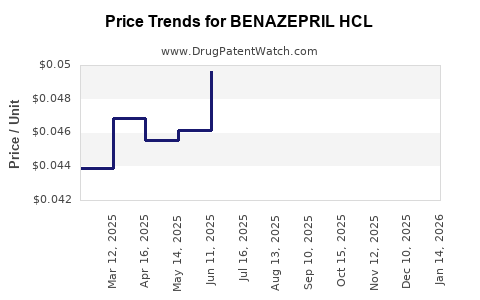
Pricing Trends and Projections
Current Pricing:
- Average retail price for a 30-day supply in the US: approximately $10–$15.
- Price in Europe varies from €5–€12 ($5.50–$13.20).
- Prices differ depending on formulation and dosage.
Competitive Pricing Dynamics:
- Price erosion is expected due to increased generic competition.
- Entry of bioequivalent generics could lower prices by 10–15% annually over the next 3-5 years.
| Year |
Estimated Wholesale Price (per 30-day supply) |
Projected Price Change (annual) |
| 2023 |
$10.50 |
-- |
| 2024 |
$9.00–$9.50 |
-10% to -14% |
| 2025 |
$8.00–$8.50 |
-11% to -15% |
| 2026 |
$7.00–$7.50 |
-12% to -16% |
Key Competitive and Regulatory Factors
- Patent Landscape: Benzapril HCl's patent has expired or is nearing expiration in many jurisdictions, enabling generic entry.
- Regulatory Approvals: More approvals for generics could further pressure prices.
- Reimbursement Policies: Variability across countries affects retail pricing and market penetration.
Investment and R&D Considerations
- Limited R&D for benzapril-specific formulations, as generics dominate.
- Focus on biosimilar and combination therapies: potential growth in fixed-dose combinations with other antihypertensives.
- Mergers and acquisitions may consolidate market share and influence pricing.
Key Takeaways
- The global benzapril HCl market was approximately $900 million in 2022, with a 4% compound annual growth rate projected through 2028.
- Present prices are $10–$15 per month’s supply, with expected declines of 10–15% annually due to increased generic competition.
- Market growth is driven by rising hypertension prevalence and penetration in emerging markets.
- Regulatory and patent expiration cycles will influence future pricing and market share.
- Most revenues stem from generic sales, limiting innovation but presenting consolidation opportunities.
FAQs
1. How does benzapril HCl compare to other ACE inhibitors in affordability?
Benzapril HCl is among the most cost-effective ACE inhibitors due to its generic status, with prices roughly 20–50% lower than branded counterparts like ramipril or lisinopril.
2. What are the primary markets for benzapril HCl currently?
The U.S., Europe, and Asia-Pacific represent the primary markets, with U.S. and European markets accounting for approximately 60% of sales.
3. Are there new formulations or delivery systems in development for benzapril HCl?
There are no significant proprietary formulations under development; the focus remains on generics and potential fixed-dose combination therapies.
4. What regulatory challenges could impact benzapril HCl market growth?
Regulatory agencies may require bioequivalence data, quality standard adherence, and post-market surveillance, which could delay approvals or increase costs.
5. How might biosimilars or advanced generics influence future market dynamics?
While biosimilars are not applicable, advanced generics such as improved bioavailability formulations could further lower prices and expand market share.
References
[1] IQVIA. Global Download Data. 2022.
[2] MarketsandMarkets. Antihypertensive Drugs Market Report. 2022.
[3] FDA Drug Approvals Database. 2022–2023.
[4] European Medicines Agency. Marketed ACE Inhibitors Summary. 2022.