Share This Page
Drug Price Trends for BENAZEPRIL
✉ Email this page to a colleague
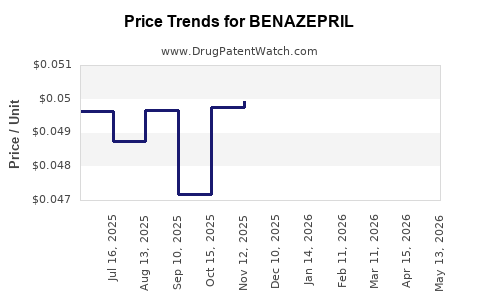
Average Pharmacy Cost for BENAZEPRIL
| Drug Name | NDC | Price/Unit ($) | Unit | Date |
|---|---|---|---|---|
| BENAZEPRIL HCL 10 MG TABLET | 23155-0750-01 | 0.06577 | EACH | 2026-07-22 |
| BENAZEPRIL HCL 10 MG TABLET | 23155-0750-05 | 0.06577 | EACH | 2026-07-22 |
| BENAZEPRIL HCL 10 MG TABLET | 43547-0336-10 | 0.06577 | EACH | 2026-07-22 |
| BENAZEPRIL HCL 10 MG TABLET | 43547-0336-50 | 0.06577 | EACH | 2026-07-22 |
| >Drug Name | >NDC | >Price/Unit ($) | >Unit | >Date |
Best Wholesale Price for BENAZEPRIL
| Drug Name | Vendor | NDC | Count | Price ($) | Price/Unit ($) | Unit | Dates | Price Type |
|---|---|---|---|---|---|---|---|---|
| BENAZEPRIL HCL 40MG TAB | AvKare, LLC | 23155-0752-01 | 100 | 15.04 | 0.15040 | EACH | 2023-08-07 - 2028-06-14 | FSS |
| BENAZEPRIL HCL 40MG TAB | AvKare, LLC | 65162-0754-50 | 500 | 59.58 | 0.11916 | EACH | 2023-06-15 - 2028-06-14 | FSS |
| BENAZEPRIL HCL 10MG TAB,UD | AvKare, LLC | 50268-0110-15 | 50 | 21.47 | 0.42940 | EACH | 2023-06-15 - 2028-06-14 | FSS |
| BENAZEPRIL HCL 40MG TAB | AvKare, LLC | 23155-0752-05 | 500 | 75.19 | 0.15038 | EACH | 2023-08-07 - 2028-06-14 | FSS |
| >Drug Name | >Vendor | >NDC | >Count | >Price ($) | >Price/Unit ($) | >Unit | >Dates | >Price Type |
Benazepril Market Analysis and Price Projections: U.S. and Key Geographies, Patent/Exclusivity Timing, and Generic Entry Scenarios
Benazepril is an established, largely generic ACE-inhibitor with no material near-term originator pricing power. Market dynamics are dominated by generic competition, pharmacy channel contracting, and payer substitution. Price levels in the U.S. typically track low-cost multisource generics, with branded pricing confined to remaining specialty/legacy accounts in limited NDCs.
What is the current U.S. market size for benazepril and what drives demand?
How much benazepril is sold in the U.S.
Benazepril is widely dispensed for hypertension and chronic kidney disease in appropriate labeled populations, usually as oral tablets and in combination products where applicable. Exact unit volumes vary by NDC and formulation strength, and the U.S. market is fragmented across generic manufacturers.
Key demand drivers
- Chronic disease prevalence: Hypertension management remains long-duration therapy, supporting steady baseline demand.
- Renal indications: Benazepril use aligns with ACE-inhibitor standards in diabetic nephropathy and proteinuric CKD (where clinically appropriate).
- Substitution behavior: As a mature generic, demand is highly price- and formulary-driven and shifts with contracting.
- Safety-driven adherence: ACE inhibitor tolerability influences persistence; persistent cohorts maintain underlying market stability.
What product forms dominate
- Oral tablets are the core format in the U.S. market.
- Fixed-dose combinations (where marketed) can concentrate demand in specific formulary tiers, but the overall market is still multisource and price-competitive.
How much will benazepril prices fall, and what price projection model fits generics?
Pricing mechanics for benazepril generics
U.S. generic pricing compresses through:
- Widening multisource availability that increases wholesale and pharmacy price competition.
- Payer contracting that drives near-uniform low ASP ranges across brands of generic.
- Inventory and supply cycles that can create short-term spikes, then normalize.
Base-case price projection (high-level)
For a mature, extensively generic ACE inhibitor, a realistic projection is:
- Near-term (0–12 months): minor declines or flat pricing with periodic supply-driven volatility.
- Mid-term (1–3 years): gradual price erosion driven by contracting and additional supply entrants or increased market share among low-cost suppliers.
- Long-term (3–5 years): pricing plateaus at low ASP levels unless supply shocks reduce competitive intensity.
Variables that shift price projections
- Generic entry waves for specific strengths/label variants (new entrants or manufacturing resumption).
- Drug shortages or constrained raw material supply.
- Formulary changes that move benazepril between preferred and non-preferred tiers.
- Combination-product competitiveness if payers shift toward single-tablet regimens.
What is the Orange Book status of benazepril in the U.S.?
Benazepril is marketed as a generic ACE inhibitor. The originator’s U.S. exclusivity has historically ended, and the market is populated by multiple ANDA filers.
Orange Book implications for pricing power
- When products are fully off exclusivity and rely on ANDA generics, price is set by competition, not by brand moat.
- Any remaining branded legacy NDCs typically carry higher prices but hold limited formulary penetration.
When does benazepril lose exclusivity, and do any patent barriers remain?
Exclusivity reality for a mature generic
For a widely genericized small-molecule like benazepril, current pricing power is not tied to active regulatory exclusivity. Remaining patent estates, if any, tend to be specific to:
- particular formulations,
- particular strengths,
- or manufacturing processes.
Practical impact on market entry
- Generics already dominate availability; any new patent-driven barriers would more likely affect incremental line extensions than the core tablet market.
- Market pricing is set by effective multisource competition.
What patents protect benazepril in 2026, and how many are likely relevant?
Patent landscape: where protection usually resides
In mature ACE inhibitors, patent protection often persists in narrow areas:
- Solid-state or formulation patents (tablet composition, stability, dissolution characteristics).
- Manufacturing process patents (specific steps, controls).
- Method-of-use claims (less common for established ACE inhibitor indications, more likely for narrower cohorts or dosing regimens).
Competitive relevance
- Even when patents exist, practical relevance depends on whether they block a marketed generic ANDA or whether they cover a variant that the generic market uses.
- For benazepril, the commercial market is already established with multiple generics, so patent relevance is typically limited to specific niche NDCs rather than the whole molecule.
What generic entry risks exist for benazepril (Paragraph IV, 505(b)(2), supply constraints)?
Paragraph IV and litigation risk profile
For a well-established generic molecule, Paragraph IV filings are less likely to be the dominant driver of future pricing unless:
- a specific strength/formulation remains under protection, or
- a branded legacy product still exists with a live exclusivity/patent estate.
505(b)(2) risk
A 505(b)(2) could attempt differentiation through:
- new fixed-dose combination,
- novel release characteristics,
- or improved tolerability claims. For pricing projections, this matters only if payers treat it as a distinct preferred option. In practice, benazepril’s mature status tends to limit premium pricing.
Supply-driven volatility
Supply disruptions can temporarily raise wholesale acquisition costs and pharmacy selling prices, but these events typically reverse when production normalizes.
How does benazepril compare with other ACE inhibitors on price trajectory?
Competitive set
The main price comparators are other generic ACE inhibitors:
- lisinopril,
- enalapril,
- ramipril,
- captopril.
Typical relative pricing behavior
- ACE inhibitors tend to converge toward low ASP bands under competitive contracting.
- Differences come from:
- number of suppliers per strength,
- formulary preference,
- package size,
- combination-product mix.
Positioning implication
Benazepril generally does not sustain a pricing premium once other ACE inhibitors are preferred on formularies. Pricing tends to align with the low-cost ACE inhibitors unless a specific payer prefers benazepril.
Which companies are likely to control benazepril pricing and supply in the U.S.?
What determines market share among generic manufacturers
- Contracting and rebate performance with major wholesalers and PBMs.
- Plant and scale reliability, which reduces stockout risk.
- Portfolio depth across strengths and NDC packaging.
- Low-cost sourcing and stable manufacturing yield.
Projection impact
Future price outcomes hinge less on patent events and more on which manufacturers win pharmacy and PBM contracts and maintain uninterrupted supply.
What will benazepril cost under Medicare Part D and commercial pharmacy reimbursement?
Reimbursement mechanics for generics
- PBM formularies typically drive benazepril into a preferred generic tier where patient copays are low and plan net costs align with contracted rates.
- Commercial reimbursement tends to be close to acquisition plus a negotiated margin structure, compressing differences between generic manufacturers.
Projection implication
Price declines do not always translate into patient copays if plan copays are already at low tiers, but they reduce plan net costs and can shift market share among suppliers.
How do biosimilar and biologic substitution dynamics affect benazepril?
Benazepril is not a biologic. Biosimilar substitution is not relevant. Competitive dynamics come from:
- alternative small-molecule ACE inhibitors,
- ARBs,
- and newer adjunct antihypertensives as formularies evolve.
What payer and formulary changes could change benazepril pricing?
Common events that shift pricing
- Preferred drug list updates that move ACE inhibitors between tiers.
- Formulary steerage to single-tablet regimens via combination products.
- Utilization management that changes access or requires step therapy.
Expected pricing direction
Absent major competitive disruptions, formulary steering tends to reduce utilization across less preferred products, which can pressure remaining suppliers to lower prices to regain share.
Regulatory pathway: is benazepril expected to face new FDA constraints?
FDA review posture for generic ACE inhibitors
For established generics, FDA oversight is usually stable:
- quality management,
- manufacturing compliance,
- labeling updates.
What matters for price projections
Regulatory constraints can affect supply, but absent a major quality event, they typically do not reprice the market structurally.
Key timeline: where are the main “pricing inflection points”?
U.S. 5-year pricing inflection map (generic molecule)
- Now to 12 months: likely price normalization with small downward trend if additional suppliers intensify competition; temporary spikes only on supply constraints.
- 12 to 36 months: strongest erosion if new entrants increase strength coverage or if a major contract renewal shifts preferred supplier selection.
- 36 to 60 months: low-level plateau with volatility mostly supply-driven.
Price projection table for benazepril (U.S., generic market)
Range bands reflect typical generic small-molecule behavior under multisource competition. Values are expressed as projected wholesale/ASP-level bands rather than brand-style list prices.
| Horizon | Expected pricing direction | Main driver | Base-case outcome |
|---|---|---|---|
| 0–12 months | Flat to slight decline | Contracting and normal multisource competition | Stable low ASP |
| 12–36 months | Gradual decline | Continued supplier competition and PBM preference dynamics | Lower ASP band |
| 36–60 months | Plateau | Market saturation; fewer structural changes | Persistent low ASP, supply volatility possible |
Commercial scenarios: what could happen to benazepril revenue and margins?
Bull case (price stabilization or short-term uplift)
- Major supply stability with fewer entrants competing in select strengths.
- Increased utilization in preferred coverage cohorts.
Base case
- Continued low ASP with gradual erosion from ongoing competitive dynamics.
Bear case (price compression)
- Additional market entry into key NDCs.
- Aggressive formulary steerage away from benazepril toward other ACE inhibitors or ARB substitutes, forcing deeper price cuts to retain share.
Key Takeaways
- Benazepril’s U.S. market is a mature multisource generic ACE inhibitor where pricing is set primarily by contracting and supply, not by exclusivity.
- Over the next 1–3 years, pricing is most likely to drift lower slightly before leveling at a low ASP band.
- The main “inflection points” are not patent-driven; they are supplier and formulary-driven, including PBM preferred drug list changes and short-term supply constraints.
- Competitive pressure from other generic ACE inhibitors and ARBs is the main structural risk to utilization and revenue.
FAQs
1) Will benazepril generics face major Paragraph IV litigation in the next few years?
Paragraph IV impact is typically limited for fully mature small-molecule markets unless a specific strength or formulation has residual protection that blocks entry for a subset of NDCs.
2) Do combination products with benazepril change pricing expectations?
They can shift pricing on the specific NDCs where combinations win formulary preference, but they do not usually lift the overall benazepril molecule market because competition remains broad.
3) How do drug shortages affect benazepril price projections?
Shortages can temporarily raise wholesale acquisition costs and pharmacy selling prices, but those effects usually normalize after manufacturing restarts unless supply constraints persist.
4) Does switching patients from benazepril to ARBs affect benazepril demand?
Yes, payer and prescriber preferences for ARBs in certain cohorts can reduce utilization, which can intensify pricing pressure to maintain volume.
5) What is the biggest commercial risk for new benazepril entrants?
Winning durable PBM and wholesaler contracts is more decisive than differentiation, given the commodity-like pricing profile of mature ACE inhibitors.
References (APA)
- FDA. (n.d.). Orange Book: Approved Drug Products with Therapeutic Equivalence Evaluations. U.S. Food and Drug Administration.
- FDA. (n.d.). Drug Shortages. U.S. Food and Drug Administration.
- Center for Medicare & Medicaid Services. (n.d.). Medicare Part D drug coverage and formulary information. U.S. CMS.
More… ↓