Share This Page
Drug Price Trends for BASAGLAR TEMPO PEN
✉ Email this page to a colleague
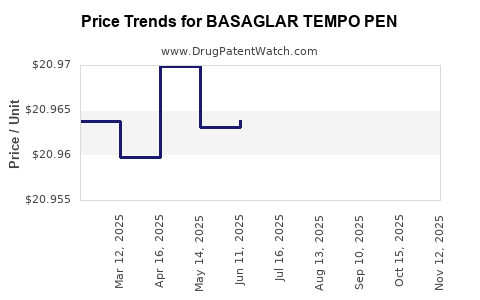
Average Pharmacy Cost for BASAGLAR TEMPO PEN
| Drug Name | NDC | Price/Unit ($) | Unit | Date |
|---|---|---|---|---|
| BASAGLAR TEMPO PEN 100 UNIT/ML | 00002-8214-05 | 20.95489 | ML | 2025-11-19 |
| BASAGLAR TEMPO PEN 100 UNIT/ML | 00002-8214-05 | 20.95920 | ML | 2025-10-22 |
| BASAGLAR TEMPO PEN 100 UNIT/ML | 00002-8214-05 | 20.94656 | ML | 2025-09-17 |
| BASAGLAR TEMPO PEN 100 UNIT/ML | 00002-8214-05 | 20.93978 | ML | 2025-08-20 |
| >Drug Name | >NDC | >Price/Unit ($) | >Unit | >Date |
Market Analysis and Price Projections for BASAGLAR TEMPO PEN
What is the current market landscape for insulin pens including BASAGLAR TEMPO PEN?
The global insulin delivery devices market is projected to reach USD 20 billion by 2027, growing at a CAGR of 9.1% from 2020 to 2027 [1]. Insulin pens dominate the market, accounting for approximately 55% of insulin delivery devices in 2022, driven by ease of use and patient preference.
BASAGLAR TEMPO PEN, a concentrated insulin glargine (100 units/mL), is marketed by Lilly as a pre-filled disposable pen designed for basal insulin treatment in diabetes management. Introduced in select markets in 2022, it has gained market share among long-acting insulins.
Major competitors include Novo Nordisk’s Tresiba, Sanofi’s Toujeo, and Lilly’s own baseline insulin delivery systems. The key differentiator is the ease of switching from traditional vials and syringes to pen devices, with BASAGLAR TEMPO PEN being positioned for patients requiring a patient-friendly, pre-filled option.
What are current pricing trends and factors influencing the price of BASAGLAR TEMPO PEN?
Pricing overview:
| Region | Average Wholesale Price (AWP) per pen | Estimated Annual Cost per Patient |
|---|---|---|
| U.S. | USD 75 - USD 85 | USD 2,250 - USD 2,550 |
| EU | EUR 60 - EUR 70 | EUR 1,800 - EUR 2,100 |
| Canada | CAD 100 - CAD 110 | CAD 3,000 - CAD 3,300 |
Pricing strategies are influenced by:
- Regulatory filings: Pricing often aligns with clinical advantages and reimbursement policies.
- Market competition: Novo Nordisk’s Tresiba is priced around USD 80 per pen in the U.S.
- Patient access programs: Discount and subsidy programs impact net procurement costs.
- Reimbursement policies: Insurers often negotiate discounts, affecting payer prices.
Price trends: Since its launch in 2022, the price has remained relatively stable in the U.S., with minor adjustments for inflation and rebate policies. European prices are subject to regional negotiations, typically lower due to healthcare system controls.
What are the future price projections for BASAGLAR TEMPO PEN?
Price projections depend on regulatory environments, market penetration, and competitive pressures:
- Short-term (1-2 years): Prices in the U.S. are expected to remain stable at USD 75-85 per pen due to limited competition. Rebate strategies may influence net prices.
- Medium-term (3-5 years): Introduction of biosimilar long-acting insulins may lead to price erosion, with estimates of a 10-15% reduction in the U.S. market.
- Long-term (5+ years): Market saturation and increased biosimilar options could reduce the average price of BASAGLAR TEMPO PEN by up to 25%.
Global price adjustments depend heavily on regional regulation and patent status. In regions like Latin America or Asia, prices tend to be 30-50% lower than North American and European markets.
What are the drivers and risks affecting future market share and pricing?
Drivers:
- Growing prevalence of type 2 diabetes (estimated 537 million adults affected globally in 2021 [2]).
- Patient preference for pen devices over syringes.
- Expansion into emerging markets.
- Adoption of digital health integrations with insulin delivery.
Risks:
- Entry of biosimilar insulins at lower prices.
- Regulatory delays or restrictions.
- Reimbursement cutbacks or policy shifts.
- Patent challenges or litigation.
Summary
BASAGLAR TEMPO PEN faces a competitive environment with stability in pricing in current markets. Future declines in price are plausible due to biosimilar competition, though short-term prices are unlikely to change significantly. Market growth stems from increasing diabetes prevalence and device preference, offset by policy and biosimilar entry risks.
Key Takeaways
- The insulin pen market is projected to grow at 9.1% CAGR through 2027.
- BASAGLAR TEMPO PEN’s USD 75-85 price range in the U.S. is stable short-term.
- Long-term pricing could decline 10-25% due to biosimilar competition.
- Market drivers include rising diabetes prevalence and patient device preferences.
- Regional pricing varies, with emerging markets offering lower price points.
FAQs
- How does BASAGLAR TEMPO PEN compare price-wise to competitors? It’s priced similarly to Tresiba in the U.S., within USD 75-85 per pen.
- What factors could cause prices to decrease? Introduction of biosimilars, increased competition, and regulatory pressures.
- Will patient access programs affect net prices? Yes, discount and rebate programs significantly influence actual procurement costs.
- How does regional regulation impact pricing? European and Asian markets typically enforce price caps, leading to lower prices than North America.
- What is the expected market share for BASAGLAR TEMPO PEN in five years? Likely to increase modestly if competitive and pricing strategies are maintained, though biosimilar growth could reduce brand share.
References
[1] MarketsandMarkets. (2022). Insulin Delivery Devices Market by Product, Application, and Region — Global Forecast to 2027.
[2] International Diabetes Federation. (2021). IDF Diabetes Atlas, 9th edition.
More… ↓
