Share This Page
Drug Price Trends for BABY SKIN PROTECTANT
✉ Email this page to a colleague
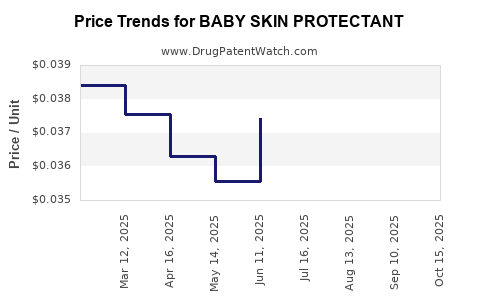
Average Pharmacy Cost for BABY SKIN PROTECTANT
| Drug Name | NDC | Price/Unit ($) | Unit | Date |
|---|---|---|---|---|
| BABY SKIN PROTECTANT 41% OINT | 70000-0079-01 | 0.05424 | GM | 2026-04-22 |
| BABY SKIN PROTECTANT 41% OINT | 70000-0079-01 | 0.05424 | GM | 2026-03-18 |
| BABY SKIN PROTECTANT 41% OINT | 70000-0079-01 | 0.05424 | GM | 2026-02-18 |
| BABY SKIN PROTECTANT 41% OINT | 70000-0079-01 | 0.03716 | GM | 2025-10-22 |
| BABY SKIN PROTECTANT 41% OINT | 70000-0079-01 | 0.03862 | GM | 2025-09-17 |
| BABY SKIN PROTECTANT 41% OINT | 70000-0079-01 | 0.03963 | GM | 2025-08-20 |
| >Drug Name | >NDC | >Price/Unit ($) | >Unit | >Date |
What Is the Market Size and Demand for Baby Skin Protectant?
The global baby skin protectant market was valued at approximately $1.2 billion in 2022. It is projected to grow at a compound annual growth rate (CAGR) of around 5% from 2023 to 2030, reaching roughly $1.75 billion. The growth drivers include increasing awareness of infant skincare, rising birth rates in emerging markets, and demand for hypoallergenic and natural formulations.
Regional Insights:
North America dominates the market, driven by high consumer awareness, a well-established retail infrastructure, and a preference for premium skincare products. Asia-Pacific exhibits the highest growth potential, with a CAGR of 6.5%, attributed to rising disposable incomes, increased health consciousness, and expanding distribution channels in countries like China and India.
Market Segmentation:
- Product Type: Diaper rash creams, barrier ointments, soothing lotions.
- Application: Diaper area protection, eczema management, general skincare.
- Distribution Channel: Hypermarkets and supermarkets, pharmacies, online retail.
Who Are the Leading Players and What Is Their Market Share?
Major companies include Johnson & Johnson, P&G, Aveeno (Johnson & Johnson), The Hartz Mountain Corporation, and Burt’s Bees. Johnson & Johnson’s Baby Johnson’s brand commands approximately 30% of the global market share, making it the top entity in baby skin protectants. P&G’s Pampers brand maintains a significant footprint with roughly 20% market share through its diaper products.
Market Strategies:
Leading firms focus on advancing product formulations with natural ingredients, expanding online presence, and engaging in targeted marketing campaigns. Mergers and acquisitions are less frequent but include innovations such as natural, dermatologically tested lines.
What Are the Current Pricing Trends and Future Price Projections?
Pricing varies significantly based on product type, formulation complexity, and brand positioning.
- Average Retail Price: Baby skin protectants retail at $4 to $12 per tube or jar.
- Premium Segment: Natural and organic options command prices between $10 and $15 due to ingredient sourcing and branding.
- Budget Segment: Conventional brands are available for $3 to $6.
Price Trends:
Prices have remained relatively stable over the last five years, with minor fluctuations due to raw material costs and competitive forces. Organic and natural product lines see a 20–30% premium over traditional options.
Projections for 2025-2030:
Prices for mainstream baby skin protectants are expected to grow at an annual rate of 2% owing to inflation and increased costs for natural ingredients. Premium products could increase at 3–4% annually, driven by consumer willingness to pay for organic, hypoallergenic formulations.
What Regulatory and Market Entry Considerations Exist?
Regulatory Environment:
- In the U.S., the Food and Drug Administration (FDA) classifies many baby skin protectants as cosmetics. They are subject to the Federal Food, Drug, and Cosmetic Act but do not require pre-market approval.
- In the EU, products classified as cosmetics must meet the EU Cosmetic Regulation (EC) No 1223/2009, requiring safety assessments before marketing.
Market Entry Barriers:
- Stringent regulatory approval processes for new formulations.
- Consumer trust necessitates proven safety and efficacy, demanding clinical testing and dermatological testing.
- High competition from established brands with extensive distribution networks.
Distribution Channels:
Online retail accounts for roughly 25% of sales, with growth driven by e-commerce platforms like Amazon. Pharmacies and hypermarkets account for about 50%, emphasizing the importance of retail partnerships.
How Are Formulation Trends Changing the Market?
Firms increasingly develop formulations with natural, organic ingredients such as shea butter, calendula, and aloe vera. Certification from bodies like USDA Organic or COSMOS influences purchasing decisions. Fragrance-free, hypoallergenic, and dermatologist-tested features are standard expectations.
Potential for New Entrants and Innovation
Entry barriers include brand trust, regulatory compliance, and distribution scale, but opportunities lie in niche segments such as plant-based or allergen-free products. Innovations focus on multi-component formulations offering barrier protection, moisture retention, and soothing effects within single products.
Key Takeaways
- The market is expanding around 5% CAGR, driven by rising infant skincare awareness and emerging markets.
- Johnson & Johnson dominates with about 30% share; formulators focus on natural ingredients and certification.
- Average prices range from $3 to $15, with premium products commanding higher margins.
- Regulatory frameworks in major regions favor established formulations but require compliance.
- E-commerce growth and consumer preference for natural, hypoallergenic products create opportunities for innovation and market entry.
FAQs
1. What are the most common ingredients in baby skin protectants?
Shea butter, zinc oxide, petrolatum, calendula, and aloe vera feature prominently due to their skin barrier and soothing properties.
2. How does regulation impact new product development?
Regulatory processes necessitate safety testing, documentation, and compliance with regional cosmetic or drug laws, affecting time-to-market and R&D costs.
3. What is the outlook for online retail in this market?
Online sales account for about one-quarter of total sales, and growth is expected to continue at double-digit rates as e-commerce adoption accelerates.
4. Which regions are emerging markets for baby skin protectants?
China, India, and Brazil show the highest growth potential, driven by demographic trends and rising disposable incomes.
5. Are organic formulations gaining traction?
Yes, organic and natural formulations with certifications like USDA Organic are increasingly preferred, allowing brands to command premium pricing.
Sources:
[1] Market Research Future, "Baby Skin Care Market," 2022
[2] Statista, "Global Baby Care Market Size," 2023
[3] US FDA, "Cosmetics Regulations," 2023
[4] European Commission, "Cosmetic Products Regulation," 2023
More… ↓
