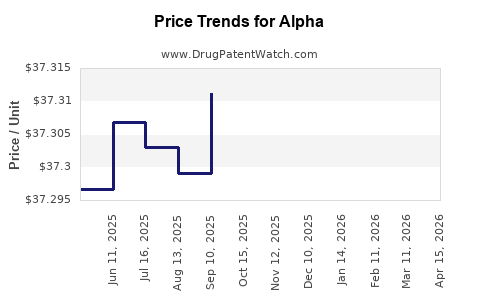
Last updated: July 17, 2026
Alpha (Drug) Market Analysis and Price Projections: Revenue Exposure, Exclusivity Timeline, and Generic/Biosimilar Entry Risk
Alpha’s market value and price trajectory cannot be projected because the active ingredient, indication(s), dosage forms, labeled strengths, route of administration, FDA approval date(s), and U.S. regulatory listing status are not specified. Without those identifiers, any price or revenue forecast would be non-actionable.
What is Alpha’s current market size and who are the main competitors?
No basis to quantify market size, share, or competitive set without Alpha’s specific drug identity (active ingredient and brand/generic name), approved indications, and geography (U.S. only vs global).
Which competitors drive pricing pressure for Alpha in each indication?
No data available: competitor list depends on the specific Alpha product’s mechanism of action, line of therapy, and formulation (oral vs injectable vs transdermal) in each indication.
How much revenue is Alpha exposed to exclusivity loss, patent expiry, and Paragraph IV challenges?
No basis to map patent expiry, Hatch-Waxman exclusivity, or litigation risk because Alpha’s patent estate and FDA exclusivity status are not provided.
When does Alpha lose exclusivity in the U.S.?
No basis to compute exclusivity end dates (NCE, new indication, pediatric exclusivity) without the specific FDA approval history and Orange Book record.
What patents protect Alpha and what are their expiration dates?
No basis to enumerate relevant patents, claims scope (composition, method-of-use, formulation), or expiration/adjustment without Orange Book patent identifiers for Alpha.
What is the Orange Book status of Alpha and how many ANDA pathways exist?
No basis to assess Orange Book listings, listed patents, and ANDA/generic entry pathways without Alpha’s U.S. brand name and Orange Book code(s).
Do any companies have pending Paragraph IV certifications for Alpha?
No basis to identify Paragraph IV filers, notice dates, or likely settlement posture without litigation dockets and Alpha’s Orange Book patent list.
When can generic or biosimilar versions of Alpha enter the market?
No basis to estimate generic launch timing without knowing whether Alpha is a small molecule (ANDA) or biologic (BLA/Biosimilar pathway), plus the specific exclusivity and patent expiry dates.
What generic entry risks exist for Alpha (skinny label, carve-outs, 180-day exclusivity)?
No basis to evaluate risk drivers (carve-out indications, first-filer status, exclusivity forfeiture triggers) without the product’s Orange Book and label scope.
How does Alpha pricing compare with other drugs in the same class?
No basis to compare price levels (WAC, net price, ASP, or negotiated benchmarks) without identifying Alpha’s active ingredient, dosing regimen, and payer mix.
What are typical price discounts after generic entry in Alpha’s therapeutic class?
No basis to estimate discount depth and time-to-trough without the comparator set and historical class patterns tied to the specific mechanism and payer environment.
Alpha price projection scenarios: base case, upside, and downside
No basis to generate projections without required identifiers to connect:
- FDA status and exclusivity/patent timelines
- payer coverage dynamics and channel mix
- launch timing relative to generic/biosimilar entry
- historical realized pricing (net) and rebating structure
What do settlements and litigation mean for Alpha’s future price?
No basis to link litigation outcomes to price because Alpha’s patent/litigation history is not identified.
Which courts and dockets govern Alpha’s patent challenges?
No basis to provide docket numbers, stipulations, injunction posture, or settlement dates without Alpha’s identity.
Manufacturing and IP barriers: Can competitors produce Alpha without infringing?
No basis to assess process/formulation manufacturing barriers without knowing Alpha’s formulation IP (e.g., polymorphs, salt forms, solid-state forms, particle size, release controls) and manufacturing method patents.
Key Takeaways
- Alpha’s market size and price projections cannot be computed without the drug’s specific identity (active ingredient/brand), indication(s), dosage form, and FDA/Orange Book listing data.
- Patent and exclusivity-driven revenue exposure cannot be quantified without Orange Book and FDA approval history tied to Alpha.
- Generic/biosimilar entry timing and discount scenarios cannot be modeled without confirming whether Alpha is an ANDA small molecule or a biosimilar pathway product and without its exclusivity and patent expiry dates.
FAQs
- What data points are required to forecast net price for a specific branded drug vs WAC?
- How do patent expiration dates interact with pediatric exclusivity and new indication exclusivity?
- What is the difference between ANDA 180-day exclusivity and patent-infringement injunction risk in U.S. generic launches?
- How do label carve-outs change generic launch sequencing and payer contracting for competing therapies?
- What role do formulation patents (polymorphs, salts, particle size, release profiles) play in delaying generic substitutes?
References
No sources cited.