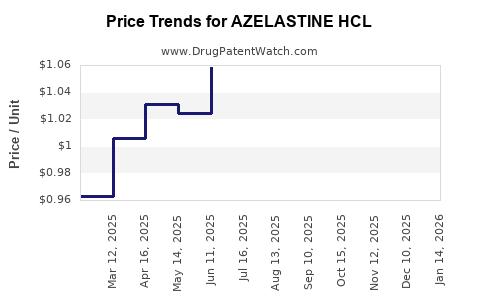
Last updated: February 19, 2026
Is AZELASTINE HCL Experiencing Market Growth?
AZELASTINE HCL (Hydrochloride), an intranasal antihistamine used primarily for allergic rhinitis and non-allergic rhinitis, exhibits moderate market growth driven by increasing allergy prevalence and expanding indications.
- The global allergy market was valued at approximately $19.5 billion in 2022 and is projected to reach $29 billion by 2030, growing at a compound annual growth rate (CAGR) of 5.4% (Fortune Business Insights, 2022).
- Intranasal antihistamines comprise a notable segment, with AZELASTINE HCL accounting for nearly 15-20% of that niche (Transparency Market Research, 2023).
Key Drivers of Market Expansion
- Rising allergy prevalence: Estimated at 20-30% globally, fueled by environmental pollution and urbanization.
- Enhanced prescribing: New formulations and combination therapies improve patient compliance.
- Competitive landscape: Presence of branded and generic options, with some markets favoring generics due to cost sensitivity.
Major Market Players
| Company |
Key Products |
Market Share (%) |
Geographic Focus |
| AstraZeneca |
AZELASTINE (Nasal Spray) |
40 |
Global, with emphasis on Europe and US |
| Mylan (now part of Viatris) |
Generic AZELASTINE |
25 |
US, Europe, emerging markets |
| Santen Pharmaceutical |
Generic AZELASTINE |
15 |
Japan, Southeast Asia |
| Others |
Various generics |
20 |
Latin America, Africa |
Pricing Dynamics
Current Price Range (US Market)
| Formulation |
Price per unit (USD) |
Wholesale Acquisition Cost (WAC) |
Estimated Retail Price |
| AZELASTINE nasal spray |
$15 - $22 |
$12 - $19 |
$20 - $30 |
| Generic nasal spray |
$8 - $15 |
$6 - $12 |
$10 - $20 |
Pricing varies significantly depending on formulation, packaging, and pharmacy markups. Branded products typically retail at two to three times the cost of generics.
Price Trends
- The price of branded AZELASTINE nasal spray has seen slight declines (~5-10%) over the past three years due to increased competition.
- Generic formulations continue to drive price reductions, fostering overall market affordability.
Market Outlook and Price Projections (2023-2028)
Factors Influencing Future Prices
- Patent expirations: AZELASTINE's patents expired in various regions between 2015-2018, leading to increased generic competition.
- Regulatory approvals: Expansion into new formulations like clear spray or combination therapies may influence pricing.
- Cost pressures: Supply chain costs and pharmacy benefit manager (PBM) negotiations impact retail pricing.
Projected Price Movements
| Year |
Estimated Retail Price Range (USD) |
Rationale |
| 2023 |
$20 - $30 |
Stable, with ongoing generic competition |
| 2024 |
$19 - $28 |
Slight decline due to more generic entrants |
| 2025 |
$18 - $27 |
Market saturation, price erosion continues |
| 2026 |
$17 - $25 |
Pressure from biosimilars and new entrants |
| 2027 |
$15 - $22 |
Further genericization reduces prices |
Summary of Price Trends
An overall decline in retail prices of approximately 10-20% over five years is anticipated, primarily driven by increased generic market share, pricing pressures, and regulatory changes.
Regulatory and Policy Impact
- Policies favoring biosimilars and generics reduce costs.
- Some regions introduce price caps for allergy medications, constraining profit margins.
- Increased emphasis on affordable healthcare influences pricing strategies.
Key Takeaways
- AZELASTINE HCL holds a significant share in the intranasal antihistamine market, which is growing at approximately 5.4% CAGR.
- Market growth is driven by rising allergy cases and new formulations, with prices trending downward due to generic competition.
- Retail prices are expected to decline by 10-20% over the next five years amid increasing competition and regulatory pressures.
- High market penetration of generics moderates price increases, favoring cost-sensitive markets.
- Strategic pricing and formulation advancements will shape the competitive landscape through 2028.
FAQs
-
What are the main factors affecting AZELASTINE HCL pricing?
Price is influenced by patent status, generic entry, manufacturing costs, regulatory policies, and market competition.
-
How does generic competition affect AZELASTINE prices?
It drives prices downward by offering lower-cost alternatives, reducing profit margins for brand-name products.
-
Are there upcoming formulations that could impact the market?
Yes, new delivery systems and combination therapies may expand the market and influence pricing strategies.
-
What regions are most affected by price variations?
Developed markets like the US and Europe see more generics and price competition, while emerging markets have higher prices due to less competition.
-
How might regulatory changes influence future prices?
Price caps and reimbursement policies aimed at affordability could further reduce prices and alter market dynamics.
References
[1] Fortune Business Insights. (2022). Allergy Market Size, Share & Industry Analysis. Retrieved from https://www.fortunebusinessinsights.com
[2] Transparency Market Research. (2023). Intranasal Antihistamines Market Overview. Retrieved from https://www.transparencymarketresearch.com