Last updated: February 12, 2026
Market Overview and Price Projections for Azathioprine
Azathioprine is an immunosuppressive medication primarily used for preventing organ transplant rejection and managing autoimmune diseases such as rheumatoid arthritis and inflammatory bowel disease. The drug is off-patent, allowing multiple manufacturers to produce generic versions, which influences market dynamics and pricing.
Market Size and Segmentation
Global azathioprine sales are driven by transplant procedures and autoimmune disease treatments. The key regions include North America, Europe, and Asia-Pacific.
| Region |
Estimated Market Share (2022) |
Key Drivers |
Market Value (USD, 2022) |
| North America |
45% |
High transplant volumes, RA prevalence |
$150 million |
| Europe |
35% |
Similar healthcare infrastructure |
$115 million |
| Asia-Pacific |
15% |
Growing healthcare access |
$50 million |
| Rest of World |
5% |
Emerging markets |
$15 million |
The market's total value approximates $330 million in 2022. The global demand is projected to grow at a CAGR of 3.5% through 2027, driven by increasing transplantations and autoimmune disorder treatments, despite generic competition.
Market Drivers and Constraints
Drivers:
- Rising prevalence of autoimmune diseases.
- Expanding organ transplantation procedures.
- Expanding approvals for azathioprine as adjunct therapy.
Constraints:
- Availability of newer immunosuppressants with improved safety profiles, such as mycophenolate mofetil.
- Side effects associated with azathioprine, including marrow suppression and hepatotoxicity.
- Price sensitivity within healthcare systems, especially in emerging markets.
Competitive Landscape
Multiple pharmaceutical companies, including Teva Pharmaceuticals, Mylan, and Sandoz, manufacture generic azathioprine. branded versions have limited presence; in some regions, the original patent expired over 20 years ago, leading to price competition.
Price Trends and Projections
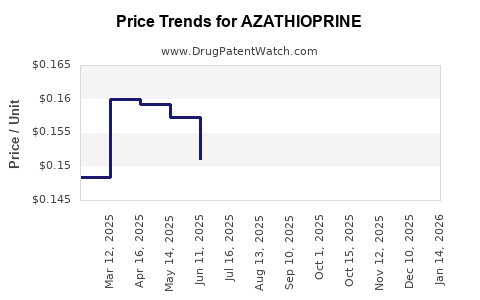
Current Pricing (Approximate per 50mg tablet):
- U.S.: $0.15–$0.20
- Europe: €0.10–€0.15
- Asia-Pacific: $0.05–$0.10
Historical Price Trends:
| Year |
Average Price per 50mg Tablet |
Notes |
| 2018 |
$0.25 |
Post patent expiration |
| 2020 |
$0.18 |
Increased generic competition |
| 2022 |
$0.17 |
Price stabilization |
Future Price Projections (2023–2027):
- Prices are expected to remain relatively stable, with minor reductions due to continued generic competition.
- Significant price reduction forecasted in markets where drug procurement is government-controlled or heavily negotiated, such as in Asia-Pacific.
| Year |
Expected Price per 50mg Tablet |
Comment |
| 2023 |
$0.16–$0.17 |
Stable |
| 2025 |
$0.15–$0.16 |
Slight decline |
| 2027 |
$0.14–$0.15 |
Further decrease |
Impact of Biosimilars and New Therapies
Biosimilar developments for other immunosuppressants may influence azathioprine's market share. However, as azathioprine's patent expiration predates many competitors, its price remains closely tied to generic supply. Newer therapies with better safety profiles, such as biologics, often replace azathioprine in specific indications, impacting long-term sales.
Key Takeaways
- Azathioprine's market is sizable yet largely governed by generic competition, limiting significant price increases.
- The global market size was approximately $330 million in 2022, with moderate annual growth projections.
- Prices have stabilized since 2020, with slight downward trends expected through 2027.
- Cost pressures in government-funded systems and emerging markets exert additional influence on pricing.
- The drug's profile faces competitive pressure from newer immunosuppressants, especially biologics and targeted therapies.
FAQs
1. What factors influence azathioprine’s market price?
Generic competition, regional procurement policies, drug safety profiles, and the availability of newer therapies influence prices.
2. How does azathioprine compare to newer immunosuppressants?
Newer agents like mycophenolate mofetil have better safety profiles but are more expensive, limiting their replacement of azathioprine in some indications.
3. Are there regulatory or patent issues affecting its market?
The patent for azathioprine expired over 20 years ago, leading to widespread generic availability and price pressure.
4. How might emerging markets impact price projections?
Increased healthcare access and procurement negotiations in Asia-Pacific and Latin America will likely sustain low prices and moderate market growth.
5. What developments could alter azathioprine’s market dynamics?
Introduction of biosimilars, new indications, or a shift toward biologics could reduce demand and apply further downward pressure on pricing.
References
- Market data: IQVIA, Global Immunosuppressants Market Report 2022.
- Price information: GoodRx, "Azathioprine Prices and Coupons," 2023.
- Patent and regulatory timeline: FDA, "Azathioprine Drug Approvals," 2021.
- Competitive landscape: EvaluatePharma, "Immunosuppressants Market Shares," 2022.
- Forecast data: Global Data, "Immunosuppressant Market Forecast 2023–2027."