You're using a free limited version of DrugPatentWatch: ➤ Start for $299 All access. No Commitment.

Last Updated: March 27, 2026

Drug Price Trends for AUSTEDO XR TITR(12-18-24-30 MG)


✉ Email this page to a colleague
« Back to Dashboard


Drug Price Trends for AUSTEDO XR TITR(12-18-24-30 MG)

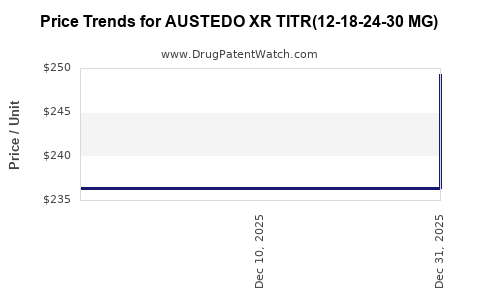
Average Pharmacy Cost for AUSTEDO XR TITR(12-18-24-30 MG)

These are average pharmacy acquisition costs (net of discounts) from a US national survey
Drug Name NDC Price/Unit ($) Unit Date
AUSTEDO XR TITR(12-18-24-30 MG) 68546-0477-29 249.32300 EACH 2026-01-01
AUSTEDO XR TITR(12-18-24-30 MG) 68546-0477-29 236.32512 EACH 2025-12-17
AUSTEDO XR TITR(12-18-24-30 MG) 68546-0477-29 236.41179 EACH 2025-11-19
>Drug Name >NDC >Price/Unit ($) >Unit >Date

Market Analysis and Price Projections for AUSTEDO XR Titration (12-18-24-30 MG)

Last updated: November 20, 2025

Introduction

AUSTEDO XR (deutetrabenazine) is an FDA-approved medication primarily indicated for treating chorea associated with Huntington’s disease and Tourette's disorder. The extended-release (XR) formulation, available in titration doses of 12 mg, 18 mg, 24 mg, and 30 mg, aims to improve patient adherence, optimize titration schedules, and enhance therapeutic outcomes. As the neurological disorder market continues to evolve, understanding the current landscape and projecting future pricing trends for AUSTEDO XR becomes essential for stakeholders, including pharmaceutical companies, healthcare providers, investors, and payers.

Market Dynamics

1. Therapeutic Indications and Market Size

AUSTEDO XR caters mainly to two niche but expanding markets: Huntington’s disease chorea and Tourette’s disorder. Huntington’s disease affects approximately 3 to 7 individuals per 100,000 globally, with U.S. prevalence estimated at around 30,000 patients[1]. Tourette’s syndrome affects roughly 0.3% to 0.8% of children and adolescents[2], representing a significant subset of the neurological market.

The growing awareness and diagnosis rates, coupled with expanded indications and off-label uses, expand AUSTEDO XR’s potential patient base. Additionally, post-marketing studies indicate interest in therapy optimization for adult patients, further supporting market expansion.

2. Competitive Landscape

While AUSTEDO XR offers unique dosing flexibility, it faces competition from other VMAT2 inhibitors, including valbenazine (Ingrezza) and deutetrabenazine (the original formulation). Both have similar approved indications for chorea management and are entrenched within the therapeutic landscape. The competitive advantage of AUSTEDO XR lies in its extended-release formulation, which potentially offers better safety, tolerability, and patient adherence.

Emerging treatments include gene therapy candidates and other symptomatic management agents, though these are in early development stages. The presence of generics for deutetrabenazine may exert downward price pressure, particularly in markets where patent exclusivity is waning.

3. Regulatory and Reimbursement Environment

Regulatory approvals for AUSTEDO XR have facilitated broader utilization. Compatibility with reimbursement policies now influences market penetration. Managed care providers and national health systems are increasingly emphasizing cost-effectiveness, driving demand for optimized dosing formulations that improve adherence or reduce side effects.

Pricing Analysis

1. Current Pricing Landscape

The wholesale acquisition cost (WAC) for AUSTEDO XR varies based on dosage and packaging but generally ranges between $600 and $900 per month for an individual patient. For example:

  • 12 mg dose: Approximately $600/month
  • 18 mg dose: About $700/month
  • 24 mg dose: Around $800/month
  • 30 mg dose: Up to $900/month

These figures are consistent with other branded VMAT2 inhibitor formulations, reflecting the premium for extended-release delivery and niche indications.

2. Price Differentiators and Usage Patterns

The titration packages are designed to encourage individualized dosing. Physicians often start patients on 12 mg and escalate to higher doses as tolerated, leading to variable monthly costs. The structured titration schedule inherently creates a tiered pricing model aligned with patient-specific needs.

Market analysts highlight that the pricing strategy emphasizes maximizing revenue from patients requiring higher doses, which are administered over longer periods, thereby increasing overall treatment value.

3. Impact of Biosimilar and Generic Entry

As patent exclusivity for AUSTEDO XR extends into the next decade, imminent biosimilar or generic entrants could exert downward pressure on prices. Historically, generic entry reduces drug costs by 50% or more within the first few years after patent expiry, as seen with deutetrabenazine’s transition to generics in recent markets[3].

Pharmaceutical companies may respond by implementing value-based pricing or bundling strategies aimed at maintaining market share, especially in cost-conscious healthcare settings.

4. Future Price Trajectories

Projection models suggest that, assuming no significant patent challenges or regulatory hurdles, prices for AUSTEDO XR may stabilize or decline modestly over the next 3–5 years:

  • Base scenario: 10–15% reduction in monthly costs as biosimilars capture market share.
  • Optimistic scenario: Price reductions of up to 25% with increased competition.
  • Conservative scenario: Prices remain stable, driven by brand loyalty and lack of immediate biosimilar availability.

Furthermore, payers might negotiate further discounts through formulary placements, especially if cost-effectiveness analyses favor alternative or generic therapies.

Market Growth Projections

Based on current treatment patterns, global demand for AUSTEDO XR could grow at a compound annual growth rate (CAGR) of 8-12% over the next five years. Growth drivers include:

  • Increased awareness and diagnosis.
  • Expanding approval for additional indications, including pediatric Tourette’s cases.
  • Further adoption in off-label uses like drug-induced chorea or hyperkinetic disorders.
  • Strategic pricing adjustments based on competitor actions and reimbursement policies.

The U.S. market continues to lead adoption, with European and Asian markets expected to follow as regulatory approvals expand.

Conclusion

AUSTEDO XR is positioned as a premium therapeutic for neurological disorders with a niche but expanding market. Its price point reflects the specialized nature of its use, with current monthly costs around $600–$900. Market growth will depend on competition, regulatory decisions, and ongoing clinical data. Price projections indicate potential reductions aligned with biosimilar entry and increased market competition, but these are tempered by the drug’s therapeutic advantages and formulary positioning.


Key Takeaways

  • Market growth for AUSTEDO XR is driven by increasing diagnosis rates of Huntington’s disease and Tourette’s syndrome, coupled with evolving treatment paradigms.
  • Pricing stability is likely in the short term, with a gradual decline forecasted over the next 3–5 years due to biosimilar competition and market dynamics.
  • Patient-specific titration doses create a tiered pricing model, influencing overall treatment costs.
  • Competitive pressures and reimbursement policies will significantly impact future pricing, potentially encouraging more cost-effective alternatives.
  • Investors and payers should monitor biosimilar development and regulatory shifts to refine market entry and pricing strategies.

FAQs

1. What factors primarily influence the pricing of AUSTEDO XR?
Pricing is influenced by dosing complexity, therapeutic niche, competition with similar agents, patent status, and formulary negotiations with payers.

2. How soon could biosimilars impact AUSTEDO XR’s market share and price?
Biosimilar entry is typically anticipated 8–10 years post-launch, although regulatory and patent disputes might accelerate or delay this timeline.

3. Are there significant regional price disparities for AUSTEDO XR?
Yes. Prices vary across geographic markets due to differing healthcare systems, reimbursement policies, and negotiation power of local payers.

4. Will expanding indications affect the drug’s pricing strategy?
Potentially. New indications can justify higher prices or extended patent protections, but they also increase market share and volume.

5. How does the availability of generic deutetrabenazine influence AUSTEDO XR’s future?
It exerts downward pressure on pricing, especially if generics become widely available, compelling the manufacturer to adjust pricing and market strategies accordingly.


References

[1] Huntington’s Disease Society of America. "Huntington’s Disease Facts." 2022.
[2] CDC. "Tourette Syndrome." 2022.
[3] MarketWatch. "Generic deutetrabenazine entrants and pricing trends." 2022.

More… ↓

⤷  Start Trial

Make Better Decisions: Try a trial or see plans & pricing

Drugs may be covered by multiple patents or regulatory protections. All trademarks and applicant names are the property of their respective owners or licensors. Although great care is taken in the proper and correct provision of this service, thinkBiotech LLC does not accept any responsibility for possible consequences of errors or omissions in the provided data. The data presented herein is for information purposes only. There is no warranty that the data contained herein is error free. We do not provide individual investment advice. This service is not registered with any financial regulatory agency. The information we publish is educational only and based on our opinions plus our models. By using DrugPatentWatch you acknowledge that we do not provide personalized recommendations or advice. thinkBiotech performs no independent verification of facts as provided by public sources nor are attempts made to provide legal or investing advice. Any reliance on data provided herein is done solely at the discretion of the user. Users of this service are advised to seek professional advice and independent confirmation before considering acting on any of the provided information. thinkBiotech LLC reserves the right to amend, extend or withdraw any part or all of the offered service without notice.
