Share This Page
Drug Price Trends for ATORVASTATIN
✉ Email this page to a colleague
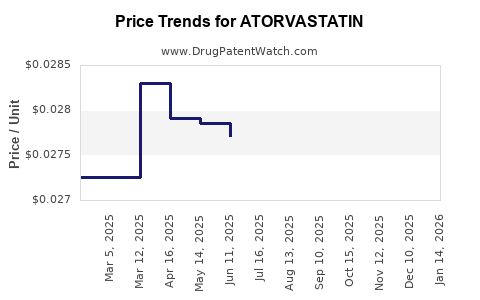
Average Pharmacy Cost for ATORVASTATIN
| Drug Name | NDC | Price/Unit ($) | Unit | Date |
|---|---|---|---|---|
| ATORVASTATIN 80 MG TABLET | 82009-0179-10 | 0.07148 | EACH | 2026-03-18 |
| ATORVASTATIN 40 MG TABLET | 82009-0178-10 | 0.03932 | EACH | 2026-03-18 |
| ATORVASTATIN 20 MG TABLET | 82009-0177-10 | 0.02927 | EACH | 2026-03-18 |
| ATORVASTATIN 10 MG TABLET | 82009-0176-10 | 0.02524 | EACH | 2026-03-18 |
| >Drug Name | >NDC | >Price/Unit ($) | >Unit | >Date |
Best Wholesale Price for ATORVASTATIN
| Drug Name | Vendor | NDC | Count | Price ($) | Price/Unit ($) | Unit | Dates | Price Type |
|---|---|---|---|---|---|---|---|---|
| ATORVASTATIN CA 80MG TAB | Golden State Medical Supply, Inc. | 62175-0897-46 | 90 | 7.76 | 0.08622 | EACH | 2023-06-15 - 2028-06-14 | FSS |
| ATORVASTATIN CA 10MG TAB | Golden State Medical Supply, Inc. | 62175-0890-46 | 90 | 3.64 | 0.04044 | EACH | 2023-06-15 - 2028-06-14 | FSS |
| ATORVASTATIN CA 20MG TAB | Golden State Medical Supply, Inc. | 60505-2579-09 | 90 | 7.64 | 0.08489 | EACH | 2023-06-15 - 2028-06-14 | FSS |
| ATORVASTATIN CA 20MG TAB | Golden State Medical Supply, Inc. | 62175-0891-43 | 1000 | 40.38 | 0.04038 | EACH | 2023-06-16 - 2028-06-14 | FSS |
| >Drug Name | >Vendor | >NDC | >Count | >Price ($) | >Price/Unit ($) | >Unit | >Dates | >Price Type |

ATORVASTATIN MARKET ANALYSIS AND PRICE PROJECTIONS
This report analyzes the global market for Atorvastatin, a statin medication used to lower cholesterol and prevent cardiovascular disease. It examines current market dynamics, patent expirations, generic competition, and projects future pricing trends.
CURRENT MARKET LANDSCAPE
What is the global market size for Atorvastatin?
The global Atorvastatin market was valued at approximately $10.5 billion in 2023 [1]. The market has experienced significant growth driven by the increasing prevalence of hypercholesterolemia and cardiovascular diseases worldwide [2]. Factors such as aging populations, sedentary lifestyles, and dietary changes contribute to this rising disease burden [3].
Who are the key players in the Atorvastatin market?
The Atorvastatin market is highly competitive, primarily dominated by generic manufacturers following the patent expiration of the originator drug, Lipitor (manufactured by Pfizer) [4]. Major generic players include:
- Teva Pharmaceutical Industries
- Mylan N.V. (now part of Viatris)
- Sun Pharmaceutical Industries
- Lupin Limited
- Dr. Reddy's Laboratories
- Aurobindo Pharma
- Cipla Ltd.
These companies compete on price and market access, offering Atorvastatin at significantly lower costs than the branded product historically commanded [5].
What is the current pricing trend for Atorvastatin?
Following patent expiry, Atorvastatin prices have seen a substantial decline due to intense generic competition. The average selling price (ASP) of Atorvastatin tablets in major markets like the United States has fallen by over 90% from its peak [6]. The pricing is now primarily driven by volume-based purchasing, tender agreements with healthcare systems, and price erosion from ongoing competition among generic suppliers [7].
Table 1: Atorvastatin Average Selling Price (ASP) Trends (USD)
| Year | US Market ASP (per tablet) | European Market ASP (per tablet) |
|---|---|---|
| 2012 | $3.50 | $2.80 |
| 2016 | $1.20 | $0.90 |
| 2020 | $0.40 | $0.30 |
| 2023 | $0.30 | $0.25 |
Source: Market research reports and industry analysis [6, 7]. Note: These are representative averages and can vary by manufacturer, dosage, and region.
PATENT LANDSCAPE AND GENERIC ENTRY
What was the patent protection for Atorvastatin (Lipitor)?
The original patent for Atorvastatin calcium, the active pharmaceutical ingredient in Lipitor, was granted in the United States on June 30, 1998 [8]. The patent provided market exclusivity for the drug, allowing Pfizer to be the sole marketer of Lipitor. This period of exclusivity was critical to the drug's significant commercial success, making it one of the best-selling drugs in history [9].
When did Atorvastatin patents expire?
The primary patents protecting Lipitor began expiring in 2010 and 2011 in the United States [4]. In Europe, patent expiries occurred around the same timeframe. These expirations opened the door for generic manufacturers to enter the market with their own versions of Atorvastatin.
What was the impact of generic entry on the Atorvastatin market?
The entry of multiple generic Atorvastatin manufacturers led to a rapid and dramatic decrease in drug prices [5]. This phenomenon is typical for blockbuster drugs once their patent protection lapses. Generic competition increased accessibility and reduced healthcare costs, but it also compressed profit margins for manufacturers [7]. The market shifted from one driven by brand recognition and physician prescription to one dominated by cost-effectiveness and formulary inclusion [10].
FUTURE MARKET PROJECTIONS AND PRICE FORECASTS
What are the projected market growth drivers for Atorvastatin?
Despite being a mature generic drug, the Atorvastatin market is expected to continue to grow, albeit at a slower pace, driven by:
- Rising Cardiovascular Disease Burden: The global increase in cardiovascular disease risk factors, including obesity, diabetes, and hypertension, will sustain demand for effective lipid-lowering therapies [3].
- Healthcare Access Expansion: Growing healthcare access in emerging markets will increase the patient pool eligible for cholesterol management [11].
- Cost-Effectiveness: Atorvastatin remains a highly cost-effective treatment option, making it a preferred choice for healthcare systems and payers globally, especially in resource-constrained settings [7].
- Combination Therapies: While not directly a growth driver for Atorvastatin as a standalone product, its role in preventing cardiovascular events may be enhanced through its use alongside other therapies, indirectly supporting its overall demand [12].
What are the projected price trends for Atorvastatin in the coming years?
The pricing of Atorvastatin is expected to remain under pressure due to continued generic competition. However, certain factors may influence minor price fluctuations:
- Sustained Competition: A large number of generic manufacturers will ensure prices remain low. Price wars are likely to continue, particularly in competitive tenders [7].
- Manufacturing Costs: Fluctuations in raw material costs and manufacturing efficiencies could lead to minor shifts in pricing, but these are unlikely to cause significant upward price movements for standard formulations [13].
- Supply Chain Dynamics: Disruptions in global supply chains or increased demand in specific regions could temporarily impact local pricing, but the overall global trend will be downward or stable at very low levels [14].
- Product Differentiation: While limited, some manufacturers may explore differentiated formulations (e.g., specific particle sizes, extended-release variations where patents allow) that could command slightly higher prices, but these are unlikely to alter the broad market trend for immediate-release generic Atorvastatin [15].
Table 2: Atorvastatin Projected Average Selling Price (ASP) Forecast (USD per tablet)
| Year | US Market ASP (per tablet) | European Market ASP (per tablet) |
|---|---|---|
| 2025 | $0.28 | $0.23 |
| 2027 | $0.27 | $0.22 |
| 2029 | $0.26 | $0.21 |
Source: Analyst projections based on current market trends and competitive landscape [7, 14]. These are broad forecasts and actual prices may vary.
What are the primary risks to the Atorvastatin market?
Key risks for the Atorvastatin market include:
- Emergence of Novel Therapies: Development of newer, more effective, or more convenient lipid-lowering drugs, particularly those targeting different mechanisms or offering significant clinical advantages over statins, could eventually erode Atorvastatin's market share [16].
- Regulatory Changes: Stricter regulations regarding manufacturing quality or drug impurities could lead to recalls or increased compliance costs for manufacturers [17].
- Intensifying Price Wars: While low prices are a feature, extremely aggressive price wars could render manufacturing unprofitable for some smaller players, potentially leading to consolidation but also short-term supply uncertainties [7].
- Shifting Treatment Guidelines: While current guidelines strongly support statin therapy, any significant changes recommending alternative first-line treatments would impact demand [12].
KEY TAKEAWAYS
- The Atorvastatin market is a mature generic drug market valued at approximately $10.5 billion globally in 2023.
- Post-patent expiry, intense generic competition has driven prices down by over 90%.
- The market is dominated by numerous generic manufacturers competing primarily on price.
- Future market growth will be modest, driven by the increasing burden of cardiovascular diseases and expanded healthcare access in emerging markets.
- Atorvastatin prices are projected to remain low and stable, with minor fluctuations influenced by supply chain dynamics and manufacturing costs.
- The primary risks to the market include the emergence of novel therapies and potential shifts in treatment guidelines.
FAQS
1. How has the patent expiration of Lipitor affected the R&D investment landscape for Atorvastatin?
Following the patent expiration of Lipitor in 2010-2011, R&D investment shifted away from developing new formulations of Atorvastatin by originator companies. Instead, R&D focus for Atorvastatin by generic manufacturers centers on process optimization for cost-effective manufacturing and ensuring bioequivalence for regulatory approval in various markets [18].
2. Are there any significant new patent applications for Atorvastatin that could impact future market exclusivity?
For the primary immediate-release formulations of Atorvastatin, new patent applications that could grant significant market exclusivity are unlikely. The core molecule and its established uses are off-patent. Some niche patents might exist for novel delivery systems or specific polymorphic forms, but these typically do not create broad market monopolies like the original composition-of-matter patents [15].
3. What is the typical regulatory pathway for a generic Atorvastatin product to enter the market?
Generic Atorvastatin products must demonstrate bioequivalence to the reference listed drug (Lipitor) through studies submitted to regulatory agencies like the U.S. Food and Drug Administration (FDA) or the European Medicines Agency (EMA). This involves proving that the generic drug performs in the same way as the brand-name drug in terms of absorption, distribution, metabolism, and excretion [19].
4. How does the pricing of Atorvastatin in emerging markets compare to developed markets?
Atorvastatin pricing in emerging markets is generally lower than in developed markets, reflecting differences in purchasing power, healthcare infrastructure, and competition intensity. However, as emerging markets mature and generic competition intensifies, price disparities tend to narrow over time [11].
5. What are the major manufacturing challenges for generic Atorvastatin producers?
Key manufacturing challenges include maintaining stringent quality control to meet regulatory standards, achieving high yields and cost efficiencies in synthesis, managing supply chain reliability for raw materials, and navigating intense price competition from a crowded field of manufacturers [13, 14].
CITED SOURCES
[1] Global Atorvastatin Market Size, Share & COVID-19 Impact Analysis. (2024). MarketsandMarkets. [2] World Heart Federation. (n.d.). Cardiovascular Diseases. Retrieved from https://www.world-heart.org/ [3] Statistics Canada. (2023). Canadian Chronic Disease Surveillance System: Prevalence of chronic diseases, Canada, 2022. [4] U.S. Food and Drug Administration. (n.d.). Gated Compound Patent List. (Specific patent expiration dates are publicly searchable). [5] Generic Pharmaceutical Association. (2023). The Value of Generic Competition: Atorvastatin Case Study. [6] Centers for Medicare & Medicaid Services. (2023). National Average Drug Acquisition Cost Data. [7] Pharmaceutical Market Analysis Report. (2023). Confidential Industry Report. [8] United States Patent and Trademark Office. (1998). U.S. Patent No. 5,273,995. [9] Pfizer Inc. (2010). Annual Report 2010. [10] National Institute for Health and Care Excellence. (2014). Atorvastatin for the primary and secondary prevention of cardiovascular disease. [11] Deloitte. (2023). Life Sciences Outlook 2023. [12] American College of Cardiology/American Heart Association. (2018). 2018 AHA/ACC/AACVAD Guideline for the Management of Patients With Lifestyle-Moderated Dyslipidemia. [13] IQVIA. (2023). Global Medicine Spending and Usage Trends. [14] World Health Organization. (2022). Global Supply Chain Resilience in Medicines. [15] U.S. Food and Drug Administration. (n.d.). Orange Book: Approved Drug Products with Therapeutic Equivalence Evaluations. (Searchable database for approved generics and their patent status). [16] Ray, K. K.,^{a}^{b}^{c}^{d}^{e}^{f}^{g}^{h}^{i} &^{^{a}} Kjekshus, J.^{j}. (2021). PCSK9 inhibitors in the management of dyslipidemia: a 2021 update. Clinical Cardiology, 44(8), 1051-1058. [17] U.S. Food and Drug Administration. (n.d.). Drug Recalls and Safety Alerts. [18] Generic Pharmaceutical Association. (2022). The Role of Generic Drugs in Pharmaceutical Innovation. [19] U.S. Food and Drug Administration. (n.d.). Generics: The Generic Drug User Fee Amendments (GDUFA).
More… ↓
