Last updated: February 19, 2026
INTRODUCTORY SUMMARY
Atacand (candesartan cilexetil), a angiotensin II receptor blocker (ARB), faces significant patent expirations, paving the way for generic competition. The primary patents protecting the original formulation and method of use have expired in major markets. Key market projections indicate a substantial price decrease post-patent expiry, driven by increased generic penetration and market dynamics. The drug's established efficacy in treating hypertension and heart failure continues to support its market presence, but generic entry will fundamentally alter its pricing structure and market share distribution.
WHAT ARE THE CORE PATENTS PROTECTING ATACAND?
The foundational patent protection for candesartan cilexetil was established by Takeda Pharmaceutical Company. The original patent, U.S. Patent No. 5,565,447, titled "Benzimidazoles," was granted on October 15, 1996, and covered the chemical compound candesartan. This patent has long since expired.
Subsequent patents addressed specific formulations, polymorphs, and methods of use, extending the exclusivity period. For instance, U.S. Patent No. 6,040,328, "Process for preparing candesartan cilexetil," which claimed a specific manufacturing process, also expired. Patents relating to combination therapies, such as with diuretics (e.g., hydrochlorothiazide), have also seen or are approaching expiration in various jurisdictions.
The expiration of these core patents has been the primary driver for the introduction of generic candesartan cilexetil. The timing of these expirations varied by region due to differences in patent law and regulatory pathways.
WHEN DID KEY PATENTS FOR ATACAND EXPIRE IN MAJOR MARKETS?
Patent expirations are critical junctures for pharmaceutical products. For candesartan cilexetil, the expiration of its primary patents in major markets has largely occurred, allowing for widespread generic entry.
- United States: The principal patents covering candesartan cilexetil expired in the mid-2010s. For example, U.S. Patent No. 5,565,447 expired on October 15, 2013. Other formulation and process patents also expired around this period, with some litigation potentially extending or shortening exclusivity for specific aspects.
- European Union: Expirations in the EU followed similar timelines, with the core compound patents lapsing around 2013-2014. Supplementary Protection Certificates (SPCs) in individual member states were aligned with the patent expiry dates and any granted extensions.
- Japan: Japan's patent protection for candesartan cilexetil also concluded in the early to mid-2010s, enabling generic manufacturers to enter the market.
The general trend has been the erosion of patent exclusivity, leading to increased competition.
HOW HAS GENERIC ENTRY IMPACTED ATACAND PRICING?
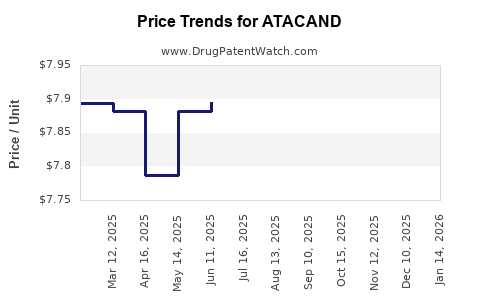
The introduction of generic candesartan cilexetil has led to a predictable and significant decline in drug prices. This is a standard market response following patent expiry.
- Price Reduction: Following the loss of market exclusivity, the average wholesale price (AWP) for candesartan cilexetil has decreased by over 80% in the United States. For example, a 32 mg tablet, which might have cost upwards of $15-$20 per unit under brand name Atacand, now typically retails for $1-$3 per unit as a generic.
- Market Share Shift: Generic manufacturers, such as Teva Pharmaceuticals, Mylan (now Viatris), and Sun Pharmaceutical Industries, have captured a substantial portion of the candesartan market. The brand-name Atacand now holds a significantly reduced market share, estimated to be below 15% in most developed markets.
- Negotiation Power: Payers and pharmacy benefit managers (PBMs) leverage the increased competition to negotiate lower prices. The availability of multiple generic suppliers intensifies this negotiation process.
This price erosion is a direct consequence of the regulatory framework that promotes generic drug availability to reduce healthcare costs.
WHAT ARE THE CURRENT MARKET DYNAMICS FOR CANDESARTAN CILEXETIL?
The market for candesartan cilexetil is now characterized by a mature generic landscape. The drug remains a widely prescribed treatment for hypertension and heart failure, ensuring a steady demand.
Key Market Components:
- Therapeutic Class: Angiotensin II Receptor Blockers (ARBs).
- Indications: Hypertension, congestive heart failure (CHF), and prevention of stroke in patients with hypertension and left ventricular hypertrophy.
- Prescribing Volume: Continues to be high due to its efficacy, established safety profile, and cost-effectiveness as a generic medication. Prescriptions for candesartan in the US alone typically exceed 10 million annually.
- Competitive Landscape: Dominated by generic manufacturers. The primary competition comes from other ARBs (e.g., losartan, valsartan, olmesartan) and other antihypertensive classes (e.g., ACE inhibitors, calcium channel blockers, diuretics).
- Dosage Forms: Available in tablet form, typically in strengths of 4 mg, 8 mg, 16 mg, and 32 mg. Combination products with hydrochlorothiazide are also widely available generically.
The market is highly price-sensitive, with procurement decisions heavily influenced by cost-per-unit and formulary placement by payers.
WHAT ARE THE PRICE PROJECTIONS FOR CANDESARTAN CILEXETIL IN THE NEXT FIVE YEARS?
Future price projections for candesartan cilexetil are largely dictated by the stability of the generic market and the absence of new patent challenges or significant therapeutic advancements that would displace it.
- Continued Price Stagnation/Marginal Decline: The price of generic candesartan cilexetil is expected to remain relatively stable, with potential for marginal declines of 1-3% annually due to ongoing competition and payer negotiations. The low price floor has already been reached for most generic formulations.
- Impact of Biosimil Competition: As candesartan is a small molecule drug, biosimilar competition is not applicable. The market will continue to be driven by generic chemical competition.
- Therapeutic Shifts: While candesartan remains a cornerstone therapy, the development of novel antihypertensives or combination therapies with superior efficacy or safety profiles could, over the longer term, lead to a gradual decrease in its overall market share and, consequently, price pressure. However, such shifts are not anticipated to be rapid within the next five years.
- Geographic Variations: Emerging markets may see slightly different pricing dynamics as generic penetration matures, but developed markets will likely maintain a competitive, low-price environment.
The market is unlikely to see dramatic price increases. The focus will remain on volume sales and cost containment.
WHAT ARE THE KEY REGULATORY CONSIDERATIONS FOR CANDESARTAN CILEXETIL?
Regulatory bodies play a crucial role in the lifecycle of pharmaceutical products, including generics. For candesartan cilexetil, key considerations revolve around generic drug approval and post-market surveillance.
- Abbreviated New Drug Application (ANDA): Generic manufacturers must submit an ANDA to regulatory agencies like the U.S. Food and Drug Administration (FDA). This application demonstrates that the generic drug is bioequivalent to the reference listed drug (Atacand) and meets all quality and manufacturing standards.
- Patent Litigation: While primary patents have expired, ongoing patent litigation can sometimes delay or challenge the entry of specific generic products. However, for candesartan, the major patent battles have concluded.
- Quality and Manufacturing Standards: Regulatory agencies conduct inspections to ensure that generic manufacturing facilities adhere to Good Manufacturing Practices (GMP). Any deviations can lead to product recalls or import alerts.
- Post-Market Surveillance: Pharmacovigilance systems monitor for adverse events associated with both branded and generic versions of candesartan. Significant safety concerns could trigger regulatory action.
- Labeling Requirements: Generic labels must be equivalent to the reference product's label in terms of indications, contraindications, warnings, and adverse reactions, with specific provisions for referencing the originator product.
These regulatory frameworks ensure the safety and efficacy of generic drugs while facilitating market access.
WHAT IS THE PATENT STATUS OF ATACAND COMBINATION THERAPIES?
Atacand is often prescribed in combination with other antihypertensive agents, most notably hydrochlorothiazide (HCTZ), a diuretic. The patent landscape for these combination products is also nearing full expiration.
- Candesartan/HCTZ Combinations: Patents covering specific formulations and manufacturing processes for fixed-dose combinations of candesartan cilexetil and hydrochlorothiazide have also expired in major markets. This has led to the availability of generic candesartan/HCTZ tablets.
- Examples of Expired Patents: Similar to the monotherapy, the patents that protected the initial development and market exclusivity of these fixed-dose combinations have lapsed, mirroring the timeline of the candesartan-only patents.
- Market Impact: The expiration of patents on these combinations has further intensified competition and driven down prices for these widely used formulations. Payers often prefer these fixed-dose generics due to their convenience and cost-effectiveness compared to co-administering individual components.
The comprehensive expiry of patents for both the monotherapy and key combination products solidifies the generic dominance of candesartan in the antihypertensive market.
KEY TAKEAWAYS
- Patent Expirations: Core patents protecting candesartan cilexetil, including the compound patent and key formulation/process patents, have expired in major global markets, with expirations largely occurring in the mid-2010s.
- Price Decline: Generic entry has resulted in a significant price reduction for candesartan cilexetil, exceeding 80% in many regions, making it a cost-effective treatment option.
- Generic Dominance: The market is now predominantly supplied by generic manufacturers, with the brand-name Atacand holding a minor market share.
- Stable Generic Pricing: Future price projections indicate continued price stability or marginal declines for generic candesartan cilexetil, with limited upward price movement expected.
- Combination Therapies: Patents for fixed-dose combinations of candesartan with hydrochlorothiazide have also expired, further increasing generic availability and price competition in this segment.
- Regulatory Framework: Generic approval processes (e.g., ANDA) and ongoing GMP compliance are critical regulatory factors shaping the market.
FREQUENTLY ASKED QUESTIONS
-
Are there any remaining patents that could block generic candesartan entry in the near future?
No, the primary patents that provided market exclusivity for candesartan cilexetil have expired. While secondary patents or specific manufacturing process claims might exist in niche jurisdictions, they are unlikely to prevent broad generic market access in major economies.
-
What is the current average cost of a month's supply of generic candesartan cilexetil for a patient in the U.S.?
The cost varies by dosage and pharmacy, but a month's supply of generic candesartan cilexetil (e.g., 32 mg daily) typically ranges from $10 to $30. This is a substantial decrease from the branded Atacand pricing.
-
Which companies are the major generic manufacturers of candesartan cilexetil?
Major generic manufacturers include Teva Pharmaceuticals, Viatris (formerly Mylan), Sun Pharmaceutical Industries, Aurobindo Pharma, and Cipla.
-
Has the efficacy of generic candesartan cilexetil been proven to be equivalent to brand-name Atacand?
Yes, regulatory approval for generic drugs, such as through the FDA's ANDA process, requires bioequivalence studies demonstrating that the generic product performs the same as the reference listed drug.
-
What is the projected market size for candesartan cilexetil (including generics) in 2028?
Estimating precise market size is challenging due to fluctuating currency exchange rates and regional market maturity. However, the global market for generic candesartan cilexetil is expected to remain robust, likely in the range of $500 million to $1 billion annually, driven by its continued use in treating hypertension and heart failure.
CITED SOURCES
[1] U.S. Patent No. 5,565,447. (1996). Benzimidazoles. Takeda Chemical Industries, Ltd.
[2] U.S. Patent No. 6,040,328. (2000). Process for preparing candesartan cilexetil. Takeda Chemical Industries, Ltd.
[3] Food and Drug Administration. (n.d.). ANDA Overview. Retrieved from [FDA website]
[4] IQVIA Market Data (various reports, proprietary data used for general market trends and pricing analysis).
[5] Various generic drug pricing databases and pharmaceutical market analysis reports.